
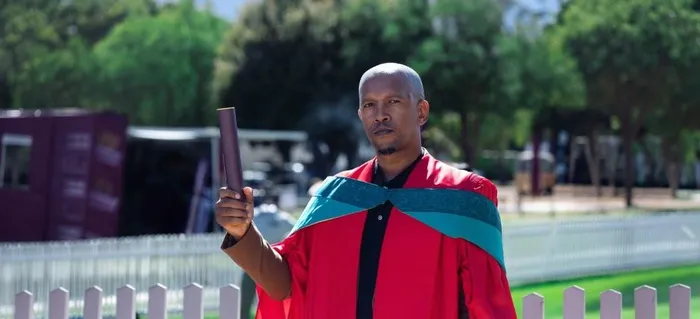
Stellenbosch University graduate Dr Luphiwo Mduzana becomes the first black medical orthotist and prosthetist in South Africa to obtain a PhD.
Image: Supplied
In a landmark achievement for the field of medical orthotics and prosthetics, Dr Luphiwo Mduzana has made history as the first black medical orthotist and prosthetist in South Africa to be awarded a PhD. During the graduation ceremony at Stellenbosch University (SU) on March 26, Mduzana proudly donned his cap and gown, a symbol of resilience and dedication against all odds.
Hailing from the small town of Cala in the Eastern Cape, Mduzana believes his accomplishment extends far beyond personal success. "Many people have contributed to my journey," he said. "It has taken me nearly six years to complete my PhD, and throughout this time I have been supported by many individuals, particularly my children, my siblings, my mother, colleagues at WSU, my supervisor, and mentors at SU’s Division of Disability and Rehabilitation Studies." He expressed gratitude to those who walked alongside him, stating that this significant milestone belongs to the broader orthotics and prosthetics profession.
Prof Lieketseng Ned, Mduzana’s supervisor at SU, hailed his achievement as a critical milestone in the field and a testament to his potential as a role model for aspiring medical orthotists and prosthetists. "Through his leadership and scholarship, he is poised to contribute meaningfully to the advancement, transformation, and academic strengthening of the profession in South Africa," she remarked.
Initially aspiring to be an engineer, Mduzana's path took a pivotal turn at his mother's suggestion towards medicine. "When I discovered the field of medical orthotics and prosthetics, it felt like the perfect balance between the two," he explained, noting how this career allows him to blend design and healthcare, fulfilling his mother’s vision for him. Mduzana emphasised the joy he finds in restoring mobility to patients, recounting a transformative moment during his studies in Tanzania when a lecturer highlighted the profound impact of prosthetics in returning independence to individuals.
Yet, like many academic journeys, Mduzana’s pursuit of a PhD was fraught with challenges. The onset of the Covid-19 pandemic in 2020 disrupted his research, forcing him to adapt both his methodology and design. Managing the rigours of academic expectations alongside his responsibilities as a father to four children presented another level of difficulty. "There were certainly moments when the demands of research and family felt overwhelming," he shared. However, he praised the unwavering support from his family and friends that helped him maintain his dedication to both roles.
His research focused on developing clinical guidelines for lower-limb prosthetic prescription, addressing a crucial gap in South Africa’s healthcare landscape. Currently, there are no standardised national guidelines available for practitioners, often leading them to rely on overseas protocols that may not suit local conditions. "My research seeks to develop practitioner-informed guidelines grounded in the experiences and expertise of clinicians working within our context," Mduzana explained, indicating his hope that these guidelines will lead to better outcomes for patients requiring prosthetic rehabilitation.
Mduzana envisions that his work will resonate beyond South African borders, encouraging collaboration among the Southern African Development Community (SADC) countries in refining and implementing relevant protocols for prosthetic care. "Hopefully, these guidelines can be adopted or adapted by neighbouring countries," he remarked, expressing a desire for regional co-operation providing the best practices in prosthetic interventions.
With a heart set on inspiring a new generation of professionals, Mduzana encourages young individuals from rural or disadvantaged backgrounds to believe in their dreams. "If one person can achieve something, it means others can achieve it as well," he asserted, urging students to know their backgrounds do not define their potential. "What matters most is determination, belief, and commitment to your goals. Pursue your dreams boldly. Those goals are entirely within reach," he advised, ending on a note of hope and empowerment for aspiring medical professionals.
IOS