
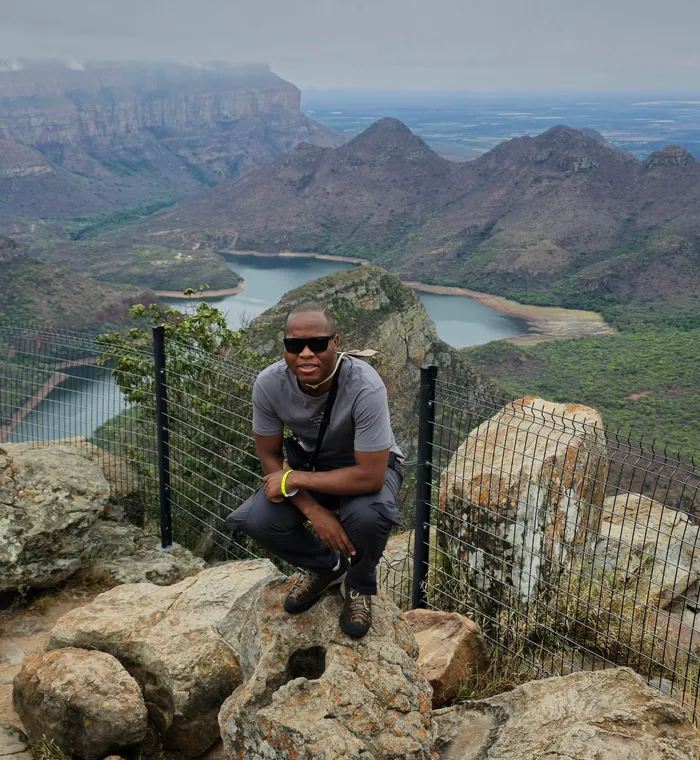
Professional natural scientist Dr Khodani Matshusa, pictured on a visit to the Blyde River Canyon, has become the first Black African to attain PhD in geoheritage and geotourism.
Image: Supplied
In a nation grappling with the legacy of its extensive mining history, Dr Khodani Matshusa emerges as a beacon of innovation and environmental stewardship. With a remarkable focus on tackling approximately 6 000 abandoned mining sites across South Africa, Matshusa’s efforts aim not only to mitigate environmental damage, but also to empower local communities entwined in the narratives of these mining legacies.
Born and raised amidst the mining landscapes of South Africa, including prominent sites like the Folovhodwe magnesite mine dumps and the De Beers Diamond Mine in Musina, Matshusa's childhood experiences ignited a profound curiosity about Earth Sciences and geology. His academic trajectory, with a PhD in Tourism and Hospitality from the University of Johannesburg and an MSc in Earth Sciences from the University of Venda, underscores his intellectual rigor and commitment to his field.
Now a professional natural scientist at Unisa's Department of Environmental Sciences, Matshusa is widely recognised as a leading expert in geoheritage and geotourism, notably achieving the distinction of being the first Black African to secure a PhD in this field. “My journey has never just been about the extraction of minerals, but rather a quest to understand the rich tapestry of geodiversity the Earth offers,” he says.
His work over the last 15 years, which spans research, academia, and consulting, has been pivotal in initiating projects that intertwine geoheritage, geotourism, and sustainable development. Matshusa's dedication has led to innovative solutions aimed at promoting environmental sustainability while creating viable employment opportunities for surrounding communities.
In 2011/2012, a visit to the Ruhr Museum in Germany greatly inspired Matshusa, reinforcing his belief in the potential for revitalising mining regions into thriving eco-tourism destinations. “Standing upon geological formations exceeding 3.5 billion years of age fundamentally shifted my perspective,” he reflects. This experience taught him that mining history can be repurposed to enhance cultural appreciation and scientific education, while promoting environmental conservation.
At the forefront of efforts to address environmental repercussions from abandoned mines, Matshusa's initiatives, such as the derelict and ownerless mines project, seek to derive sustainable solutions from mining legacies. His integration of geotourism and geoparks not only aims to generate employment but also encourages market diversification and social responsibility among local communities.

Dr Khosani Matshusa has has spearheaded initiatives that tackle about 6 000 abandoned mining legacies in South Africa and their environmental repercussions.
Image: Supplied
Moreover, Matshusa’s extensive research plays a crucial role in policymaking within Africa and globally. His efforts have sparked vital conversations among government departments, education sectors, and private organisations about the significance of geotourism and geoconservation. He is frequently invited to share his insights as a guest speaker at conferences and workshops, both locally and internationally.
In recognition of his contributions to geoscience, Matshusa was appointed Chair of the Geoscience and Society (Geoheritage) Division at the Geological Society of South Africa in February 2025. “My research tackles the delicate balance between mining operations and geoconservation, ensuring that economic considerations do not overshadow the imperative of preserving our natural and cultural heritage,” he explains.
This high-profile recognition culminated in Matshusa receiving a prestigious Y National Research Foundation (NRF) rating in 2025, distinguishing him as the only NRF-rated researcher in his field under 40. He attributes his success to the support from Unisa and to the encouragement of leaders like Professor Llewellyn Leonard, highlighting the importance of nurturing young researchers in advancing scientific inquiry.
IOS