
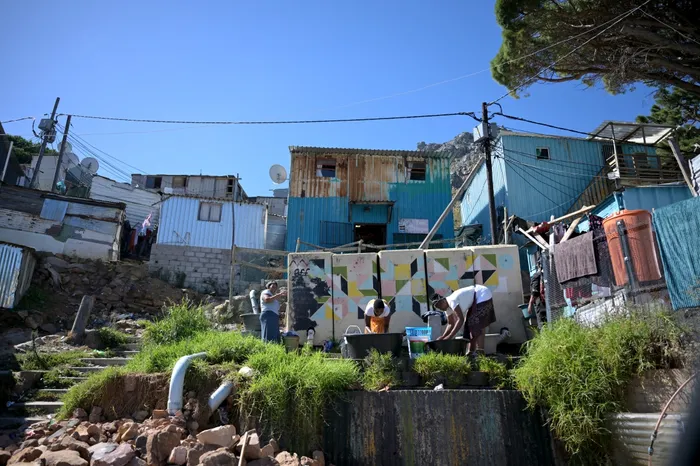
SHARED BURDEN: Women wash laundry by hand at a communal tap block in Imizamo Yethu, Hout Bay. There is no running water in their homes.
Image: AYANDA NDAMANE
Well before the sun rises, Yonelisa Mali gets up, wakes her three young children, and rubs Vaseline all over their bodies.
It is the only way to protect them from the early morning cold that seeps through the thin walls of their tiny one-room shack on the slopes of Imizamo Yethu, high above the harbour in Hout Bay.
It is still dark when she leaves.
Barefoot, and sometimes wading through sewage, the asthmatic 39-year-old carries two empty 20-litre plastic paint containers to the communal taps 450 metres away, where she fills them.
Then Mali carries them back, heavy and full, so her children can wash, eat, and drink.
Back in the shack, she washes each child's face one by one.
On mornings when the early air is really cold, she rubs another layer of Vaseline onto their skin before sending them out the door. They will bathe properly in the evening.
With the water in the second container, she fills a pot and cooks on her small gas stove — usually a simple mieliemeal porridge — and makes sure they eat quickly.
When they are ready, she empties the remaining water into paraffin bottles, grabs the empty tubs and a bundle of laundry, and walks the children to the road to catch the taxi to school.
Then she turns around, walks all the way back to the taps, fills the tubs again, and washes the family's laundry by hand in black plastic basins that the women of the settlement share between them.
This is where an IOL team found her earlier this week — hunched over such a basin, washing laundry in the open air — as she described the daily routine that has defined her life for the past two years.
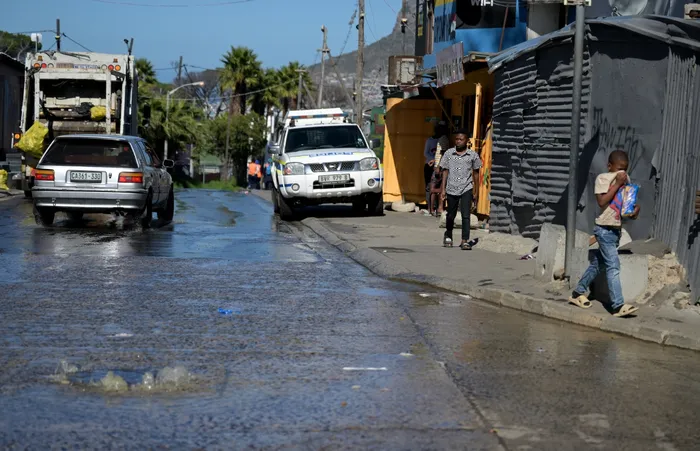
OPEN DRAIN: Sewage flows freely down a road in Imizamo Yethu as residents and children navigate around it on foot. A police vehicle passes through in the background.
Image: AYANDA NDAMANE
The visit follows the tabling of the City of Cape Town's Municipal Public Accounts Committee (MPAC) report, which found that the metro had failed to provide or maintain adequate toilets, taps, or refuse removal in Imizamo Yethu.
"The city did not provide or maintain adequate toilets, taps, or solid-waste services in Imizamo Yethu, and illegal connections were not removed," the report, seen by IOL, said.
"As a result, the area experienced frequent sewer and stormwater overflows, pollution of stormwater systems and nearby rivers, severe environmental and public-health nuisances, and non-compliance with WSA and NEMA."
WSA is the Water Services Act, the law governing the provision of water and sanitation to communities.
NEMA is the National Environmental Management Act, which governs the protection of the environment.
On root cause, the report said: "Project managers did not execute their project management responsibilities, including monitoring whether contractors and PSPs performed in terms of their contracts and enforcing corrective action in a timely manner when they performed poorly."
The report was tabled at council on Monday last week and presented to the MPAC the following day.
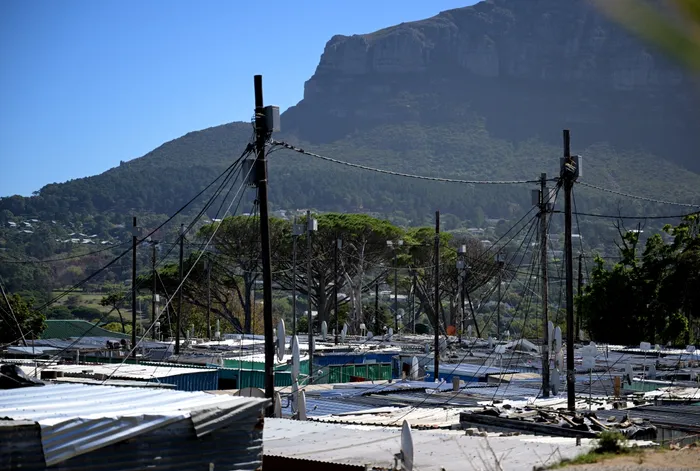
LIVE WIRES: A tangle of illegal electricity cables stretches between poles above the rooftops of Imizamo Yethu, with the mountain looming behind. The MPAC report found that illegal connections in the settlement were never removed.
Image: AYANDA NDAMANE
During IOL's visit, electricity cables hung haphazardly overhead, garbage lay strewn across the ground, and a foul odour clung to the air.
The findings were documented in photographs.
Further up towards Molokwane Road, sewage spurted from an open manhole in the middle of the road.
A young boy walking past, a loaf of bread tucked under his arm, pulled his shirt up over his nose.
A hawker selling fruit directly opposite said the problem had been going on for weeks.
"It affects us very much," she said, declining to be named out of fear of reprisals from community members with "political agendas".
"We do phone the city and they do come out, I do not want to lie, but after two or three days it is the same thing again.
"They do not fix it properly.
"When children are young they don't know what to touch, and so they touch the poo, or play in the water, they get sick."
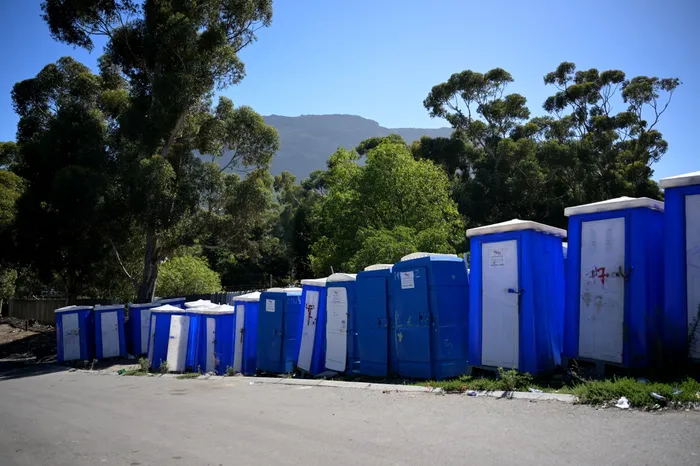
QUEUE HERE: Rows of portable toilets line the road in Imizamo Yethu — the only sanitation available to residents. Each unit is locked and allocated to families by community leaders. There are no toilets at home.
Image: Ayanda Ndamane
On the other side, a row of blue portable toilets lined the road.
It is the only toilets available to residents of Imizamo Yethu.
There are no toilets at home.
Each unit is locked and allocated by community leaders, shared between families.
Driving out of Imizamo Yethu, heaps of garbage lay strewn on the left-hand side of the road — a final image of what the report had laid bare in black and white.
The next stop was Gugulethu.
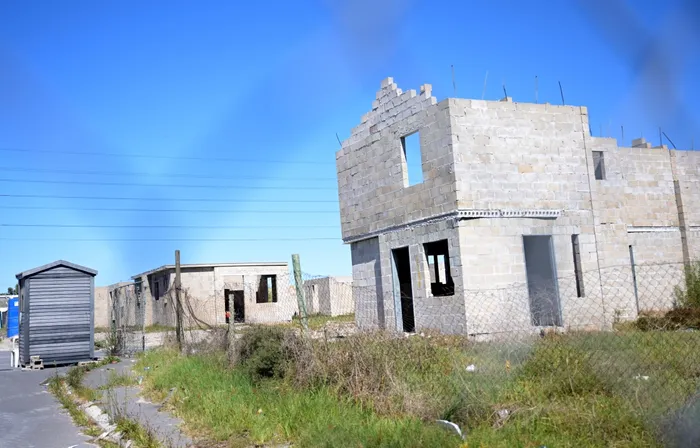
LEFT UNFINISHED: Unfinished brick shells stand abandoned at the Gugulethu Infill Housing project on Lansdowne Road. Some were built without approved building plans and handed over without the required safety sign-off, the MPAC report found.
Image: AYANDA NDAMANE
On Lansdowne Road sits the Mother City's Gugulethu Infill Housing project.
The project was meant to deliver homes to families who have waited years for them.
The report found that when a 2018 agreement between the metro and the former Western Cape human settlements department expired, only 23 houses had been completed on Phase Five.
The city then appointed its own contractor in February 2024, who completed 124 houses by September 2025.
But the report flagged serious problems.
No steps were taken to recover additional costs from the former department, according to the report.
Some houses were built without approved building plans.
Others were handed over without the required National Home Builders Registration Council (NHBRC) sign-off, the final check that confirms a home is safe to live in.
The report stated: "Some houses were built without approved building plans, and practical completion was signed off without the required NHBRC Final Unit Reports."
During the visit, IOL was escorted in by LEAP officers.
Row upon row of unfinished brick shells stood abandoned — no roofs, no windows, no doors.
Walls rose to varying heights and then simply stopped.
Overgrown grass pushed up through the rubble at their bases, and garbage lay scattered along the fence line.
Razor wire ran along the perimeter.
The structures had numbers scrawled on their walls.
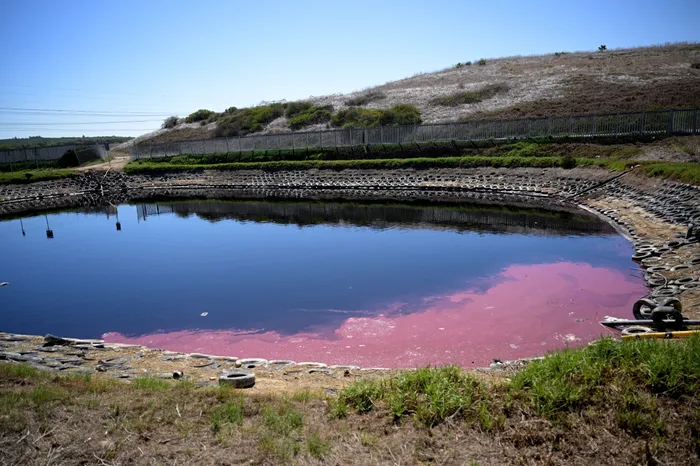
TOXIC PINK: A leachate pond at the Vissershok Landfill Site outside Table View sits discoloured and untreated. The plant meant to treat the toxic liquid has not worked since June 2022, costing ratepayers R29.5m in transport costs to move it elsewhere. When it rains heavily, the pond overflows.
Image: AYANDA NDAMANE
About 27km away, at the Vissershok Landfill Site just outside Table View, a large containment pond of deep pink liquid came into view.
Security at the entrance was lax, so gaining access to the site was easy.
The pink colour comes from leachate.
Emeritus Prof Kevin Winter, a water expert, said leachate is the toxic liquid that forms when rainwater filters down through layers of rotting landfill waste, picking up harmful chemicals along the way.
He said it is similar to a bathroom sponge absorbing water, and when it is squeezed, the water comes out.
"Landfill material squeezes the moisture to the bottom of the contained area and leachate, consisting of toxics, heavy metals, chemical compounds, pathogens, and much more, flows through the landfill as leachate," he explained.
"All licensed landfills are compelled to have a leachate collection point that drains the build up of these liquids, treats it effective on site, or delivers the concentrated liquid to a licensed treatment plant."
He said leachate must be carefully collected, contained, and treated.
If it is not, it can seep into the soil, poison groundwater, and contaminate nearby rivers or wetlands.
"When on-site leachate treatment fails there is potential for the concentrated liquid to contaminate groundwater and enter surface water nearby such as rivers or wetlands," Winter said.
At Vissershok, the plant responsible for treating leachate has been out of operation since June 2022.
Without on-site treatment, the city has been forced to truck the liquid to the Borcherds Quarry wastewater treatment works.
According to the MPAC report, that temporary arrangement has already cost ratepayers R29.5 million in transport and operational expenses.
Borcherds Quarry can only handle a limited amount at a time.
When those limits are reached and heavy rains fall, the containment pond at Vissershok overflows, and there is no proper outlet for the excess toxic liquid.
Approached for comment, the City of Cape Town said: "The city is a responsive organisation and where highlighted corrective measures are implemented as a matter of course to ensure internal controls remain sufficient and that contract management requirements are optimised for this vast organisation built on service delivery.
"The city always endeavours to improve on any shortcomings identified to ensure top levels of service delivery.
"All recommendations have been noted."
Imizamo Yethu Development Forum chair Loyiso Skoti said that, apart from the issues the city flagged in its report, the settlement also had to deal with delays during fire disasters.
"Residents often wait too long for materials to rebuild their homes," he said.
He added that people needed sustainable jobs, not short-term three-month EPWP jobs, though these could be extended to 24 or 36 months.
He said water and sanitation cut-offs at times inconvenienced residents. He said access to basic services was non-negotiable.
He also said residents needed better housing.
“People need decent houses, which the city has for many years failed to build for the people of Imizamo Yethu. But there is hope that houses will be built.”
IOL