
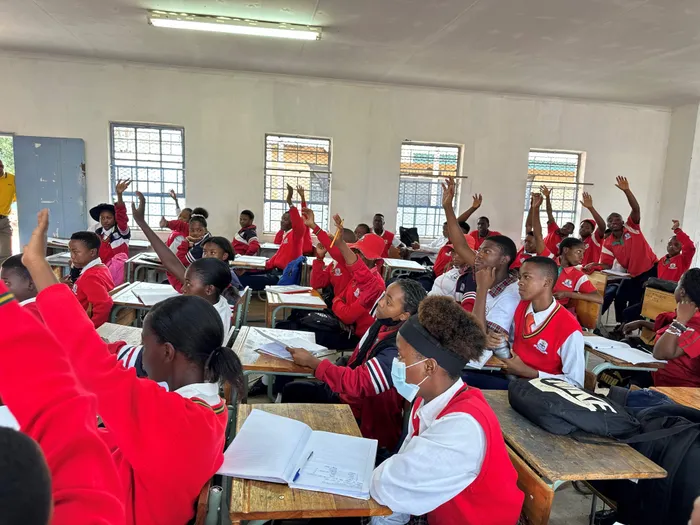
Pupils respond during a financial literacy lesson delivered by facilitators for the Safer South Africa Foundation (SSAF) and the Banking Association South Africa (BASA). As South Africa observes Financial Literacy Month against the backdrop of global turmoil, the spotlight is on the pressing need for financial education that empowers households to navigate uncertainty and make informed financial decisions essential for survival.
Image: Supplied
April marks Financial Literacy Month in South Africa, an essential observance that feels especially pertinent this year as the world grapples with unprecedented economic challenges. With conflicts in the Middle East affecting oil supply routes, the rand continuing to fluctuate, and fuel prices poised for potential spikes, millions of households are facing a financial crunch that makes money management less of a luxury and more of a critical survival skill.
The stakes are particularly high. Research from the Financial Sector Conduct Authority (FSCA) and Trialogue reveals that only about 51% of South Africans can be classified as financially literate, which means close to half of the population lacks the fundamental skills to make informed financial decisions. This reality compounds the challenges posed by a landscape rife with geopolitical tensions affecting everyday costs.
While the geopolitical realm may seem remote, its implications reach directly into South African pantries. According to insights from Momentum Financial Planning, global instabilities typically influence local economies in three phases: first, energy price volatility; second, rising logistics costs, as transport providers push increased fuel prices down the supply chain; and finally, the inevitable spike in the prices of groceries and essential goods.
As a net importer of oil, South Africa faces acute vulnerability to these fluctuations. Current hostilities in the Middle East have created uncertainties regarding fuel supplies, with some analysts warning of diesel and petrol price hikes of up to 44%. Such increases could spark food inflation in the range of 6% to 10%, as illustrated by ECR's cost-of-living analysis, thereby further straining already budget-worn households.
Even prior to any hikes, the financial stability of South African families is precarious. The Household Affordability Index from the Pietermaritzburg Economic Justice and Dignity Group highlights that, as of February 2026, the average cost of a household food basket is R5,383.81 — R1,076 short of what a family of seven requires for adequate nutrition. If fuel-driven inflation nudges up costs by 6%, families may find themselves needing to absorb an additional R323 monthly, a burden many simply can't carry.
This cost-of-living challenge is compounded by an entrenched debt crisis. According to the National Debt Advisors' latest Consumer Report, consumers are carrying an average debt of R91,126 against a median monthly income of just R9,536. In some instances, this translates to debt levels as high as 28 times a household's earnings.
Even high earners are not spared from this plight. Data from DebtBusters’ Q4 2025 Debt Index shows that individuals earning over R35,000 monthly are allocating approximately 85% of their income to service existing debts. Purchasing power has fallen drastically, leaving consumers who entered debt counselling in late 2025 with about 47% less real income than they had in 2016, despite nominal income growth.
Denise Neethling, Head of Marketing at Paymenow, warns of the turning tide: “The numbers paint a troubling picture. South Africans are navigating a perfect storm of geopolitical instability, stagnant wages, and a history of mounting debt. Financial Literacy Month serves as an urgent reminder that while we can't control global oil prices or fluctuations in currency, we can gain knowledge about our finances and prepare ourselves for potential turbulence.”
Amid rising pressures, however, a notable thirst for financial knowledge persists. Paymenow, which provides Earned Wage Access to over 750,000 employees across South Africa, Zambia, Namibia, and Pakistan, reports that its users have completed more than 2.5 million financial education modules on its platform. Topics such as budgeting, loan management, and credit score education — crucial areas for managing household finances — have emerged as the most popular among users.
The positive impact is evident; four in five Paymenow participants indicate that their saving abilities have improved since using the platform, while 92% note that without access to earned wage access, they would have had to resort to borrowing. Moreover, research suggests that individuals who engage with financial education make markedly better financial decisions, such as choosing fee-free vouchers instead of cash withdrawals.
Neethling underscores the importance of accessible financial education, stating, “When individuals are given relevant and digestible financial knowledge, they act on it. In a year overshadowed by uncertainty, the South Africans who manage to weather rising costs will be those who truly understand their budgets, know how to minimise debt exposure, and wield the tools necessary for financial flexibility.”
To aid consumers in facing escalating costs throughout 2026, Paymenow offers these practical recommendations:
“Financial literacy isn’t about becoming an expert — it’s about mastering enough information to make astute choices,” says Neethling. “In a climate where global factors could suddenly inflate your expenses, that knowledge is your most indispensable financial asset. This Financial Literacy Month, we encourage every South African to take at least one meaningful step toward fortifying their financial understanding. The dividends of this investment? Resilience.”
IOS