
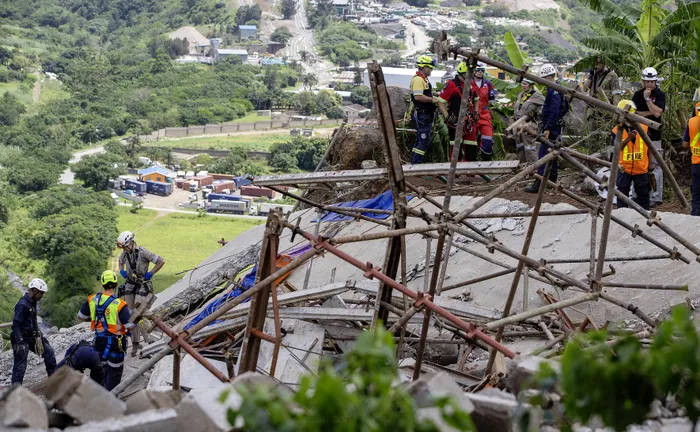
Preliminary findings show substandard concrete and structural failures in the December four-storey Verulam temple collapse. The Building Industry Bargaining Council (BIBC) says a breakdown in labour compliance and site control contribute to these tragedies.
Image: Leon Lestrade/ Independent Newspapers
In South Africa, the sound of construction often betrays an underlying chaos — a landscape marred by tragic building fails, such as the George and Ormonde collapses in 2024 and 2026. While such incidents are commonly attributed to engineering misjudgments or outright safety violations, a troubling pattern underscores these calamities: the persistent challenges of weak oversight, fragmented accountability, and a severe lack of visibility regarding who is on-site.
"Building collapses are often framed as engineering or safety failures," says Danie Hattingh, spokesperson for the Building Industry Bargaining Council (BIBC). "But we repeatedly see a breakdown in labour compliance and site control." At the heart of these breakdowns is the alarming reality that a significant portion of South Africa’s construction sector operates outside formal regulations.
According to the International Labour Organisation, nearly 38% of the sector, particularly the building industry, functions in the shadows of the law. "If you don't know who is on your site, you don't know your risk," says Hattingh, highlighting the critical implications of lax regulations and underreported employees.
This risk is magnified by the complex layers of subcontracting and the involvement of labour brokers, creating a fragmented system where multiple parties operate without the necessary oversight. "Where systems are not integrated into a unified compliance framework, accountability fragments and traceability weakens," he continues. This disarray enables non-compliant contractors to undercut compliant firms, leading to a remarkable 25% to 35% pricing disadvantage for those adhering to regulations.
Hattingh notes, "To avoid levies, contractors keep workers off the books," resulting in a trickle-down effect that leaves workers without critical protections. "No UIF, PAYE, COIDA or structured training and safety" not only lowers industry standards but also puts lives at risk — many workers now lack proper guidance, Personal Protective Equipment (PPE), and skills certifications.
Complicating the situation is the shift from master builder models to a reliance on subcontractors, blurring lines of responsibility and accountability. "Principal contractors may think risk is shifted through these arrangements," warns Hattingh, "but the law is clear: you can delegate work, not accountability." Even as responsibilities are ostensibly passed down, ultimate liability for safety and compliance rests with the principal contractor.
The allure of non-compliant labour may provide short-term financial relief, but it can quickly become a financial burden. Hattingh cautions that a single audit could result in back-pay and penalties amounting to hundreds of thousands of rand. In the aftermath of a tragic building collapse, unpaid benefit obligations can escalate even further, with sums potentially exceeding R500,000 per deceased worker.
When compliance falters, the implications extend beyond financial losses. The absence of accurate worker records can lead to dire consequences during emergencies. "Off-book workers don't appear on site registers," explains Hattingh. "In a collapse, they become invisible, delaying rescue efforts, complicating investigations, and deepening anguish for affected families."
While the BIBC itself does not enforce health and safety regulations, its compliance structures play an essential role in traceability. "What is required is an integrated system where labour records, contractor registration, and site access control are aligned, ideally digitally and in real time." Without such integration, oversight begins fractured from the outset.
In response to these ongoing issues, enforcement efforts are evolving. Multi-agency High Impact Task Teams (HITTs) involving the Department of Employment and Labour, SARS, Home Affairs, SAPS, and BIBC are emerging to tackle these challenges and ensure immediate action, including full site shutdowns for serious non-compliance. The shift toward compliance embedded within financial processes is also gaining momentum.

Danie Hattingh, spokesperson for the Building Industry Bargaining Council (BIBC).
Image: Supplied
Regulatory enforcement is slated for an escalation, especially in private estates and high-value projects. An essential transition is the challenging of the passive client model, with developers and project owners taking on non-delegable responsibilities for labour and safety compliance.
Ultimately, for the BIBC, compliance is not merely an administrative hurdle; it serves as a safeguard — ensuring fair pay, benefits, and recourse in cases of injury or death, while enhancing being able to accurately track who is on site. For stakeholders appointing contractors, the stakes are clear: verify contractor registrations, ensure worker documentation is compliant, and ascertain who is present on-site. Because when cost-cutting overshadows compliance, the ramifications extend well beyond the construction landscape, touching the very essence of community welfare.
IOS