
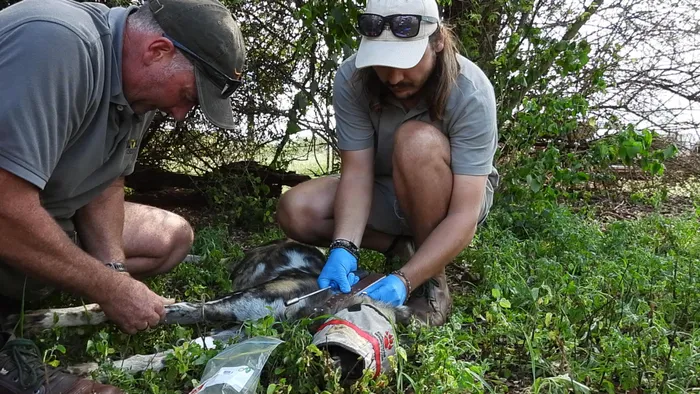
An African wild dog is tagged before being released into Zimanga Private Game Reserve in a groundbreaking reintroduction that is helping to restore genetic diversity and safeguard the future of this endangered species.
Image: Tavish Farquhar / Wildlife ACT
In a remarkable achievement for wildlife conservation in South Africa, a pack of African wild dogs has been successfully reintroduced to Zimanga Private Game Reserve after an extended absence of several years. This initiative marks a significant milestone not only in the conservation of the species but also in efforts to enhance genetic diversity and ensure a sustainable future for one of Africa’s most endangered carnivores.
Once prevalent across the continent, African wild dogs now exist in fragmented populations due to a multitude of threats, including habitat loss, human-wildlife conflict, and disease. However, through co-ordinated conservation initiatives at both provincial and national levels, efforts to manage a metapopulation have become essential for the long-term survival of these animals.
This ground-breaking reintroduction has seen the collaborative involvement of various stakeholders, including Tswalu Kalahari Reserve, Zimanga Private Game Reserve, the Endangered Wildlife Trust, Wildlife ACT, Wildlife Solutions Africa, the Bateleurs, and the Ivan Carter Wildlife Conservation Alliance. Each organisation has played a vital role, guided by the Wild Dog Advisory Group and KwaZulu-Natal Wild Dog Management Group, emphasising the critical need for integrated conservation strategies across landscapes.
The newly established pack, consisting of two females and one male, has been carefully transported to Zimanga Private Game Reserve, where they will enhance the ecological dynamics of the area and contribute positively to the overall metapopulation. By strategically moving these animals between regions, conservationists aim to promote genetic exchange and bolster population resilience. This is vital to ensure that smaller, isolated groups remain viable, significantly reducing the risk of inbreeding.
Eugene Greyling, Carnivore Conservation Field Officer at the Endangered Wildlife Trust, emphasises the importance of safe habitats for these animals, stating, “With a lack of safe space as the key limiting factor, African wild dogs are no longer biologically independent; they are logistically dependent assets that require active life support.”
Located in northern KwaZulu-Natal, Zimanga Private Game Reserve is dedicated to conservation, biodiversity, and responsible ecotourism, making it a perfect environment for this endangered species. Spanning approximately 7,000 hectares, the reserve is ecologically equipped to support the newly reintroduced pack, complementing wider efforts to increase the number of breeding groups across the landscape. Historically, Zimanga has been successful with wild dogs, contributing to the establishment of 13 new packs across Southern Africa.
“Historically, Zimanga hosted wild dogs extremely successfully... A big thank you to all involved.” said Charl Senekal, Owner and Manager of Zimanga Private Game Reserve, expressing his enthusiasm regarding the return of the species, which reflects the enduring impact of conservation efforts implemented over a decade ago.
The reintroduction comes at a critical time. African wild dogs are one of the continent’s most endangered species, with fragmented populations continuing to decline. Conservation strategies aimed at expanding suitable habitat are imperative for their survival. Implementing a co-ordinated metapopulation management approach, where smaller, isolated populations are managed as an interconnected system, is essential to counteract the risk of genetic isolation.
This involves the strategic selection and relocation of individuals between regions, supported by a national and provincial advisory structure that focuses on collaboration among conservation organisations, Protected Area managers, and government stakeholders.
Upon their arrival at Zimanga, the African wild dog pack will undergo a transition phase in a temporary predator holding facility to aid acclimatisation to their new surroundings. Following this acclimatisation, the pack will be released into the protected area to explore, hunt, and establish their territory. Wildlife ACT will play a crucial role in monitoring the pack’s activities through GPS and VHF collars that provide real-time data on their movements, behaviours, and adaptation.
“The use of GPS and VHF collars allows us to closely track the movements and behaviour of newly established packs... We look forward to seeing how this pack establishes,” said Chris du Toit, Wild Dog Programme Manager at Wildlife ACT, highlighting the importance of rigorous monitoring in ensuring successful reintroductions.
The reintroduction of African wild dogs to Zimanga is not just a triumph for conservationists but a pivotal step towards securing a stable and thriving future for this remarkable species. Through collaboration, strategic planning, and dedicated management, there is renewed hope that wild dogs can reclaim their place in the South African wilderness.
IOS