
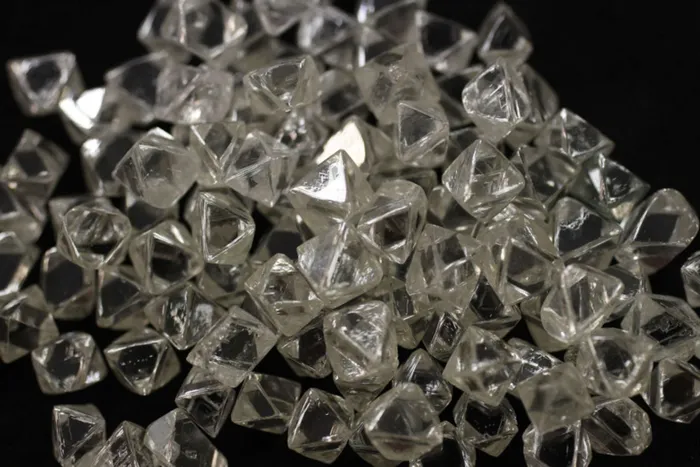
South African research is showing how the world's rarest diamonds form deep within the Earth, offering insights into their origins and potential future discoveries.
Image: File / Reuters
In a remarkable breakthrough for both geology and gemology, a team of researchers from the University of Cape Town (UCT), in collaboration with the Carnegie Institution for Science and the China University of Geoscience, has unveiled the mysteries surrounding the formation of the world’s most valuable diamonds, often referred to as Cullinan-like, large, inclusion-poor, pure, irregular, resorbed (CLIPPIR) diamonds. Their study, published in the esteemed journal Nature Communications, paves the way for a deeper understanding of these exquisite gems that have long captivated the world.
The researchers explored the chemistry of the mineral olivine found in kimberlite rocks, which are the primary source of diamond formation. What they discovered is nothing short of revolutionary. The study reveals that kimberlites that yield CLIPPIR diamonds consistently originate from iron-rich domains located more than 150 km beneath the Earth’s surface, at the base of the lithosphere.
Associate Professor Geoffrey Howarth, the study's lead author from UCT's Kimberlite Research Group (KRG), stated, “These extraordinary diamonds – some of the largest and most valuable gems on Earth – have long been a mystery.” He expounded that the interaction of rising kimberlitic melts with these unusual iron-rich regions resulted in the formation of significant olivine and garnet megacrysts, the hallmark of CLIPPIR-bearing kimberlites. Furthermore, the precious diamonds themselves crystallise in these highly specific environments, at pressures exceeding 11 gigapascals, within what is known as the mantle transition zone.
What further sets these findings apart is the implication that the iron-rich domains are not only responsible for the creation of these exceptional diamonds but also serve as a widespread source of geochemical diversity in volcanic rocks globally. The isotopic signatures discovered suggest a connection to hydrothermally altered oceanic crust, which has been subducted deep into the Earth and subsequently accreted to the continental lithosphere by buoyant upwellings from the mantle.
This research does not only offer a profound insight into the origins of exquisite diamonds but sets the stage for potential future discoveries. As Howarth explains, “By reading the chemical fingerprints preserved in the mineral olivine brought up by kimberlite eruptions, we can now trace where these exceptional diamonds come from and how to find more of them.” This newfound understanding opens the door to further exploration in the quest for rare gemstones that encapsulate nature’s most remarkable secrets.
IOS