
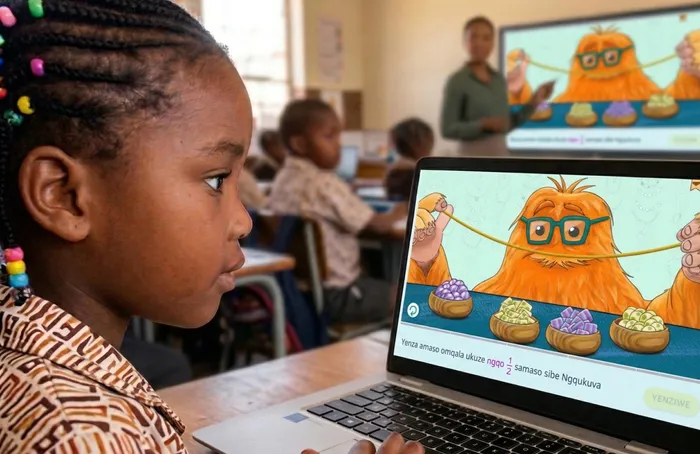
A child engages with South Africa's new digital initiative, which is set to improve maths education for isiXhosa pupils, addressing foundational literacy challenges and offering a transformative approach to multilingual learning in classrooms across the nation.
Image: Supplied
South Africa's education landscape is at a critical juncture, grappling with a foundational learning crisis that leaves three in ten early grade pupils unable to read at the expected standard. This profound challenge transcends literacy, casting a shadow over subjects like mathematics, where comprehension is essential for success. Amidst these challenges, a promising initiative has emerged, targeting the deep-seated issues at the intersection of language and education.
IsiXhosa, a language spoken by approximately 16% to 20% of South African pupils, holds significant educational value, particularly in regions such as the Eastern Cape and Western Cape. Within this context, a new initiative aims to enhance understanding of mathematics by delivering digital learning resources in isiXhosa. Collaborating entities include Matific, a global digital maths platform, the Eastern Cape Department of Education, and Click Learning, a local non-profit dedicated to improving foundational literacy and numeracy outcomes through educational technology.
The initiative represents a paradigm shift in how complex subjects like mathematics are taught, introducing curriculum-aligned digital content that is not only accessible but also thoughtfully localised to ensure practical application in classrooms. Featuring voice-enabled tools and AI-supported localisation, the model promises to redefine the educational experience for isiXhosa-speaking pupils.
Importantly, the isiXhosa content has received endorsement from the Pan South African Language Board (PanSALB), affirming its quality and alignment with national education standards. This initiative is also part of a larger movement towards multilingual education and Mother Tongue-based Bilingual Education (MTbBE), which aims to foster learning in languages familiar to students.
“South Africa’s focus on multilingual learning is a powerful opportunity to strengthen foundational numeracy outcomes,” says Craig Shotland, CEO of Matific. “By localising Matific into isiXhosa while maintaining pedagogy and curriculum alignment, we’re helping more pupils access maths concepts in the language they understand best, while supporting teachers with structured, data-informed instructional tools.”
The progression of this initiative is underpinned by a partnership that effectively combines technology with local expertise. The Eastern Cape Department of Education has ensured that student activities are translated into isiXhosa, while Click Learning steers the implementation, ensuring robust delivery, technology infrastructure, and ongoing monitoring.
Dylan Harrison, COO of Click Learning, believes this marks a significant evolution in maths education in South Africa. He points out that while pupils typically follow instruction in their home language, high-quality, curriculum-aligned maths tools in African languages have been notoriously scarce. “Integrating personalised edtech in isiXhosa will not just facilitate engagement, but will enable pupils to grasp maths concepts in an accessible, level-appropriate manner,” he adds.
Moreover, the initiative's use of AI technology extends support beyond the classroom. It enables teachers to leverage pupil data for enhanced engagement while employing familiar platforms such as WhatsApp to keep communication channels open with families.
This multifaceted approach positions technology as a catalyst for enhancing teacher capacity and enriching education systems, moving beyond mere standalone solutions to a sustainably integrated model.
The initiative holds the potential to transform education across South Africa by significantly improving accessibility to learning materials in students’ home languages. With an initial focus on isiXhosa, the goal is to expand this groundbreaking approach into other African languages, creating pathways for pupils to engage with mathematics in a manner that resonates with their cultural and linguistic identity. The continued prioritisation of foundational learning goals makes initiatives like this crucial in fostering inclusive and effective educational environments.
IOS