
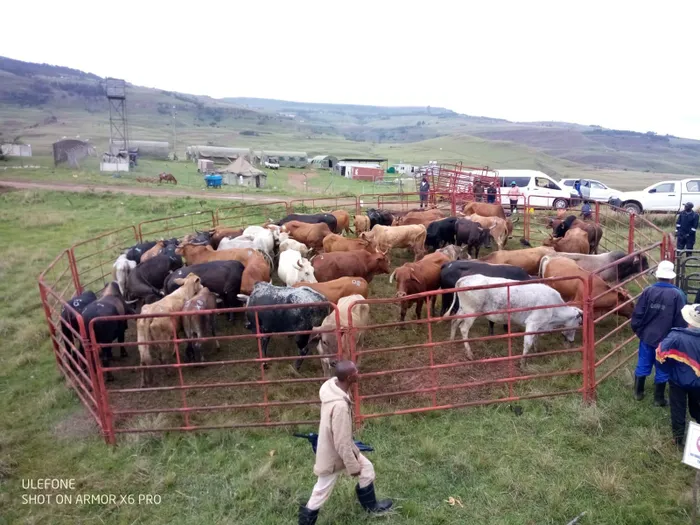
In the face of foot-and-mouth disease, vaccination initiatives and mobile markets act as a lifeline for persistently underrepresented communal farming communities across South Africa.
Image: Supplied
In the deep rural areas of South Africa, communal farmers are bracing themselves for the dire consequences of foot-and-mouth disease (FMD), which is wreaking havoc on their livelihoods. While they often remain unheard, a visit to these communities reveals an undercurrent of anxiety as farmers grapple with the inability to sell their livestock due to vaccination requirements.
This is according to Meat Naturally Africa (MN), which takes mobile auctions to deep rural areas, where participating communal farmers are involved in regenerative rangeland management programmes. Without these mobile auctions, farmers must walk their livestock to the nearest auction, often taking several days.
These issues resonate profoundly, especially when one considers that 50% of the nation's approximately 14 million cattle are owned by communal and emerging farmers, according to Stats SA.
On April 15, Agriculture Minister John Steenhuisen conveyed some hope, announcing that preliminary data from the current mass FMD vaccination strategy indicates it is yielding positive results. However, for communal farmers living on the edge of survival, every moment counts, and they feel the pressure of the ticking clock, says MN.
“From November last year, we had to cancel 27 mobile auctions that typically serve communal farmers associations in the Eastern Cape and KwaZulu-Natal,” said MN CEO Sarah Frazee. “Between December 2025 and March 2026, we facilitated only six direct sales of vetted cattle, resulting in R1.6 million for farmers — a stark contrast to the R20 million they could have received from our mobile auctions.”
Mobile auctions are crucial in these regions, allowing farmers to sell their cattle and sheep at competitive prices.
“The need for vaccines is urgent; this is the peak auction period for communal farmers,” said Frazee. “They need to sell before winter sets in, as cattle begin to lose condition.” During a meeting on April 14, Frazee represented communal farmers among all livestock auction houses in KwaZulu-Natal, where state officials shared a vaccination plan prioritising key districts.
“We are optimistic about aligning our auction schedule starting late April in Kokstad,” she said, though concerns remain about the lack of information for Eastern Cape farmers.
MN’s operations extend to 580,000 hectares from Komani to Ulundi, implementing business strategies tailored for communal farmers through a project focused on ‘Pioneering innovations for sustaining healthy communal grasslands,’ launched in January 2025 with the WWF Nedbank Green Trust's support. The initiative promotes community participation in mobile auctions, regenerative grazing, and fire management, aiming to improve not just the economy, but ecosystems as well.
As Poovi Pillay, Executive Head of Social Impact at Nedbank, explains, “It’s imperative to reward communal farmer associations committed to restoring degraded grazing lands. An estimated 90% of South Africa's rangelands face degradation, which threatens livelihoods and biodiversity.”
Frazee adds, “By enhancing farmers' livelihoods through healthy livestock management, we can cultivate an environment where ecological restoration becomes an achievable goal.” Fortunately, the recent wool season has proved favourable, allowing communal farmers to access competitive prices, particularly through the Fleece Naturally initiative, which actively encourages female farmers to become local wildfire champions.
Addressing the severe impact of wildfires in these regions, which often stem from ignition of cooking fires or children's activities, MN offers wildfire prevention training. “In 2026, the best farmers in wildfire reduction will receive quality sheep for their flocks,” notes Frazee, emphasising the importance of equipping female farmers — who make up 40% of MN’s clientele — with necessary skills.
Additionally, MN has embarked on a partnership with Sibuyi Abattoir in the buffer zone of the Kruger National Park, facilitating direct sales of beef to local communities and collaborating on products such as signature boerewors for shops in the park. “This fosters a circular economy that retains financial resources within our communities while improving food security,” Frazee said.
IOS