
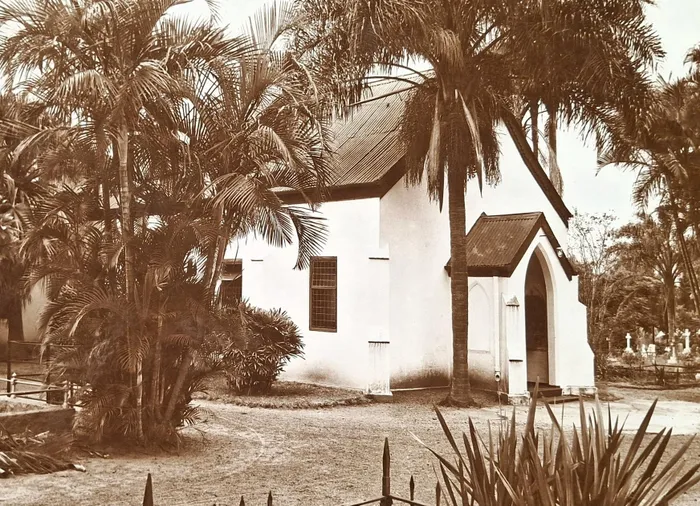
The original St John's Church in Pinetown was a simple whitewashed structure. Here the original thatched roof looks like it had been replaced by tin. The picture was probably taken around the turn of the last century.
Image: Facebook
Pinetown grew from a few scattered homesteads in the valley between what is now known as Kloof and Cowies Hill. Early church services were held in the Parkhouse in New Germany, with the Rev Posselt of the Lutheran faith, the only ordained minister in the area, conducting services.
Bishop Colenso, passing through Pinetown in 1854, was offered 5 acres of land by Mr Murray for the erection of a small church. Funds were raised, and on December 3, 1856, St John's, a little white-washed, thatched church was consecrated by Colenso. Archdeacon Mackenzie was appointed to care for Pinetown and other coastal parishes with Reverend James Walton the permanent vicar. It was one of the area's oldest churches and soon became the focal point of village life.
During the latter half of the 19th century, St John's was prominently involved in the dispute between the newly formed Church of the Province of South Africa under Bishop Grey of Cape Town and the supporters of Bishop Colenso's Church of England in South Africa. There were thus two churches in Pinetown claiming to be the Anglican Church, until the rift was healed in 1984 when Reverend William Bromilow became Vicar of St John's on 1 October.
With the outbreak of the Zulu War in 1879, thousands of British troops were rushed to Natal. Military camps were set up and Pinetown became an important garrison village. This changed the social and economic life, besides increasing the congregation. Troops and family members who died were buried in St John's graveyard. After the war, many of the soldiers and their families stayed in the area.
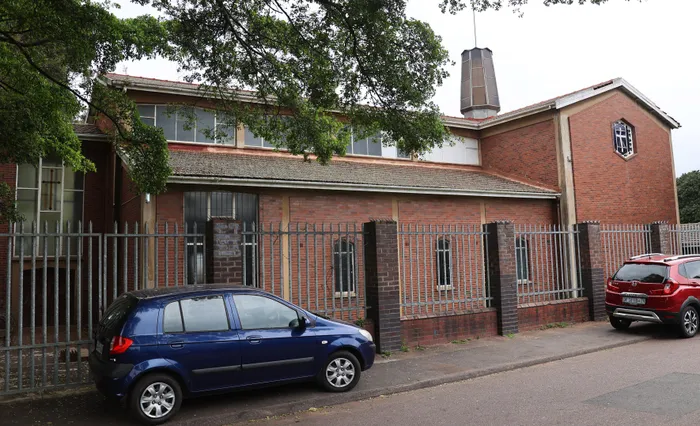
St John's Church today. It was difficult to match the two scenes as we were unable to get access to the property.
Image: Tumi Pakkies / Independent Newspapers
The Second Anglo-Boer War broke out in 1899 and saw many troop trains passing through Pinetown on their way to the northern battlefields. The Guild of Loyal Women erected the sandstone Anglo-Boer War Memorial in the cemetery in 1922.
Historically the church supported the broader Pinetown region, including surrounding areas like Kloof, Westville, Hillcrest and New Germany, however, most of these areas now have their own independent churches.
The church grounds contain historic 140-year-old paper bark trees.
The church continues to be active as a community hub in Pinetown under its rector Rev Seipati Ngcobo.