
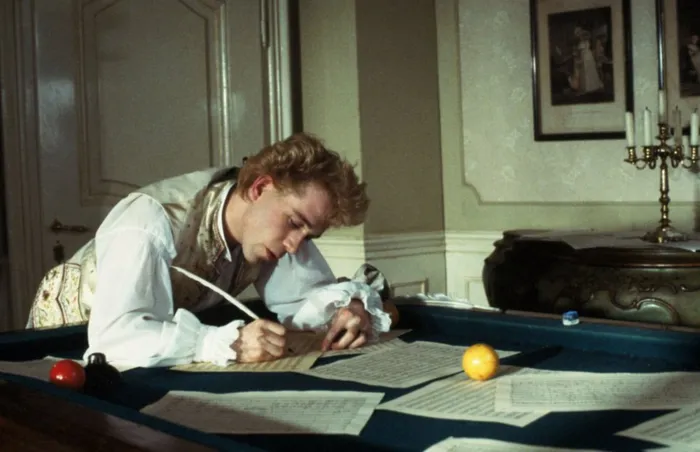
Tom Hulce became a household name overnight with his performance as Wolfgang Amadeus Mozart in Amadeus. Evidence today suggests the narrative of the Milos Forman classic movie should be treated with scepticism.
Image: File
David K. Israel
When “Amadeus” first arrived in theaters, it didn’t just win eight Oscars. It rewired how millions of people understood Wolfgang Amadeus Mozart.
Which is to say: incorrectly.
I was thinking about this while writing my novel “The Lost Mozart,” which is set in the 1980s, when the film’s success helped spark an enormous wave of Mozart-mania - and a renewed appetite for the version of his life that never quite happened.
This is not a complaint. The film is irresistible - lush, funny, operatic in all the ways that matter. But its central premise, that Antonio Salieri orchestrated Mozart’s death out of professional jealousy, belongs less to history than to a long, oddly durable game of cultural telephone.
The rumor circulated years after Mozart died in 1791. It might have faded there, one more bit of posthumous gossip, if not for Alexander Pushkin, who in 1830 transformed it into a short poetic play. Russian composer Nikolai Rimsky-Korsakov adapted that piece into an opera nearly 70 years later. Then Peter Shaffer turned the drama into a hit play in 1979, sharpening its psychological stakes. Five years later, Milos Forman made it cinematic and indelible, basing his film on the Shaffer play.
Now, with a television adaptation starring Will Sharpe as Mozart and Paul Bettany as Salieri premiering Friday on Starz, the story is back. From rumor to poetry to opera to play to film to television: It is a near-perfect case study in how a good tale improves itself by drifting ever further from the truth. It’s also a reminder that culture doesn’t preserve stories so much as refine them toward what we most want them to mean.
Because the truth, as it happens, is less obliging.
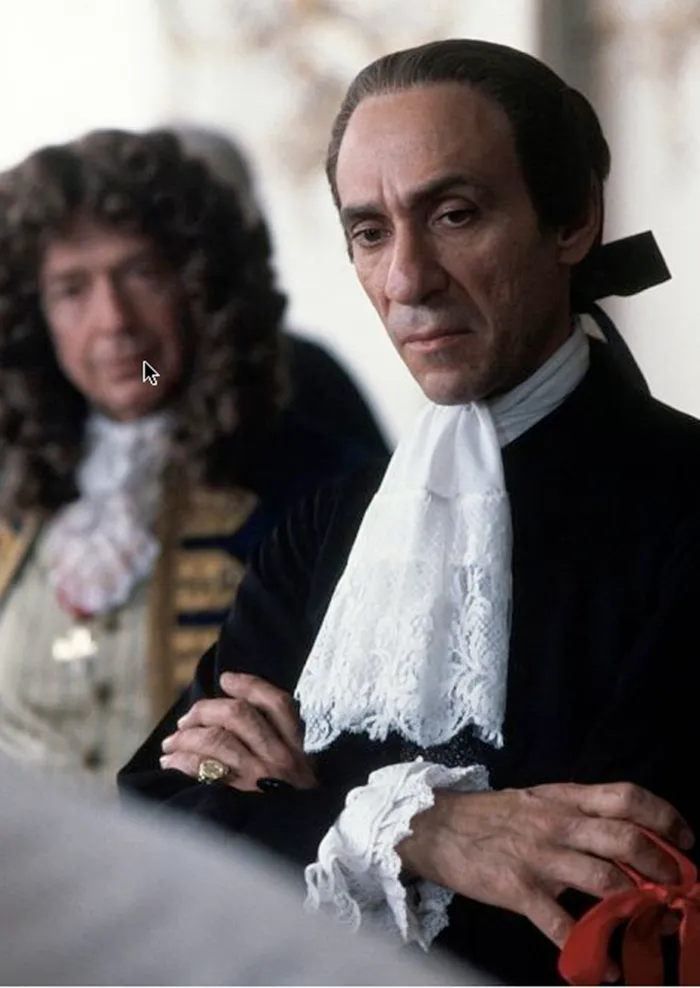
F Murray Abrahams plays the much maligned Salieri in the movie Amadeus.
Image: File
Salieri most certainly did not murder Mozart. The real reason he died remains a mystery. The two men weren’t sworn enemies circling each other in a Viennese death match of artistic egos. They were colleagues. Sometimes rivals, perhaps. Occasionally even collaborators. Salieri, by most accounts, spoke well of Mozart and later helped teach his son.
History offers no scene in which Salieri hovers at Mozart’s bedside, secretly taking dictation for the Requiem as the genius lay dying, trembling between inspiration and collapse.
But it should.
That scene may be the most powerful in “Amadeus.” It captures something we seem unable to resist: the idea that genius must be witnessed, even completed, by someone who recognizes it fully but cannot equal it. Someone close enough to understand but not to create.
It’s a fantasy of proximity. And, perhaps, of consolation. At a moment when questions of authorship - who creates, who imitates, who finishes the work - feel newly unsettled, the fantasy of Salieri at Mozart’s side lands a little differently.
Each iteration of the story tweaks the fantasy to suit its moment. Pushkin gives us moral parable. Rimsky-Korsakov gives us musical irony. Shaffer gives us psychological obsession. Forman gives us spectacle and a villain we can feel for, even as we recoil.
The new series adds another layer. Casting Sharpe as Mozart - our first Asian Mozart on-screen - feels both contemporary and overdue. Opera has long embraced a version of, for lack of a better term, colorblind casting. Grace Bumbry’s turn as Venus in Wagner’s “Tannhäuser” at Bayreuth in 1961 - so electrifying it earned her 42 curtain calls and the nickname “Black Venus” - remains one of its most famous examples.
More recently, shows like “Bridgerton” and the cultural aftershocks of “Hamilton” have reframed how audiences think about historical representation. And yet, for all this forward motion, the underlying story of the “Amadeus” reboot is essentially the same - and just as untrue.
In Shaffer’s play, the distortions go further than the death scene. When Mozart’s wife, Constanze, comes to Salieri begging him to help her husband land a decent-paying job, Salieri sexually humiliates her and exploits her vulnerability. It is lurid, effective theater. It’s also pure fabrication, the kind that reveals more about our appetites than about Mozart’s life.
Which raises a useful question: Why this story, again and again?
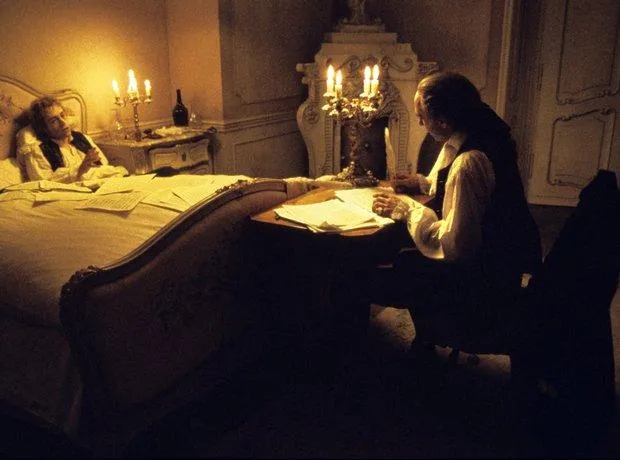
The film's famous death bed scene where a dying Mozart is dictating the music for his requiem to Salieri.
Image: File
Why, when faced with a figure such as Mozart - arguably the most naturally gifted composer who ever lived - do we insist on surrounding him with darker, more theatrical machinery? Why isn’t the real story (and the real music) enough?
One answer is that genius, on its own, resists narrative. It arrives mysteriously, operates at a level most of us can’t access, and leaves behind artifacts that feel both inevitable and impossible. It is hard to dramatize without giving it an antagonist. A piece of tainted pork is hardly a theatrical antagonist. Nor is rheumatic fever. Or any of the other legitimate, uncinematic theories for how Mozart actually died.
So we invent one.
Envy, in particular, makes for a satisfying engine. It humanizes the story. It gives us a way in. Salieri becomes our proxy: the diligent craftsman confronted with effortless brilliance, the man who understands greatness just well enough to suffer from it.
The irony is that Salieri was not a mediocrity. He was one of the most successful composers in his own time - more popular than Mozart, in fact.
There is, too, something comforting in the idea that genius is fragile - that it can be thwarted, even destroyed. It brings greatness within the realm of cause and effect. If Mozart can be undone by another man, then perhaps genius itself is not so alien after all.
What “Amadeus” and its many descendants understand - brilliantly - is that audiences are not looking for accuracy. They’re looking for meaning. And meaning often arrives dressed as myth.
David K. Israel is a novelist and composer living in Los Angeles.