
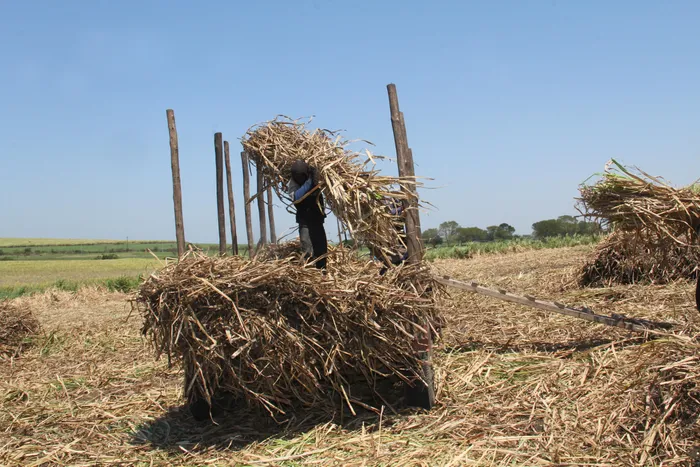
As South Africa's sugarcane milling season kicks off with record deliveries, the future of the industry remains uncertain. The liquidation case against Tongaat Hulett will be heard in June, with the outcome affecting the livelihoods of thousands of small cane growers in northern KwaZulu-Natal.
Image: SA Canegrowers
As South Africa embarks on its 2026/27 sugarcane milling season, the industry's resilience shines through, with early cane deliveries illustrating a positive trajectory for the nation's 28,000 sugarcane growers. Early statistics reveal an impressive 48% increase in raw sugarcane deliveries compared to the same period last year, reinforcing the dedication of growers and a commitment to quality production.
While growers across the country celebrate this promising start, the sugar industry remains shrouded in uncertainty, particularly with the operational future of the Tongaat Hulett mills. With three of its mills yet to open, the anticipation in the air is palpable as stakeholders await the mills’ operational status, which serves as a lifeline for 18,000 growers. “We hope growers supplying the Tongaat Hulett mills will have a productive and successful season despite the uncertainty surrounding the company,” said Higgins Mdluli, chairperson of SA Canegrowers. “The industry continues to show remarkable resilience even under extremely difficult conditions.”
These sentiments come as Tongaat Hulett recently received an infusion of R200 million in temporary operational funding from the Industrial Development Corporation (IDC) while negotiations to avoid liquidation proceed. A court return is scheduled for June 17, where parties, including the THL BRPs and stakeholders, will engage in discussions, holding the future of the company —and by extension, the livelihoods of many —hanging in the balance.
In a challenging global context, South Africa's sugar market faces further pressures from high volumes of imported sugar from countries such as Brazil, Thailand, and India, said Mdluli. In March alone, 16,000 tons of imported sugar flooded the market, double the amount from March 2025. Last year marked one of the industry's bleakest periods, with imports reaching 213,000 tons from duty-bearing countries. Every ton of sugar that enters the market costs the local industry over R7,500 in lost revenue, which raises significant concerns for local growers and milling companies.
The SA Canegrowers association has raised alarms regarding the current sugar tariff mechanism, asserting that it is outdated and inadequate against heavily subsidised global competitors. Many major sugar-producing nations maintain rigorous support for their industries, artificially suppressing prices and undercutting South African growers both domestically and in export markets. The International Trade Administration Commission of South Africa (ITAC) is in the midst of reviewing the tariff mechanism, a process initiated by the sugar sector in October 2024 — a move prompted by a sense of existential threat faced by approximately one million livelihoods relying on this industry.
Reflecting on the importance of a sustainable local sugar industry, Mdluli urged that those in charge of policy development must catalyse necessary changes. “Entire rural communities in KwaZulu-Natal and Mpumalanga depend on sugarcane farming for jobs and economic activity. We hope the industry’s significant contribution to food security, rural development and the national economy will continue to receive the protection and policy attention it deserves,” he affirmed.
Despite ongoing challenges, South African sugarcane growers remain determined to demonstrate that they can produce sufficient, cost-competitive sugar to meet local demand, maintaining a hopeful outlook as the season progresses.
IOS