
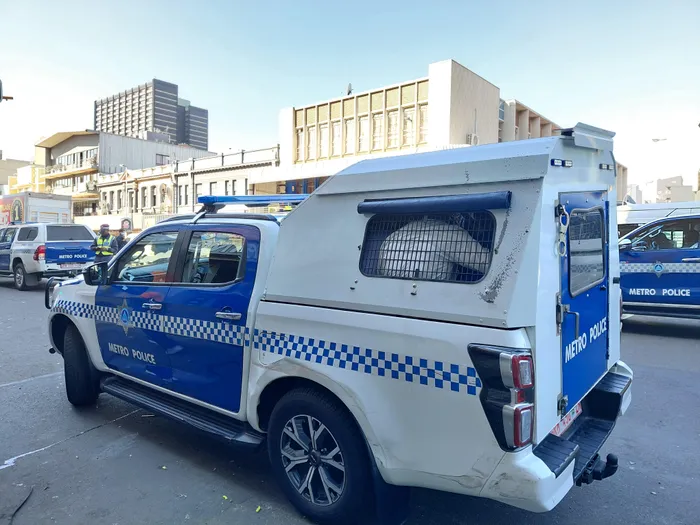
Tension on the streets of Durban as raids, arrests and business closures unfold in CBD.
Image: XOLILE MTEMBU
On Wednesday, life in Durban appeared largely unchanged, with most businesses operating as normal and streets carrying their usual midweek pace of commuters, traders and shoppers.
However, in parts of the city, a noticeably different scene unfolded as several foreign-owned shops remained closed, with doors shuttered and security gates pulled down during trading hours.
Police operations were also visible in certain areas, with officers conducting targeted raids and making arrests of individuals suspected of being in the country without valid documentation.
This comes after various demonstrations by March and March in the city, which called for illegal migrants to leave the country.
Foreign nationals who have businesses in the CBD told IOL that they were shaken and feared an escalation of violence from those telling them to leave as the June 30 “deadline” looms.
On upper Dr Pixley KaSeme Street, an electronics shop owner described a tense and uncertain situation unfolding over the past three days, with his business among several reportedly affected as police operations continued in the area.
The entrepreneur, a Pakistani national, told IOL: “This is the third day of this happening.
“We’re not allowed to open the shops, the Metro Police [allegedly] say. We don’t know what this is. We don’t know for what reason.”
He further explained his personal situation: “I’m from Pakistan, but I have been a permanent resident here for three years.”
Despite the uncertainty, he said business owners were left with little choice but to comply as they faced mounting losses and unanswered questions about the operation.
Police said more than 60 foreign nationals were taken in for verification during the operations.
“Several businesses were found operating in violation of municipal bylaws,” they said.
The authorities added that some individuals were arrested for trading under asylum seeker visas with study-only conditions.
In a separate raid on Park Street, officers uncovered what they described as serious building violations, where a property had allegedly been unlawfully converted into flats, restaurants and a sports bar.
“Operations of this nature continue to sweep across the district as SAPS intensifies efforts to enforce the law and restore order in communities,” police said.
At a salon near South Beach, a Nigerian woman working there described a separate incident that left her shaken, saying the environment around the business had become increasingly unpredictable during the ongoing operations in the city centre.
“A while back, some people came here and they looted the shop, took the extensions, wigs and everything. Some of the things they tossed out onto the street.
“My young son was here, and he ran away because he was scared.”
She described being left traumatised by what she witnessed, saying she had never experienced anything like it before. Despite her fear, she said she still felt safe in the country overall.
“With the June 30 deadline, I have just prayed to God that we will be saved,” she said.
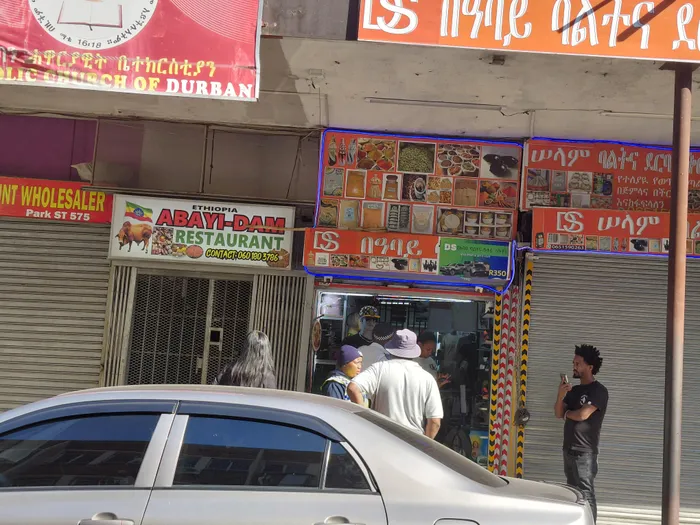
Fear, loss and uncertainty as foreign nationals face verification raids across Durban.
Image: XOLILE MTEMBU
Political analyst Goodenough Mashego said the current migration pressures were often misunderstood and driven by deeper structural factors.
“The foreign nationals do not access South Africa because the borders are open,” he said.
“They access South Africa because there’s something that’s pulling them to the country.”
He argued that enforcement alone was not a long-term solution.
“So, the argument that the borders are open is not valid, and even if governments are to deport them today, next week they’ll be here.
“Let’s suppose it costs R10,000 to deport one person. Next week they’ll be here, they’ll be deported again next month, R10,000.”
He added that repeated removals would strain state resources without resolving the underlying dynamics.
“And the government will just spend money. Deporting people who are going to end up coming here.
“People will always find a way because Britain, the UK, is surrounded by the sea, but last year it had 46,000 illegal immigrants.”
He compared this to South Africa’s geography.
“So, if they could access a country surrounded by the sea, it’s so easy for them to come to a country that is surrounded by land, which is South Africa.”
He also commented on local economic dynamics.
“They come here and then we allow them to stay because we are collecting rent from them.”
He also criticised political narratives around the issue.
“I think it’s a populist thing.”
He added that migration had become [allegedly] politically instrumentalised.
“People are pushing themselves to enter into politics because the local elections are coming. They’re using the issue of immigration to build or to brand themselves,” he said.
Activist and social commentator Mukhethwa Dzhugudzha warned that the rising anti-immigration climate could have wider consequences for South Africa’s global standing and internal cohesion.
“My prediction is that South Africa’s anti-immigration movement is going to become one of the most effective weapons ever used against this country.”
He argued that the country’s international reputation was at risk.
“This will not only damage our reputation internationally, but it will also weaken our moral authority.”
He added that the country’s global influence was historically rooted in its democratic legacy.
“People don’t understand that South Africa’s influence does not come from military power or economic dominance. This is the country that ended apartheid, built a constitutional democracy, and then positioned itself as the voice for the oppressed.”
He referenced this in relation to foreign policy positioning.
“That is why South Africa took Israel to the ICJ for human rights violations.”
He cautioned that domestic conduct could undermine this standing.
“But the nation’s moral authority becomes fragile the moment South Africans are seen to be humiliating and abusing vulnerable African immigrants inside its own borders.”
He also warned against conflating xenophobia narratives.
“This is why xenophobia is a more dangerous vulnerability than the fake white genocide narrative.
“The white genocide accusation was strategically deployed to pressure and discredit the South African government, but the claim was weak and easy to challenge. Xenophobia is different. It is not only visible, it is being amplified by social media.”
IOL News