
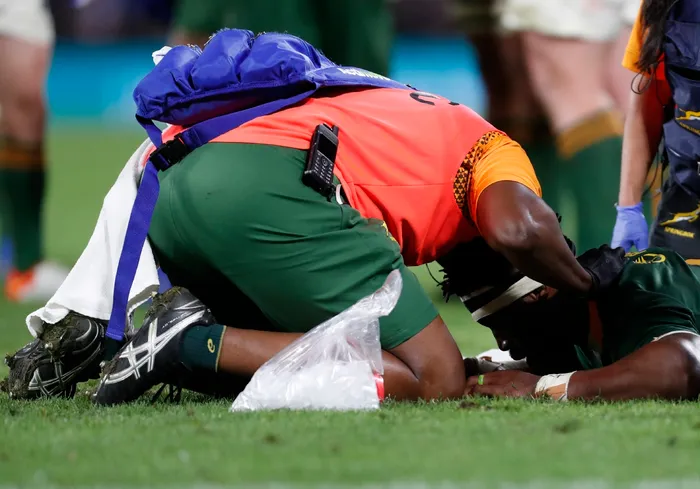
Springbok captain Siya Kolisi is attended after suffering an injury during the Round 6 Rugby Championship match against the All Blacks in 2021. The Safe Sport 2026 conference has marked a turning point in global sports governance, showcasing an urgent commitment to safeguarding athlete welfare.
Image: REGI VARGHESE
More than 500 delegates from 87 countries descended upon the University of Cape Town (UCT) from May 25 to 27 for the landmark Safe Sport 2026 conference. This is the first time the event, which champions the global safe sport movement, has been hosted on the African continent. Under the theme “Moving safeguarding from intention to implementation,” the conference aimed to galvanise collective action among researchers, policymakers, athletes, educators, safeguarding practitioners, and sports leaders committed to enhancing athlete welfare worldwide.
Opening the event, UCT Vice-Chancellor Professor Mosa Moshabela underscored the significance of the gathering, noting it as not only an opportunity to learn from international best practices but also as a vital platform for amplifying African perspectives in shaping the future of safe sport. He remarked, “Sport has the power to transform lives and create opportunities for young people from disadvantaged backgrounds, but only if sporting environments are safe and supportive.”
Professor Moshabela highlighted UCT's commitment to advancing athlete welfare discussions, stating, “We must ensure that they are free from injury, abuse, harassment, exploitation and harm. We have to create a safe environment for them to be able to engage in sport. This is why this conference is very important.”
Organised by Associate Professor David Maralack, Head of Department at the School of Management Studies, the conference represents a pivotal step for UCT in establishing itself as a hub for safe sport research and policy development. He emphasised, “The African continent and the broader Global South remain significantly underrepresented in safe sport scholarship, which has real consequences for federations, communities, and athletes facing these issues in the absence of evidence-based guidance.”
Across three days, delegates engaged in discussions tackling a multitude of topics affecting athletes worldwide. Key areas of focus included using research to foster safer sport systems, addressing mental health in sport, confronting trafficking through athletic avenues in Africa, and the inclusion of women and girls with albinism in sport. Conversations were aimed at ending child sexual violence through integrated approaches, embracing research and survivor-led initiatives.
The Chief Executive Officer of Safe Sport International, Neal Anderson, stressed the need for a sustained commitment to creating safer sporting environments: “Safe sport does not happen by chance. It must be chosen, built, resourced, and sustained.” He highlighted that abusive behaviours within sport are harmful, stating, “When power is abused or boundaries are violated, sport can become a place of profound harm.”
FIFA Senior Safeguarding Manager Kathryn Leslie acknowledged the efforts of safeguarding officers operating with limited resources globally, asserting the necessity for continuous improvement in safeguarding practices. She noted, “What is happening on the continent reflects what is happening in the world. We are continuing to try to improve ourselves while keeping an ear to the ground.”
The Regional Partnership Manager for Africa at World Rugby, Coralie van den Berg, remarked on the significance of the conference for rugby following the recent adoption of Rugby Africa's continent-wide safeguarding policy. She affirmed, “This gathering is about building a trusted network of trained safeguarding focal points who can put the policy into practice.”
As the conference drew to a close, delegates united in adopting a Safe Sport Principles Pledge, aimed at advancing global accountability in safeguarding practices. They affirmed that safeguarding in sport should no longer be relegated to mere aspiration, but must translate into actionable measures that protect athletes and foster trust within sporting environments.
IOS