
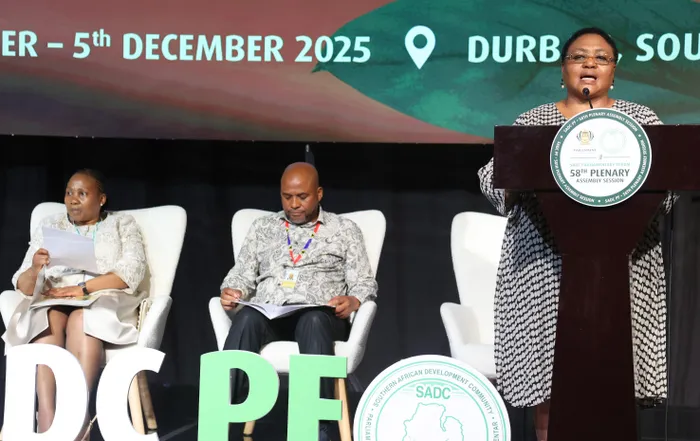
At the 58th SADC Parliamentary Forum Plenary Assembly, leaders discussed climate change’s immediate impact and necessary legislative measures for mitigation and adaptation. From left: SADC PF Secretary General Boemo Sekgoma, Secretary to Parliament Xolile George, and Speaker of Parliament Thoko Didiza.
Image: Tumi Pakkies / Independent Newspapers
Climate change is not just an environmental issue; it is a pressing social challenge that disproportionately affects vulnerable populations, particularly women and youth.
As southern Africa grapples with the harsh realities of extreme weather events such as floods, heatwaves, and droughts, the urgency for effective legislative action has never been greater.
At the ongoing 58th Plenary Assembly of the Southern African Development Community Parliamentary Forum (SADC PF) in Durban, Speaker of Parliament Thoko Didiza said the president’s work on the climate action fund is evident.
This initiative is designed to boost investments aimed at tackling climate change challenges. Consequently, the budget presented by the Finance Minister must be scrutinised to determine the extent to which it equips countries to effectively mitigate climate change.
Didiza stressed that support is needed in both the environment and agriculture ministries. Agricultural ministers require aid for research and development to create and promote new, drought-resistant crops.
This is vital for equipping farmers to withstand extreme weather, such as severe droughts or heatwaves, and thus ensure food security. She highlighted the success of a drought-resistant maize seed.
Furthermore, collaboration with departments like housing is essential. Their planning must integrate infrastructure designed for climate change resilience as standard practice, moving past the stage where it is treated as an optional add-on or a justification for inaction.
“When we look at climate financing, it’s not just about moving from fossil fuels to alternative energy,” Didiza said.
“It’s also about adaptation of how the different sectors can, in their preparation and planning, ensure that we can now plan our infrastructure in a manner that responds to climate change, but also investment in information and innovation, because if information is only thought of a few, those who are planners, those who are decision making, it limits the capability of the citizens to be able to respond themselves in issues of climate change.
“All of those, from a planning point of view, from a resource mobilisation point of view, even if you may not have resources, but how do we utilise the limited resources that are there in our country so that we can assist in adaptation?”
Secretary to Parliament Xolile George added that the president established the Presidential Climate Commission, which looks at various instruments that can help what is called a Just Transition Framework.
George explained that when undertaking developments, particularly infrastructure projects, the mitigation aspect of the planning process focuses on utilising climate-proofed financing mechanisms. This applies to both private and public sector-led development initiatives.
Furthermore, budget planning incorporates a blueprint developed by the Centre for Scientific and Industrial Research (CSIR) — a national research agency. This blueprint outlines how infrastructure development can be made “finance-proofed”, thereby strengthening its resilience mechanisms. Consequently, budgets are evaluated and developed within this specific framework.
“There are also oversight committees of Parliament in both Houses that, when they examine developments, are also guided by these frameworks that our country is a signatory to in terms of the climate commitments that we have globally,” George said.
Discussing the SADC PF’s approach to climate change, SADC PF Secretary General Boemo Sekgoma said that at the Southern Parliamentary Forum level, they have set themselves the green objective of ensuring that organisations look at environmentally friendly options.
“Even at the architectural level, nowadays, when we start building, we are supposed to take into account the green policy,” Sekgoma said.
She said that under the sexual reproductive health and rights programmes, the forum is already convinced that without the contribution of parliaments to ensure that the rights of individuals impacted by climate (change) are responded to adequately, they find that it would not be going any further to ameliorate the impact of climate.
“Therefore, we have parliaments coming up with policy positions,” Sekgoma said.
She said they have offshoots around infrastructure and finance. She is seeing a lot of offshoots dedicated to producing research that can inform countries about their budgetary processes, specifically influencing the appropriation bill.
This ensures that when various parliaments meet, they are working on a project to which they have all agreed, and progress reports on this area are being generated.
thobeka.ngema@inl.co.za