
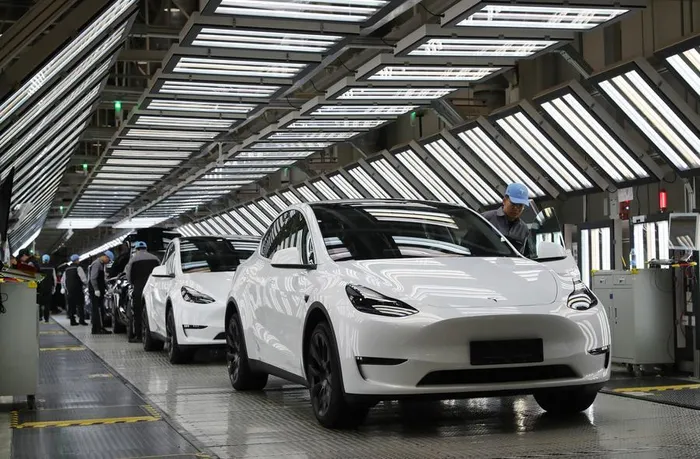
Employees work at Tesla's Shanghai Gigafactory in east China's Shanghai,
Image: XINHUA
Tesla has marked a major production milestone in China, with its Shanghai Gigafactory surpassing four million completed vehicles six years after the first Model 3 rolled off the line. The achievement underscores both the company’s deep integration into the Chinese automotive landscape and China’s central role in the global electric vehicle (EV) industry. Yet the celebration arrives at a moment when the country’s once-surging passenger vehicle market is showing clear signs of fatigue, with retail sales dipping for the second consecutive month.
Tesla’s expanding footprint and China’s shifting market dynamics are unfolding simultaneously, revealing both the opportunities and constraints ahead for global manufacturers operating in the world’s most competitive car market.
Tesla’s Shanghai Gigafactory, the company’s first overseas assembly plant, has become the backbone of its global supply chain. Opened in late 2019, the facility rapidly evolved from an ambitious expansion project into Tesla’s highest-volume production site. By 2024, it accounted for nearly half of the company’s worldwide deliveries.
The four-million-unit milestone reflects both scale and speed. Tesla reached the one-million production mark in Shanghai in 2021, the second million in 2022, and the third by late 2023—before crossing the four-million threshold in December 2025. Few automotive factories in history have expanded output at such a pace.
However, the headline figure contrasts with a softening in Tesla’s China shipments this year. In the first eleven months of 2025, the Gigafactory delivered 754,561 vehicles, representing a 9 percent year-on-year drop. Retail sales within China fell by 7 percent to 531,855 units, while exports declined 10 percent to 222,706 vehicles. These numbers mirror the broader slowdown in domestic demand, as competition intensifies and consumers become more cautious about major purchases.
Sales of the Model Y, which has become one of China’s best-selling premium SUVs, fell 4.4 percent year-to-date to 472,805 units. Meanwhile, shipments of the refreshed Model 3 dropped by more than 14 percent to 281,756 units. Although Tesla remains a leading EV manufacturer in China, the company now faces a market that is maturing more quickly than predicted.
The China Passenger Car Association (CPCA) reported an 8 percent year-on-year decline in retail sales for November 2025, with 2.23 million units sold compared with 2.45 million a year earlier. This marks the second successive month of contraction and highlights how the market—after years of aggressive growth—has begun to lose momentum.
Several factors are contributing to the deceleration:
Despite the downturn, China’s overall market remains robust. Between January and November, passenger vehicle retail sales increased by 6.6 percent to 21.62 million units. This steady growth reflects the strong first half of the year and ongoing consumer appetite for electrified models.
A closer look at the November data reveals a stark divergence between traditional internal combustion engine (ICE) vehicles and NEVs. ICE sales fell by 22 percent to 910,000 units, highlighting the rapid erosion of demand for petrol-powered models. By contrast, NEV sales rose 4 percent year-on-year to 1.32 million units, accounting for over 59 percent of monthly passenger vehicle sales.
This pattern is even more striking across the first eleven months of the year. NEVs have grown nearly 20 percent to 11.47 million units, representing more than half of all passenger vehicles sold in China during 2025. In the same period, ICE vehicles recorded 10.15 million sales—a figure that would have been unthinkable just five years ago, when combustion engines dominated the market.
China has now firmly entered the era of electric mobility, with domestic champions such as BYD, Nio, Li Auto and Geely accelerating innovation while global brands fight for relevance.
However, the landscape is poised for another shift. The Chinese government has signalled it will scale back its NEV stimulus programme at the end of 2025. While the CPCA expects a rush in December as consumers seek to benefit from the final months of support, the removal of subsidies could reshape market behaviour in 2026 and intensify competition further.
Tesla’s success in China is inseparable from the country’s broader EV revolution. The manufacturer leveraged local supply chains, reduced production costs, and optimised logistics to make Shanghai a hub for both domestic sales and exports to Europe and Asia.
But the current slowdown highlights important challenges:
Increasing Competition: Domestic automakers, particularly BYD, have surged ahead with extensive model line-ups and aggressive pricing. BYD’s plug-in hybrids and pure EVs now dominate multiple segments and have captured a broad swathe of the mid-market.
Price Pressures: Price wars across the industry—sparked by Tesla’s own price cuts in early 2023 and reignited repeatedly—have reduced margins for all players. While Tesla benefits from economies of scale, it faces fiercer battles to maintain volume.
Export Uncertainty: With Europe tightening scrutiny on Chinese-made EVs and exploring new tariffs, Tesla’s Shanghai-based export strategy will come under growing geopolitical pressure.
China’s Economic Headwinds: Weakening sentiment and slower GDP growth mean even premium car buyers are becoming more conservative, challenging Tesla's high-spec EVs.
Despite these pressures, Tesla remains well-positioned. The company’s technology brand, streamlined production processes, and expanding Supercharger network continue to attract loyal buyers. And although Tesla’s market share may contract, its long-term prospects in China remain significant given the country’s commitment to electrification.
Tesla’s four-million milestone is both a testament to China’s scale and a reminder of how quickly market realities can shift. The cooling of the passenger vehicle sector is not a crisis but a recalibration. China’s NEV penetration rate, over 50 percent year-to-date, remains unmatched globally, and the country continues to set the pace for next-generation battery technologies and autonomous driving systems.
For Tesla, the challenge is clear: sustain momentum in a maturing EV landscape dominated increasingly by fast-moving domestic competitors. For China’s automotive sector more broadly, the next phase will depend on restoring consumer confidence, managing economic pressures, and navigating the geopolitical winds shaping global trade.
Despite the slowdown, China remains the single most critical EV market in the world. And with Tesla’s Shanghai Gigafactory now past four million units, its role in shaping the next chapter of global electrification is firmly cemented.
Written By:
*Cole Jackson
Lead Associate at BRICS+ Consulting Group
Chinese & South America Specialist
** MORE ARTICLES ON OUR WEBSITE https://bricscg.com/
** Follow https://x.com/brics_daily on X/Twitter for daily BRICS+ updates