
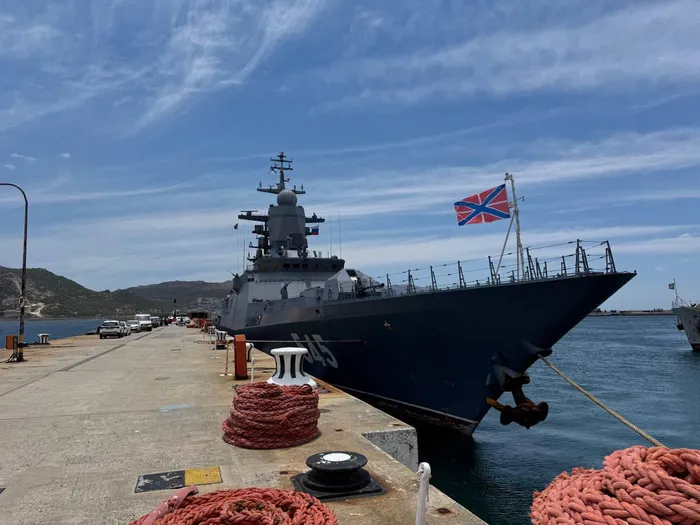
South Africa’s decision to host the naval exercise Will for Peace signals a deliberate commitment to BRICS alignment under Western pressure.
Image: Russian Embassy South Africa
South Africa’s decision to host the naval exercise known as Will for Peace places the country firmly inside a struggle over maritime power, political alignment and sovereignty that no longer allows for discreet management. The exercise began on Friday 9 January in South African territorial waters around Simon’s Town and False Bay, under the authority of an ANC-led executive, with the South African Navy acting as host. Operational headquarters are being run from a South African naval base that has not been publicly identified, a detail that has drawn attention given the limited communication from the South African National Defence Force.
According to a SANDF Joint Operations Division statement issued on 30 December, Will for Peace 2026 brings together navies from BRICS Plus countries for joint maritime safety operations, interoperability drills and maritime protection serials. The exercise involves active naval participation by China, Russia and Iran, alongside South Africa as host. Other BRICS-linked states remain present in more limited capacities. This distinction matters. Will for Peace is an operational exercise focused on maritime protection and coordination, conducted in South African waters at a moment of heightened global tension.
The title Will for Peace carries political meaning in a period when maritime routes, energy corridors and naval reach have returned to the centre of global power struggles. South Africa occupies one of the most strategically significant maritime positions on the planet. The sea lanes around the Cape historically underpinned colonial extraction and imperial logistics, and they continue to anchor global trade. That geography now places South Africa directly inside renewed competition between a declining Western order and an emerging multipolar system. Hosting this exercise makes that reality unavoidable.
President Cyril Ramaphosa governs within a structural contradiction that defines South Africa’s current position. The state remains deeply embedded in Western finance, trade and capital markets, while the governing party seeks to sustain South Africa’s role within BRICS as a substantive political formation rather than a ceremonial forum. That contradiction narrows the space for manoeuvre. When BRICS commitments move beyond speeches and summits into visible security cooperation, economic dependence asserts itself immediately. Will for Peace emerges from this constrained terrain.
The make-up of the exercise reveals where strain inside BRICS lies. South Africa hosts and commits naval capacity. China, Russia and Iran participate operationally. Brazil and India, despite earlier association with the exercise, have not joined directly. Brazil has limited its involvement to observer status, while India has remained absent altogether.
These decisions reflect structural limits rather than uncertainty about BRICS. India functions as a regional power whose military posture, intelligence cooperation and technological infrastructure remain deeply embedded within United States–led systems. That embeddedness narrows India’s ability to participate openly in BRICS security initiatives without disturbing strategic relationships that still shape its defence and economic calculations. Brazil confronts a different version of the same constraint. Western capital continues to anchor its financial system, export orientation and investor confidence, creating sensitivities around any move that could provoke market reprisal. Observer status allows Brazil to signal political alignment while limiting immediate economic risk.
South Africa shares these pressures without the insulation of scale enjoyed by India and Brazil. That difference makes the choice to host Will for Peace more exposed to consequence and more politically significant. A BRICS formation that permanently avoids pressure cannot develop into a functioning counterweight to Western dominance. At least one member has to test whether cooperation can continue under sustained external constraint. South Africa has assumed that responsibility.
Domestic response has followed predictable ideological lines. The Democratic Alliance has opposed Will for Peace, warning of diplomatic and economic consequences while reproducing the assumptions and language of United States foreign policy. This position rests on a long-standing Atlanticist worldview in which South Africa’s legitimacy derives from Western approval. Movement beyond that orbit is treated as danger rather than strategy.
The appearance of Ukrainian organisers in South Africa during the period of Will for Peace is politically revealing. Their mobilisation around the exercise signals the extent to which Ukrainian-aligned politics have taken root inside the country under a lenient administrative environment. The timing is noteworthy. The naval exercise functions not only as a message outward to Western power, but also inward, as a signal that the ANC-led state remains aligned with BRICS partners and retains military capacity. Ukrainian protests surfacing alongside the exercise expose friction between that position and a Democratic Alliance (DA) increasingly aligned with Ukrainian and Atlanticist politics.
Since the DA assumed influence within Home Affairs, regulatory conditions for Ukrainian nationals have become notably permissive, particularly when contrasted with the increasingly restrictive treatment applied to Russian nationals. This asymmetry has enabled Ukrainian actors to operate and mobilise politically with relative ease. Within ANC and security-aligned circles, it is widely believed that Ukrainian intelligence operatives are also present in the country, although no formal confirmation has been made public. The concern is not direct coordination around the exercise, but the political ease and institutional access afforded to certain foreign-aligned actors.
That permissive environment has intersected with opposition efforts to delegitimise Will for Peace and to import foreign conflict narratives into South Africa’s domestic political space. The effect has been to intensify reputational and political pressure on the ANC government at a moment of strategic vulnerability.
The same ideological orientation appears in renewed calls by DA-aligned networks for the Western Cape and Cape Town to secede and form a separate country. These proposals present themselves as arguments about efficiency or local autonomy. They align with a neocolonial logic that favours fragmentation, port enclaves and Western-facing jurisdictions detached from national geopolitical commitments. Control over maritime gateways has always featured centrally in such strategies.
External pressure reinforces these internal dynamics. The United States continues to apply diplomatic and economic force through warnings, hostile media narratives, think-tank agitation and market signalling. This approach relies on South Africa’s economic exposure and on divisions within its political class. It seeks compliance through dependency rather than consent.
Ramaphosa’s handling of Will for Peace reflects a deliberate calculation under these conditions. He has avoided grandstanding language and formal alliance declarations, while refusing to cancel or downgrade the exercise. Ramaphosa has chosen to make his position visible rather than retreat, accepting risk in order to preserve South Africa’s credibility within BRICS and across the Global South.
The maritime dimension sharpens that choice. Sea lanes around the Cape remain central to global trade and energy flows, and they cannot be insulated from shifting power relations. Hosting Will for Peace places South Africa’s coastline inside the reality of multipolar competition rather than behind a neutrality that no longer protects.
A broader question now confronts BRICS directly. The formation must determine whether it can accommodate political and ideological difference within its ranks while functioning under pressure, or whether it will retreat whenever Western power applies force through markets, narratives and internal proxies. Multipolarity cannot take material form if regional powers hedge indefinitely while expecting smaller members to shoulder the consequences.
Neocolonialism now operates through selective mobility, narrative discipline, internal political proxies and administrative asymmetry. South Africa encounters all of these pressures simultaneously. Will for Peace has concentrated them into a single moment.
Ramaphosa has opted for visibility rather than restraint. That choice tests more than naval coordination. It tests whether BRICS can tolerate disagreement, pressure and uneven risk without retreating. South Africa has stepped forward, and the response of the bloc will determine whether Will for Peace marks a threshold in the struggle for sovereignty or a warning about its limits.
By Gillian Shutte
Geopolitical writer Gillian Schutte argues that South Africa’s decision to host the naval exercise Will for Peace signals a deliberate commitment to BRICS alignment under Western pressure. She examines how the exercise reflects President Cyril Ramaphosa’s attempt to balance sovereignty with economic dependence. The article traces the domestic backlash led by the Democratic Alliance and the emergence of Ukrainian-aligned activism around the exercise. Schutte situates these tensions within a wider struggle over maritime power and political influence. She asks whether BRICS can survive sustained pressure when some members retreat as soon as the United States asserts authority.