

Research from the Global Initiative Against Transnational Organized Crime estimates that around 3.8 million unregistered firearms circulate in South Africa, Mozambique, and Zimbabwe.
Image: Freepik
South Africa’s violent crime crisis is being fuelled by a hidden market in illegal firearms. This is a trade driven not by foreign smuggling but by guns lost, stolen or diverted from within the country’s own legal stockpiles.
At the end of last year, a Parliamentary reply unearthed that, over the past five years, more than 3,400 police service firearms have been lost or stolen, with only 559 recovered.
The rest have vanished into criminal networks, where they fuel murder, armed robbery, gang violence and cash-in-transit heists.
In a Democratic Alliance statement, the party said that only 559 have been recovered, meaning the vast majority remain in criminal hands.
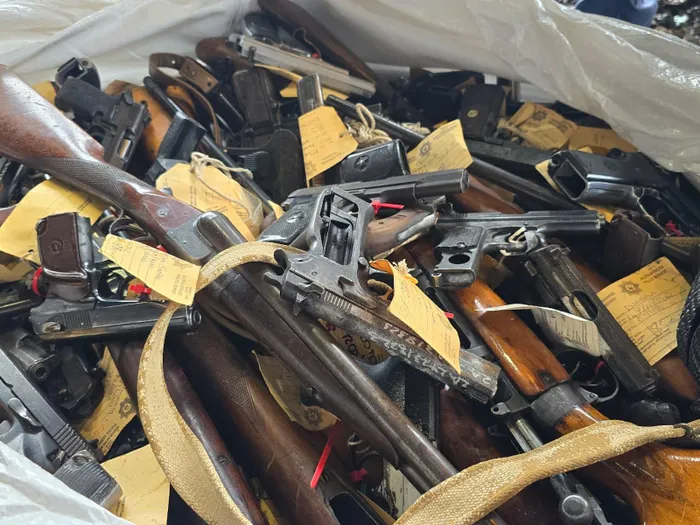
Police in the Western Cape uncovered that criminals exploit online marketplaces and covert couriers to conceal transactions and move firearms.
Image: SAPS
“Many of these guns are now being used to commit violent crimes, including robbery, assault, and murder,” the DA said.
For ordinary South Africans, this means that the weapons killing them often originate from police armouries, licensed civilian owners, and a firearms registry so dysfunctional that thousands of weapons simply vanish without accountability.
The consequences extend far beyond individual crimes. Illegal firearms underpin organised violence, enable gender-based attacks, and drive a lethal economy that costs lives daily.
Sheer scale
Over the past five years, the South African Police Service (SAPS) confiscated 21,702 illegal firearms, with 6,853 linked to murder cases, according to official SAPS data.
GroundUp calculated that firearms are involved in more than 40% of murders nationally, with provinces like the Western Cape, KwaZulu-Natal, and Gauteng seeing the highest confiscation rates and highest gun crime.
According to the SAPS, the Western Cape recorded the highest number of seizures of illegal guns, followed by KwaZulu-Natal and Gauteng.
Research from the Global Initiative Against Transnational Organized Crime estimates that around 3.8 million unregistered firearms circulate in South Africa, Mozambique, and Zimbabwe. Many originate from civilian losses or stolen state guns, with little oversight over government stockpiles.
A City of Johannesburg Public Safety briefing supports this, noting that South Africa has far higher gun numbers and gun-related deaths than neighbouring countries, and highlighting how illicit firearms circulate in urban centres.
“The scale of illegal firearms in circulation is a central factor in violent crime across the region,” the briefing states.
Guns disappearing
Official SAPS figures show that in the 2023/24 financial year, 7,736 firearms were reported stolen and 716 lost. Authorities recovered 5,469 illegal guns, but 2,499 had no serial numbers, making them untraceable.
At the end of last year, a Parliamentary reply revealed that over 3,400 SAPS firearms were lost or stolen between 2019 and 2024.
According to Acting Police Minister Firoz Cachalia’s input to Parliament, of the 3,422 service firearms lost or stolen, only 559 have been recovered, and only 16 of 170 armoury losses in the past five years were traced.
This shows that state firearms – intended to protect citizens – are entering criminal markets, often without accountability.
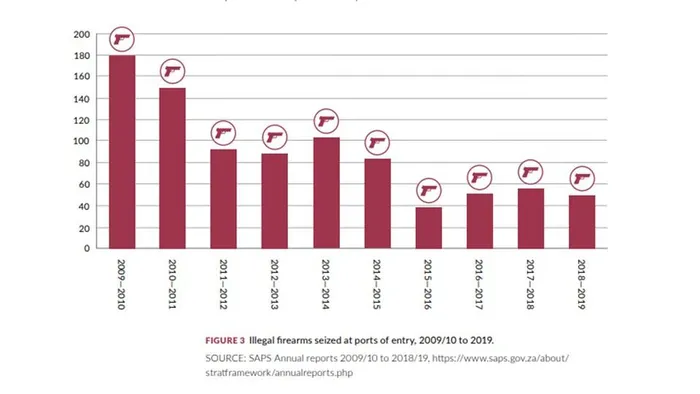
Illegal firearms seized at ports of entry.
Image: Global Initiative Against Transnational Organized Crime
99% homegrown
Contrary to public perception, most illegal guns circulating in South Africa do not come from foreign sources.
IOL found that 99% of illegal firearms originate domestically, with cross-border smuggling now playing a far smaller role than in previous decades.
Gun Free SA’s Claire Taylor said that cross-border smuggling has declined significantly since the 1990s.
“Cross-border smuggling has declined significantly since the 1990s,” she said, highlighting that only 56 illegal firearms were seized at ports of entry in 2023/24, compared with 179 a decade earlier.
Those few imported weapons are typically high-calibre firearms intended for serious crimes such as cash-in-transit heists or targeted attacks.
Instead, the vast majority of illegal firearms leak from within South Africa’s own legal stockpiles — from police armouries, licensed civilian owners, and private security companies.
One gun, ten murders
A recent Gauteng Legislature media statement illustrates the flow of illegal weapons into criminal networks.
On 28 July 2025, authorities arrested two suspects believed to be part of a sophisticated firearms trafficking syndicate in Meyersdal, Johannesburg, and recovered 30 unlicensed 9mm firearms.
The legislature warned that illegal firearms are “enablers of organised crime, murder, armed robbery, gender-based violence, and gang-related activities,” noting that one weapon used in the 2022 murder of musician DJ Sumbody and his bodyguards was later linked to at least 10 other murders across provinces.
These incidents show how a single lost or stolen firearm can have far-reaching consequences, moving through criminal networks and amplifying violence.
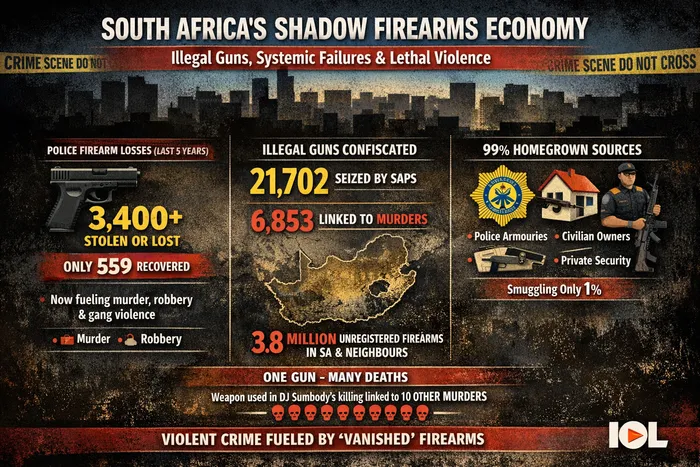
Research from the Global Initiative Against Transnational Organized Crime estimates that around 3.8 million unregistered firearms circulate in South Africa, Mozambique, and Zimbabwe.
Image: ChatGPT
Civilian firearms and private security
Civilian firearms also contribute to the illegal stock. Global Initiative research highlights that guns lost or stolen from private owners are among the most common sources of illegal firearms, and these often appear in violent crime.
Private security companies, responsible for high-value cash-in-transit protection, are not immune. Weapons can be stolen during operations or diverted through collusion, feeding organised criminal networks.
The combination of lax oversight, poor record-keeping, and inadequate auditing means that once a firearm enters the illicit market – whether from a police armoury, a private home, or a security firm – it becomes almost impossible to retrieve.
Weaknesses in tracking and oversight
The Central Firearms Registry is tasked with tracking all firearms from acquisition to disposal, but experts say gaps in record-keeping, interdepartmental coordination, and oversight make it easy for guns to slip into criminal hands.
Professor Kholofelo Rakubu, head of Law, Safety and Security Management at Tshwane University of Technology, told IOL: “This isn’t a case of a few bad apples... firearms can vanish from state custody with little trace and even less consequence.”
Without robust oversight and accurate record-keeping, the cycle of guns entering the illicit market will continue, the Global Initiative warned.
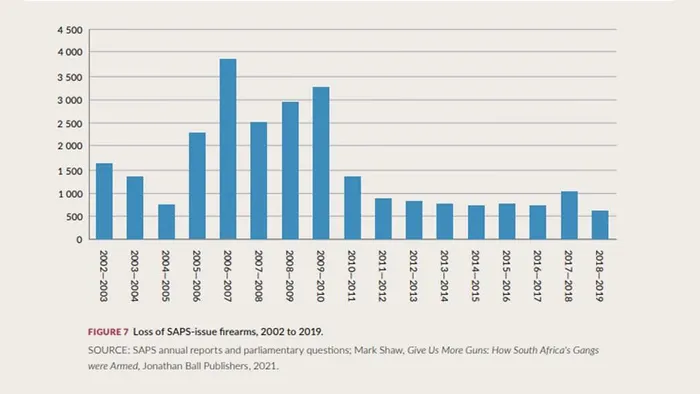
Lost police firearms.
Image: Global Initiative Against Transnational Organized Crime
Tackling the illicit gun economy
Experts and NGOs, including Gun Free South Africa, say addressing this crisis requires comprehensive reforms. These include tightening control over state and civilian firearms, regular audits of armouries and licensed owners, and a functional, centralised firearms registry with proper oversight.
The Gauteng Legislature statement, Global Initiative research, and SAPS figures all highlight that policing operations alone cannot solve the problem. Without administrative reform, illegal firearms will continue to circulate, enabling violent crime nationwide.
Illegal firearms are central to South Africa’s lethal crime profile. Studies and official records show that over 40% of murders involve firearms, making guns the single largest driver of lethal violence in the country.
Experts stress that every lost or stolen gun represents a potential instrument of murder or robbery, and the combination of civilian, state, and trafficked firearms creates a persistent, deadly problem.
IOL BUSINESS