
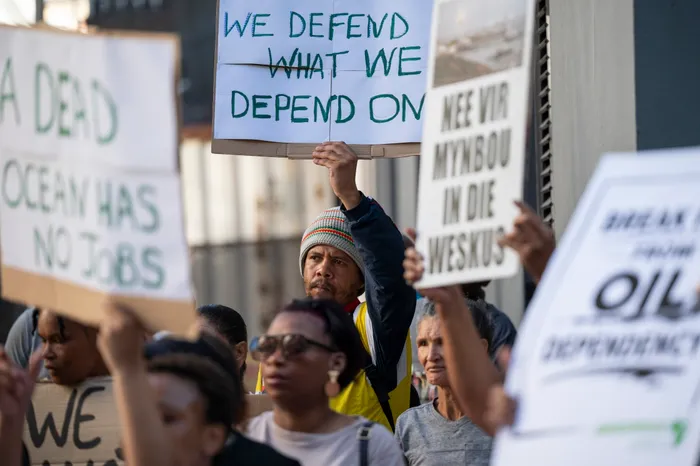
Eco-justice groups and traditional fishers reacted to the litigation, saying their livelihoods depend on the sea and implored the government to consider the impact on small-scale fishers and local communities.
Image: Armand Hough / Independent Newspapers
As judgment was reserved this week at the Western Cape High Court in the environmental battle launched by eco-justice groups, traditional fishers reacted to the litigation, saying their livelihoods depend on the sea and implored the government to consider the impact on small-scale fishers and local communities.
In a two-day hearing on Monday and Tuesday, Aukotowa Fisheries Primary Co-operative Limited, The Green Connection NPC, and Natural Justice challenged the Director-General of the Department of Mineral and Petroleum Resources, the Minister of Forestry, Fisheries and the Environment, and TotalEnergies EP South Africa, arguing that the environmental authorisation for ultra-deep-water oil and gas drilling in the Deep Western Orange Basin (DWOB) was fatally flawed, irrational, and unconstitutional.
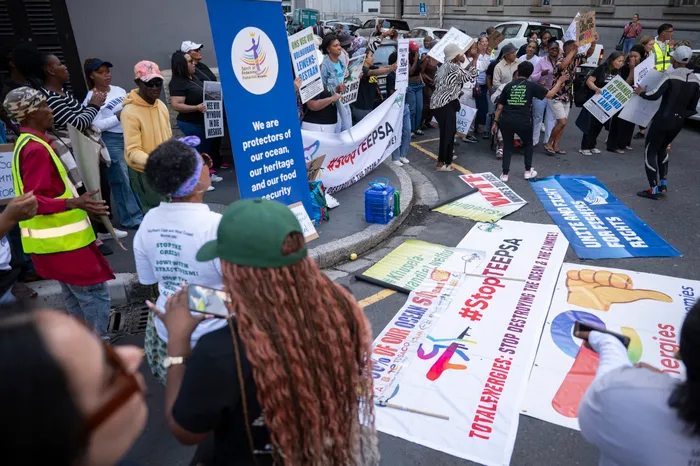
Ocean activists and small-scale fishers gathered outside the Western Cape High Court on Monday morning to protest against proposed offshore oil and gas exploration along South Africa’s West Coast.
Image: Armand Hough / Independent Newspapers
The DWOB is located roughly 200 kilometres off the West Coast of South Africa.
One of the grounds of review relates to the threat to livelihoods and food security.
The applicants submitted that communities such as those in Port Nolloth already face declining fish stocks and the frontline impacts of climate change, “yet the decision-makers treated the risks to fishing livelihoods as a minor inconvenience rather than a serious threat to food security and economic survival”.
Ahead of the hearing, a large number of small-scale fishers and coastal community members held a peaceful but spirited demonstration outside the Western Cape High Court, supporting the call to the judiciary to overturn the environmental authorisation.
They were joined by eco-justice organisations and other civil society groups, who emphasised the risks the project poses to marine ecosystems, food security, and local livelihoods. Moreover, small-scale fishers and coastal communities organised separate solidarity actions across parts of the Eastern Cape and KwaZulu-Natal.
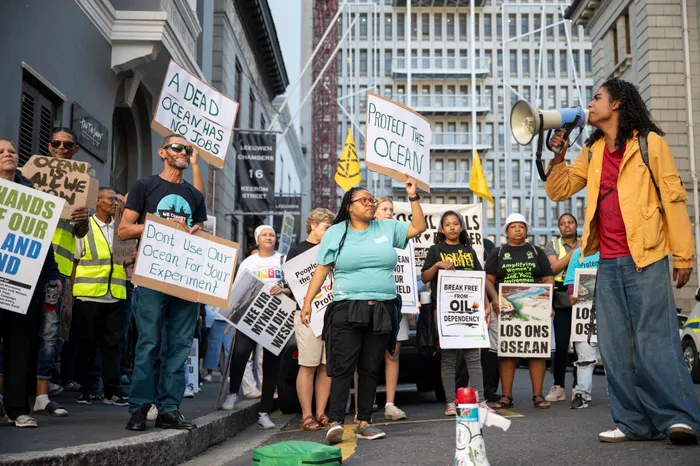
The Western Cape High Court reserved judgment in a case against Total Energies' oil drilling plans. Protesting small-scale fishers and eco-justice groups raised alarms about the potential risks to livelihoods and food security.
Image: Armand Hough / Independent Newspapers
The Green Connection’s outreach ambassador, Neville van Rooy, said: “One of the main reasons that we approached the High Court is that the DWOB presents conditions unlike anything South Africa has ever faced - both in water depth and technical complexity.
“However, the Environmental Impact Assessment (EIA) simply did not deal with these heightened risks. We believe that the law supports the rights of small-scale fishers who are already on the frontline of climate impacts, especially since this project introduces new threats that, in our view, were never properly assessed.”
The organisations submitted that the heritage and constitutional rights were sidelined and that the decision failed to give proper weight to the heritage, cultural, and constitutional rights of small-scale fishers who depend on the ocean for their way of life.
The applicants argued that by approving the project without meaningfully addressing these impacts, decision-makers effectively placed the profits of a multinational corporation above the livelihoods of vulnerable coastal communities.
Walter Steenkamp from the Aukotowa Fisheries Co-operative in Port Nolloth said: “Communities along the West Coast are already dealing with declining fish stocks and the growing impacts of climate change. Yet the State failed to meaningfully assess how this project will affect our livelihoods, food security, cultural heritage, and constitutional rights – effectively prioritising corporate interests over vulnerable fishing communities.
“Our livelihoods depend on the ocean. We have the right to be heard and the right to a healthy environment. But the approval process ignored our lived realities and the warnings we have raised repeatedly. We are hopeful that the court will recognise the seriousness of these failures.”
Ernest Titus from Lambert’s Bay, West Coast, said: “Decisions made in Cape Town, about TotalEnergies and Shell, will have a major impact on the future of our fishing industry. For generations, our families have relied on traditional fishing to put food on the table, and these decisions directly affect our ability to provide for our children and support our communities. The fishing industry plays an important role in South Africa’s economy, yet oil exploration threatens the livelihoods of small‑scale fishers.”
Solidarity protests led by the South Durban Community Alliance marched to the Department of Mineral Resources and Energy to deliver a memorandum.
The memorandum raised concerns about two proposed Gas-to-Power Projects in the South Durban Basin.
“For too long, our communities have been ignored while decisions about oil and gas projects are made without us. We reject harmful development that threatens our health, our environment, and our livelihoods. From unsafe Gas-to-Power projects in South Durban to the flawed approval given to TotalEnergies, our concerns are clear: no proper consultation, no full assessment of risks, and no protection for people or the environment. We demand change. We demand accountability. We demand to be heard.”
In contrast, Director of Community in Action (Garden Route), Richard Seekoei, said a balance must be struck between socio-economic rights and the environment.
“In most of the cases of civil society, we see that a balance is not necessarily struck when it comes to seeking the socio-economic rights of our people. When we look at the preamble of the Constitution, it speaks that we recognise the injustices of the past; however, we are saying that we need to restore or rectify those injustices.
“One of the ways to do that and restore an individual's dignity is by giving him a job, giving him the ability to support his family. We are saying that instead of coming to court, why don’t we sit and talk about it and mediate? Mediation is a quicker process, and if it cannot be resolved there, then it makes sense to approach the court. The environment is important, but people’s livelihoods are also important,” said Seekoei.
chevon.booysen@inl.co.za