
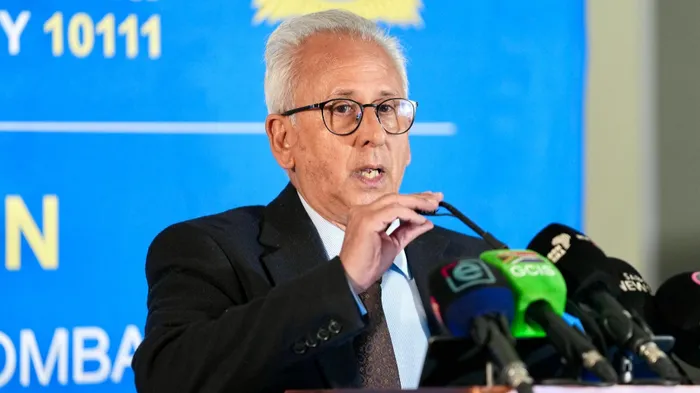
Police Minister Firoz Cachalia addresses the media in Pretoria, revealing a 9.5% decrease in murder rates but emphasising the persistent threat of violence in South Africa.
Image: Supplied
South Africa recorded 546 fewer murders in the first three months of 2026 compared to the same period last year, with national murder figures dropping by 9.5%, Police Minister Firoz Cachalia revealed on Thursday during the release of the fourth quarter crime statistics in Pretoria.
The latest crime statistics, covering January to March 2026, show that murders declined from 5 727 cases last year to 5 181 this year. Violent “contact crimes” also fell by 4.6%, while serious armed robberies including house robberies, business robberies and robberies at non-residential premises all posted double-digit declines.
But despite the improvements, Cachalia warned that South Africa remains gripped by extreme violence.
“The levels of violence and criminality in South Africa remain far too high,” he said.
“A decrease in crime is not the same as achieving safety. The levels of crime are still unacceptably high with 58 murders per day on average during this quarter.”
The minister described the statistics as “a stark mirror held up to our society”, saying behind every number was “a traumatised victim, a distraught family, a community living in fear”.
The data shows that Gauteng, the Western Cape, Eastern Cape and KwaZulu-Natal accounted for more than 80% of all murders recorded nationally, despite all four provinces showing declines.
The Eastern Cape recorded the country’s highest murder rate at 14.3 murders per 100 000 people, followed by the Western Cape at 12.8. Gauteng, despite having the highest number of murders overall, recorded a lower murder rate of 7.1 per 100 000 people.
Cachalia said violent crime remained deeply rooted in homes and communities, revealing that 1 523 murders took place either at the home of the victim or perpetrator.
Nearly half of all rape cases, 47.2%, also occurred in homes.
“That is 4 620 out of 9 782 rapes, committed not in dark alleys by strangers, but in homes, by people known to the victim,” he said.
He said arguments, revenge attacks, vigilantism and alcohol abuse continued to fuel deadly violence across the country.
“In this quarter alone, 898 murders were triggered by arguments and misunderstandings,” Cachalia said, while another 299 murders were linked to vigilantism.
Alcohol was also identified as a major driver of violent crime, with police linking 7 267 cases of assault, rape, attempted murder and murder to alcohol use.
“The more alcohol we consume, the more violence we will suffer,” Cachalia warned.
The minister also sounded the alarm over organised crime, particularly in Gauteng, which accounted for more than half of all kidnappings and carjackings nationally.
According to the statistics, Gauteng accounted for:
“These are not opportunistic crimes,” Cachalia said.
“They are the work of organised criminal syndicates that are highly mobile, heavily armed, and deeply embedded in our economic centres.”
He also raised concerns over the rise of extortion rackets and the so-called “construction mafia”, warning that criminal syndicates were sabotaging businesses, service delivery and investment.
“Protection rackets are spreading,” he said, adding that organised crime was increasingly moving online through commercial and cyber-related offences.
Cachalia announced a new “police reset agenda” aimed at rebuilding the South African Police Service through professionalisation, anti-corruption reforms, improved intelligence gathering and stronger investigative capacity.
He further confirmed the establishment of a Police Advisory Panel chaired by former SARS commissioner Edward Kieswetter to help oversee reforms and implement recommendations emerging from the Madlanga Commission.
“We will not rest until the right to safety, enshrined in our Constitution, is a lived reality in every home, every street, every school, every taxi rank, and every village in this country,” Cachalia said.
IOL News