
The Department of Basic Education is set to implement a new programme in 80 schools across four provinces, focusing on GBV prevention and support mechanisms for learners.
Image: Independent Newspapers
The Department of Basic Education (DBE) is stepping up its fight against gender-based violence (GBV) in and around schools, announcing the allocation of a significant R95 million (EUR 5 million) committed by the European Union (EU).
The funding is earmarked for a programme targeting schools across 20 communities in KwaZulu-Natal, Gauteng, Mpumalanga, and Limpopo.
Education Minister Siviwe Gwarube detailed how the R95m will be allocated and what outcomes the department expects from the intervention, following a parliamentary question by the DA’s Ciska Jordaan.
Jordaan had also raised concern about the high crime incidents in schools as reported in the Quarter 3 (October - December 2025) crime statistics published in February.
Gwarube said the EU pledged approximately R95m to a programme focused on combating GBV in and near schools. The initiative will be implemented in KZN, Gauteng, Mpumalanga, and Limpopo.
“The programme is intended to strengthen prevention, referral, and support mechanisms in selected school communities, in alignment with South Africa’s broader policy and legislative framework on school safety, learner well-being, and the National Strategic Plan on Gender-Based Violence and Femicide,” Gwarube explained.
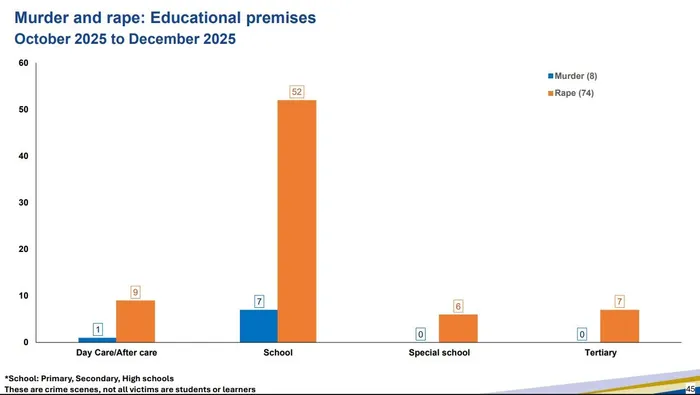
Statistics reveal the urgent need for intervention, with significant incidents of violence reported in educational settings across South Africa.
Image: SAPS
She noted that implementation will occur through two funding streams:
“According to the information provided to the DBE, the intervention is expected to be implemented in 80 primary and secondary schools across 20 communities in the four provinces,” Gwarube explained.
“The allocation is therefore directed at programme implementation, capacity-building, prevention initiatives, referral pathways, and support services for affected learners and school communities, rather than as a direct cash transfer to schools.”
Gwarube further explained that the detailed implementation framework, including the final indicators and reporting arrangements, is being concluded with the implementing partners.
She said an inaugural planning meeting between the department, EU delegation, Unesco, and Unicef to finalise the roll-out approach, implementation modalities, and measurable outcomes, was scheduled for last month.
Gwarube said the anticipated results are as follows:
She added that the department will be in a better position to report on the final measurable indicators and implementation targets once the planning process is complete.
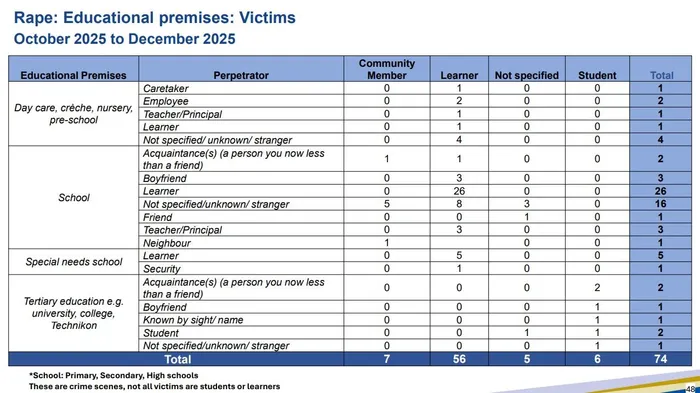
Quarter 3 crime statistics reveal that 74 rapes occurred at educational premises.
Image: SAPS
According to the Quarter 3 crime statistics, eight murders and 74 rapes occurred at educational premises (schools include primary, secondary, and high schools):
However, police said these are crime scenes, and not all victims are students or learners.
KZN registered the most rapes at educational premises with 16, followed by Gauteng with 13, Limpopo with seven, and Mpumalanga with five.
thobeka.ngema@inl.co.za