
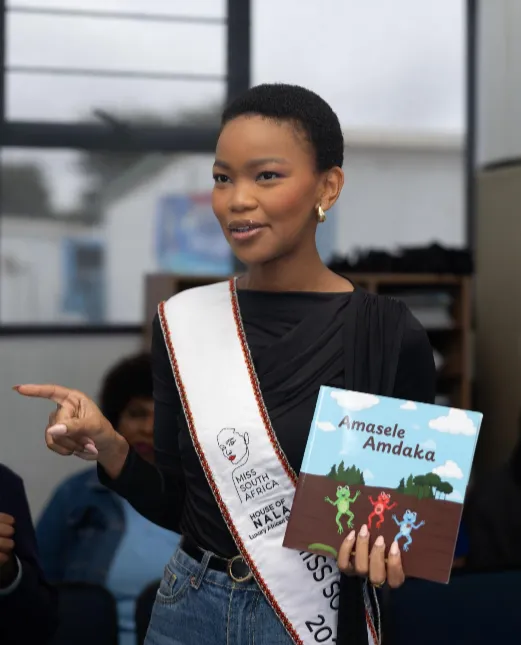
Qhawekazi Mazaleni reads from her isiXhosa children’s book Amasele Amdaka during a visit to Tshegofatsong Special School in Mamelodi.
Image: Supplied
Qhawekazi Mazaleni, Miss South Africa 2025, has used her platform to move beyond pageantry into education and youth advocacy, with a particular focus on inclusive learning.
She is the founder of Empower Youth Africa, a youth-focused initiative centred on expanding access to education and supporting underserved communities, including neurodivergent learners.
A classroom visit in Mamelodi this week placed one of education’s most urgent conversations into sharp focus: how children on the autism spectrum experience learning, and how often that experience is still misunderstood in mainstream education.
During a visit within World Autism Awareness and Acceptance Month, Mazaleni led a reading session at Tshegofatsong Special School, where she engaged learners using her isiXhosa children’s book, Amasele Amdaka.
Mazaleni said her work in special education settings is rooted in the belief that literacy must be inclusive by design, not by exception, and that reading is both a learning tool and a form of access and recognition.
Inside the classroom, engagement took many forms. Some learners followed closely, others responded through movement or sound, while others appeared to process information more quietly and internally.
Rather than a single mode of participation, the session reflected multiple ways of engaging with the same material.
Mazaleni’s reading style adapted to this environment. Her pacing shifted with the rhythm of the story, while pauses and gestures were used to support meaning beyond spoken language.
Amasele Amdaka, developed during her studies in speech therapy, was designed with accessibility in mind, incorporating repetition, rhythm, and structure to support varied forms of engagement. Mazaleni said the book emerged from her experience working with children with communication differences.
“This book was created from a place of understanding and care,” she said.
“Every child deserves to see themselves in stories and to experience learning in a way that affirms who they are. Inclusion is not just awareness, it is action.”
Autism spectrum disorder is still widely misunderstood in public discourse, often reduced to narrow assumptions about behaviour or communication.
Specialists stress that autism reflects a range of developmental differences that affect how individuals process sensory information, attention, and communication.
These differences do not reduce capacity, but they do shape how learning is expressed.
Attention, for example, may present in different ways: some learners engage visibly and verbally, others quietly or physically, and some cycle between engagement and withdrawal as part of sensory regulation rather than disinterest.
Educators at Tshegofatsong Special School said recognising these patterns is essential to effective teaching, particularly in special education environments where variation is expected rather than exceptional.
“Learning cannot be measured only through uniform participation,” Mazaleni said. “It must account for different ways attention is sustained and expressed.”
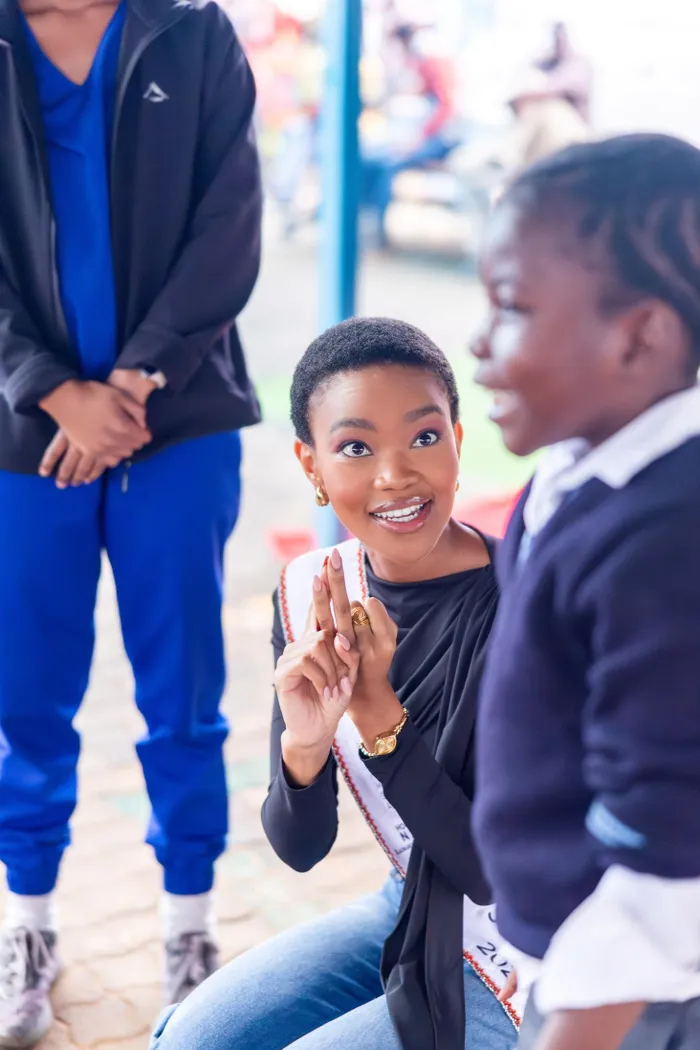
Qhawekazi Mazaleni engaging with a learner one-on-one at Tshegofatsong Special School.
Image: Supplied
World Autism Awareness and Acceptance Month, observed each April, is intended to deepen public understanding of autism and shift the conversation from awareness to meaningful inclusion.
Advocates say awareness alone is insufficient if daily educational practices remain unchanged.
One persistent misconception is that children who do not respond in expected ways are disengaged or incapable of learning.
Specialists in developmental psychology and education say this is inaccurate, noting that communication and engagement may not always be immediate or verbal.
Educational psychologist and executive function coach Casey Anley has written and spoken extensively about how these differences manifest in daily functioning, particularly in relation to ADHD and executive functioning.
At Tshegofatsong, teachers emphasise flexible approaches that recognise variation in engagement. Learning is observed across multiple forms of expression, rather than assessed through a single strand.
Following the reading session, Mazaleni met with educators to discuss literacy development, early intervention, and the representation of neurodivergent learners in educational materials.
The discussion returned repeatedly to a central point: inclusion is not achieved through visibility alone, but through consistent practice, appropriate resources, and recognition of different learning pathways.
Mazaleni’s advocacy through Empower Youth Africa focuses on expanding access to literacy and education for neurodivergent children and young people, with an emphasis on representation and communication.
Her outreach work includes school visits, storytelling sessions, and advocacy aimed at bridging clinical understanding with community-based educational support.
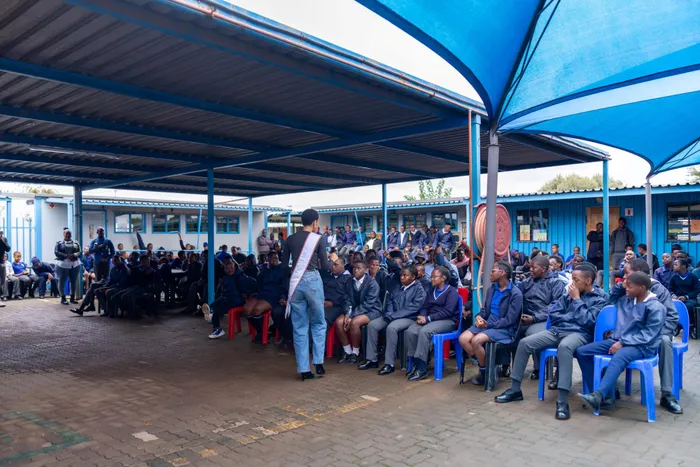
Qhawekazi Mazaleni reads from her isiXhosa children’s book Amasele Amdaka during a visit to Tshegofatsong Special School in Mamelodi.
Image: Supplied
Mazaleni, who is currently pursuing a master’s degree in speech-language pathology with a focus on autism, developed Amasele Amdaka during her final year of undergraduate study in speech therapy, inspired by her work with a young patient with cerebral palsy.
She said that experience strengthened her commitment to creating accessible and inclusive educational tools for children with diverse communication needs.
Through both her academic work and public advocacy, Mazaleni continues to highlight how literacy, when designed inclusively, can become a tool for participation rather than exclusion.
“Leadership in this space is about turning understanding into practice,” she said. “Inclusion must be lived in classrooms, not only discussed in policy spaces.”
IOL