
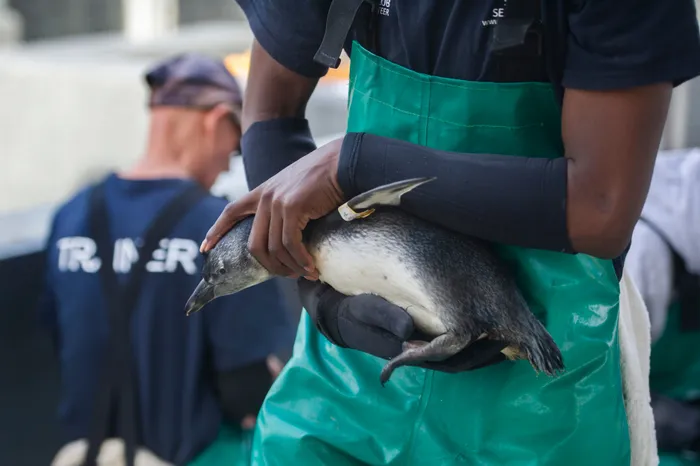
The study found that between 2016 and 2024, close to 400 oiled seabirds were admitted to SANCCOB and other rehabilitation centres, with over half of these linked to ship-to-ship (STS) transfer-related spills, mostly African Penguins and Cape Gannets.
Image: Armand Hough/Independent Newspapers
Marine conservationists have called for stricter measures in protecting seabirds after a new research paper has underscored how ship-to-ship (STS) fuel transfer impacts on aquatic life in Algoa Bay, home to what was once the world's largest colony of Endangered Cape Gannets and to two colonies of the Critically Endangered African Penguins, on Bird and St Croix islands.
The maritime bay is located on the east coast in the Eastern Cape, approximately 683 kilometres east of the Cape of Good Hope. STS transfer, also referred to as offshore bunkering, is the process of supplying fuel (bunkers) to ships at sea, away from traditional port facilities.
The service, which is expanding at many ports worldwide, saves ships from having to berth, which is convenient in terms of both time and cost.
Algoa Bay is currently the only locality in South Africa where STS fuel transfer activities occur off the South African coast, despite the Bay being a hotspot for marine biodiversity.
The study found that between 2016 and 2024, close to 400 oiled seabirds were admitted to SANCCOB and other rehabilitation centres, with over half of these linked to ship-to-ship (STS) transfer-related spills, mostly African Penguins and Cape Gannets.
More than half of the 378 seabirds admitted for rehabilitation over 8 years were oiled as a consequence of STS-transfer-related spills.
Given the increasing number of threats driving the African Penguin population ever closer to extinction, the risk posed by STS transfer is a significant concern for scientists and conservation organisations.
The research paper, published in the Marine Pollution Bulletin, is co-authored by SANCCOB scientists and academics from Nelson Mandela University and SAEON, and draws on evidentiary data from four oil spills linked to STS transfers, and one in particular, which affected over 90 African Penguins and close to 50 African Penguin chicks.
An established modelling system, developed by SAEON in support of the national Ocean and Coastal Information Management System (OCIMS), was used to model the trajectory of oil from the MV Chrysanthi S spill in 2019 (400 L of Heavy Fuel Oil), using the simulated environmental conditions at the time of the spill.
The model was used to simulate different types of spills under varying weather conditions, different locations within the anchorage areas in the Bay and with fuel amounts ranging from 400 L to 740,000 L.
The results of the study show that core foraging areas for African Penguins in the Bay can remain exposed to oil for up to a week after a spill event.
Once oiled, African Penguins tend to head to shore as fast as possible due to the effect of the oil on the waterproofing characteristics of their feathers and the consequent risk of hypothermia.
Due to prevailing weather conditions, spills have a high likelihood of both shoreline impacts as well as persistent surface contamination, especially during austral winter, when oil is more likely to impact the St Croix and Bird Island core foraging areas.
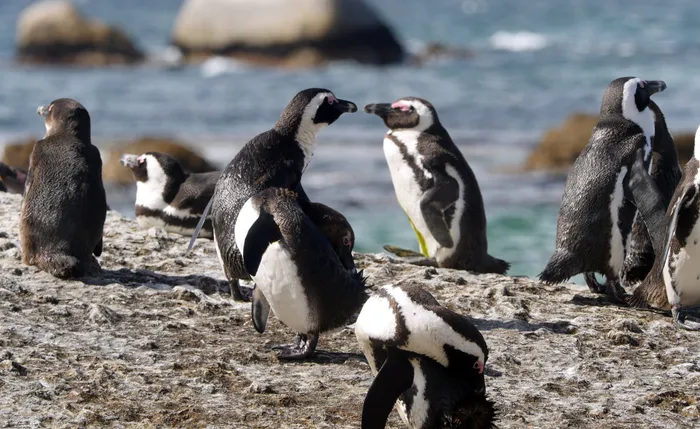
More than half of the 378 seabirds admitted for rehabilitation over 8 years were oiled as a consequence of STS-transfer-related spills.
Image: Ian Landsberg/Independent Newspapers
The research also indicates that even a very thin layer of oil on the sea surface can result in significant impacts to seabirds, particularly African Penguins, pointing to the need for a high degree of conservatism when assessing the impacts of potential spills.
The study also confirms that the proximity of a spill to seabird breeding colonies is the most critical factor, even more so than the amount of oil spilt.
Relevant to the regulation of STS transfers is that the recorded spills were all a result of human error, and the study also highlights the role of equipment malfunctions.
It is possible that the St Croix colony may not recover from another spill on the scale of what has been linked to STS-transfer in the past.
Nelson Mandela University’s Professor Lorien Pichegru from the Institute for Coastal and Marine Research said: “We have been aware of the correlation between bunkering activities and the rapidly declining number of penguins in Algoa Bay – our analysis of prior spill events gives deeper insight into both the temporal aspects, that is for how long the birds will be vulnerable, and the extent of overlap between oil affected areas and foraging range for African penguins in the Bay”.
SANCCOB’s Monica Stassen said: “This study reiterates that even a small spill can negatively impact seabird species. The island of St Croix and even to some extent Bird Island are directly in the path of oil if spilt within the anchorage areas.
“Stricter measures are needed to minimise this risk. Another oil spill in Algoa Bay could be devastating for the African penguin population,” Stassen said.
BirdLife South Africa’s Dr Kirsten Day said the study highlights an urgent need for meaningful interventions to protect the African Penguin colonies.
“At BirdLife South Africa, we remain very concerned that the recently introduced ‘Regulations for the Environmental Management of Offshore Ship-to-Ship Transfers’, exempts Algoa Bay from critical prohibitions, including that STS transfer is permissible five nautical miles from the boundary of a marine protected area.
“In our view, this makes no sense given the ecological sensitivity of the area, and it being the only location where bunkering is taking place.”
theolin.tembo@inl.co.za