
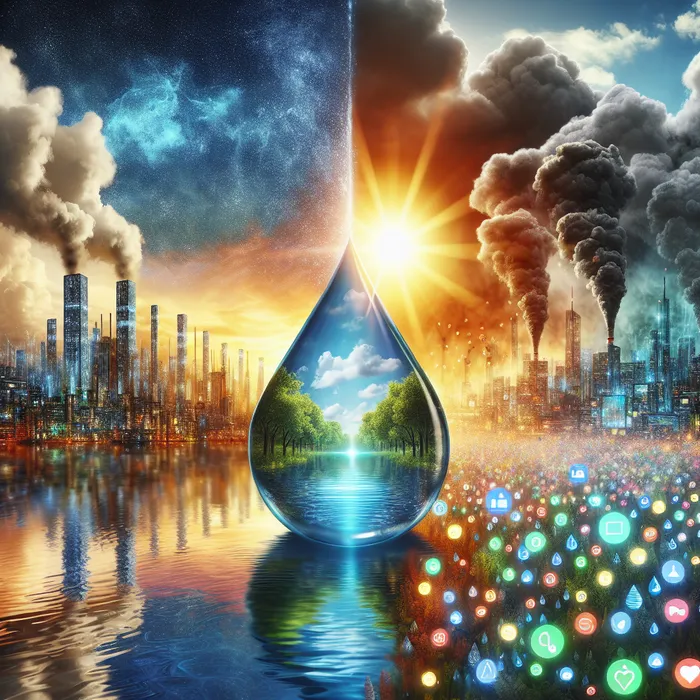
We look into how much resources does social media and AI use.
Image: RON AI/IOL
Artificial intelligence (AI) is one of those things that divides people into two camps: the "I wouldn't touch AI because it is bad and takes away job creation" camp and the "Let's just embrace AI while it's here."
And a new AI trend that entails inputting your photo and details to create a caricature is showing who is where.
As our feeds are flooded with caricatures, showing people's different personalities and jobs, there are just as many, if not more, AI critics citing concerns about the energy and water use.
AI is reshaping everything from healthcare to homework, and environmentalists have sounded the alarm on the technology's use of resources.
However, we look into comparative data that reveals that while AI’s footprint is growing, the environmental toll of our daily social media habits may currently be the bigger and overlooked polluter.
One of the biggest criticisms of AI focuses on its massive energy intensity. According to the International Energy Agency (IEA), a single query to a generative AI model like ChatGPT requires approximately ten times more electricity than a standard Google search. To put this into specific energy terms, a report by WALL-Y states that one ChatGPT query consumes roughly 3 watt-hours of energy.
Water consumption is another issue. The United Nations Environment Programme notes that global demand for AI is projected to consume between 4.2 and 6.6 billion cubic metres of water by 2027. It is worth noting that this water is primarily used to cool the massive servers that power these models, and not the water used for the queries.
However, recent breakdowns suggest individual AI usage might be less catastrophic than assumed. Early estimates were high, but closer analysis indicates that data centres consume approximately 500 millilitres of water for every 300 queries. This is contrary to reports that suggested litres per prompt per person. When accounting for the full lifecycle, including electricity production, a single ChatGPT query is estimated to use about 30 millilitres of water.
While AI is under the spotlight, the environmental cost of social media usage is staggering. According to Digital Camera World, research estimates that the average person generates 24 tons of CO₂ emissions annually simply by sharing, liking, and scrolling.
TikTok has emerged as a primary offender due to its video-centric format. The platform reportedly generates 30.7 billion kilos of carbon emissions annually, followed by Facebook with 27.5 billion kilos.
Furthermore, the water usage is remarkably high. According to a Greenspector report, spending just one minute on TikTok uses 0.27 litres of water and 1.88 square meters of land to support the necessary server infrastructure.
So our doomscrolling is not only affecting the brain, it's destroying the planet.
When directly compared, personal AI usage appears less resource-intensive than heavy social media consumption.
Energy Context: The 3 watt-hours required for one ChatGPT query is roughly equivalent to uploading 30 pictures to social media or watching TV for three minutes.
Water Usage: While a single AI query uses approximately 30 ml of water, one hour of social media use is estimated to consume 430 ml of water.
On a global scale, ChatGPT’s total energy consumption is currently comparable to that of 20,000 US households. In contrast, YouTube’s energy usage is equivalent to 1 million households.
Now that we have looked into how much resources AI and social media use, we can delve into the why. Ultimately, both technologies rely on the same backbone: data centres. These facilities are resource-heavy, consuming vast amounts of electricity and water. In Ireland, a hub for tech infrastructure, data centers already account for 17% of the country's total electricity consumption, a figure expected to double by 2026.
The United Nations emphasises that evaluating the footprint of these technologies requires looking at the full lifecycle. "Making a 2-kilogram computer requires approximately 800 kg of raw materials," the UN notes, highlighting that the hardware itself poses a huge environmental burden before a single algorithm is run.
So while AI represents a growing wedge of global energy demand—potentially increasing the internet's energy needs by 1% if it replaced all Google searches—individual social media usage remains a dominant environmental force. As the digital economy expands, the data suggests that while we must demand energy efficiency from AI developers, it would also do us well to remain conscious that their time spent scrolling is not without an environmental price tag.
IOL