
New parents in South Africa are embracing names that symbolise joy, resilience, and hope for the future.
Image: File
In celebration of identity and individualism, 2024 has introduced a vibrant selection of baby names in South Africa.
The latest Recorded Live Births (RLB) data from Statistics South Africa reveals that new parents in 2024 chose names infused with significance — names that symbolise joy, resilience, and a firm sense of cultural pride.
Leading the list for boys are the names Lethabo, Lubanzi, and Nkazimulo. Each of these names carries a unique meaning that reflects the aspirations of its bearer: Lethabo translates to “joy” or “happiness”, while Lubanzi conveys the notion of something being “wide” or “expansive”. Nkazimulo, on the other hand, embodies the concepts of “glory” or “splendour”.
For girls, the trend continues with names like Onalerona, Zanokuhle, and Melokuhle. The name Onalerona conveys “He (God) is with us”, imparting a sense of divine presence and support. Zanokuhle, meaning “to come with” or “bring what is good”, and Melokuhle, a unisex favourite signifying “to stand for good” or “uphold what is beautiful”, highlight a collective yearning for positivity in a rapidly changing world.
Names such as Lethabo, Nkanyezi, and Lesedi emerged as gender-neutral options, highlighting the greater significance of the meanings of the names.
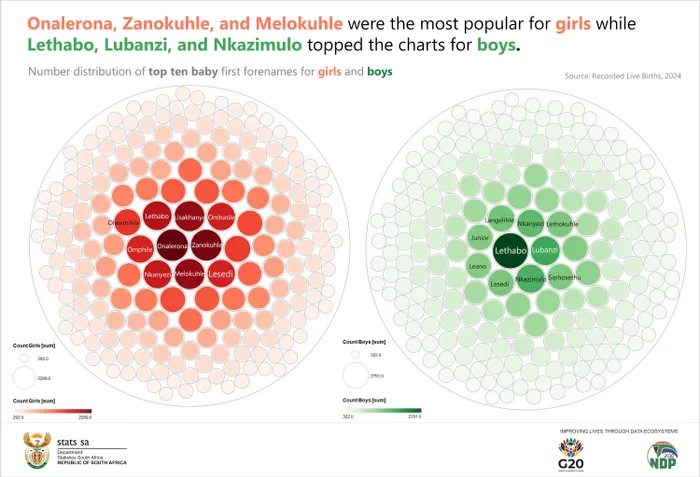
Distribution of the top 10 baby first forenames for girls and boys.
Image: Statistics South Africa
Statistics SA said these selections are more than just identifiers — they embody aspirations and values, conveying a sense of identity and optimism for the future.
Regarding second names, Junior was the most popular for boys, and Precious for girls, choices that frequently hold both personal and cultural weight.
University of KwaZulu-Natal’s professor of African languages specialising in onomastics, Sihawukele Ngubane, said names are taken seriously because a person’s name is their true self. It carries a meaning and aspirations for the parents.
“It is important that when you name a baby, you should name it with a name that will express gratitude to the person who provided the blessing of having a baby, because in the scriptures we are told that children are blessings from God. When you have a baby, you must give gratitude to God through naming your baby,” Ngubane said.
He explained that some African people traditionally believe that when they have a baby, they receive it from an ancestor. Therefore, they will give a name that will make the ancestor look upon them favourably and give them more children.
“The essence of names with Africans is that all names have meaning,” Ngubane said. “It is important to name a child a positive name.”
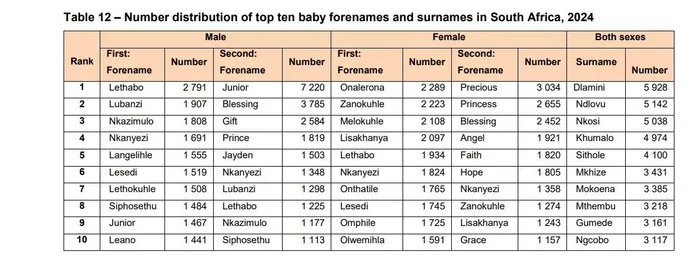
The most popular baby names in South Africa for 2024 reflect cultural pride and personal significance.
Image: Statistics South Africa
Highlighting a shift in naming babies, Ngubane said that traditionally, names like these were not used.
“In the past, people were named Mzikayifani and Vusumuzi. Now that trend has changed, which means there’s a shift in naming practices from the days of the past,” Ngubane explained, adding that during the apartheid era, those with Zulu names had to have an English name, and eventually, the Zulu name was no longer used.
He also said that some parents today are giving their children vowel-commencing names like Asanda, Aphiwe, Anele, Ayakha, which was not done before, except for the amaXhosa ethnic group.
Ngubane also noted that gender-neutral names were innovative, reiterating that there is a shift in naming practices.
thobeka.ngema@inl.co.za