
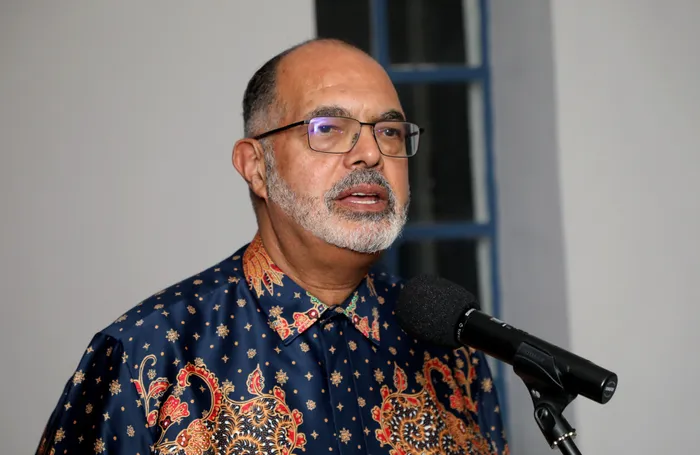
Kieswetter reflects on apartheid childhood in powerful graduation speech.
Image: Timothy Bernard
Outgoing South African Revenue Service (SARS) commissioner Edward Kieswetter delivered a deeply personal and emotional address after being awarded an honorary doctorate by the Cape Peninsula University of Technology (CPUT).
He reflected on his humble upbringing, apartheid hardship and journey from technical apprentice to national leader.
Speaking at the university's Autumn Graduation ceremony on Friday, Kieswetter transported the audience back to Ventura Street in Kensington, Cape Town, the modest home where he grew up with his five siblings in a three-bedroom house shared with his seamstress mother and general worker father.
"It is not a famous house. You will not find it in any guidebook," he said.
He described how his family had moved from a single room in Windermere into what, at the time, felt like "a palace", before life gradually adjusted to the cramped realities of everyday survival under apartheid.
Kieswetter did not hold back in his critique of the past, describing apartheid as a system "rigged to deliberately limit your development" and condemning the deep inequality and deprivation it entrenched.
He also warned that many of those injustices still echo in present-day South Africa, pointing to ongoing poverty, inequality and public service failures.
Turning emotional, he credited his parents for shaping his values, recalling lessons in discipline, humility and resilience.
His father taught him the importance of hard work and living within one's means, while his mother instilled the belief that dignity could be maintained even in poverty.
"I am the fruit of the selfless sacrifice, the incredible labour, and the unconditional love," he said.
Kieswetter said that his parents would be "bursting with pride" at the recognition.
He also reflected on his education journey through Harold Cressy High School and his early technical training, explaining that financial hardship prevented him from attending university in the traditional way. Instead, he entered the Peninsula Technikon (now CPUT) as an apprentice and engineering technician in the late 1970s.
Kieswetter told graduates that what once seemed like disappointment ultimately became one of the greatest gifts of his life, as the institution taught him that theory must be linked to practical impact.
"The question is never only what do we do, or how do we do it, but so what, and why do we do it," he said.
He expressed deep gratitude to CPUT, describing the honorary doctorate as a "full circle" moment in a life shaped by struggle, purpose and public service.
IOL News