
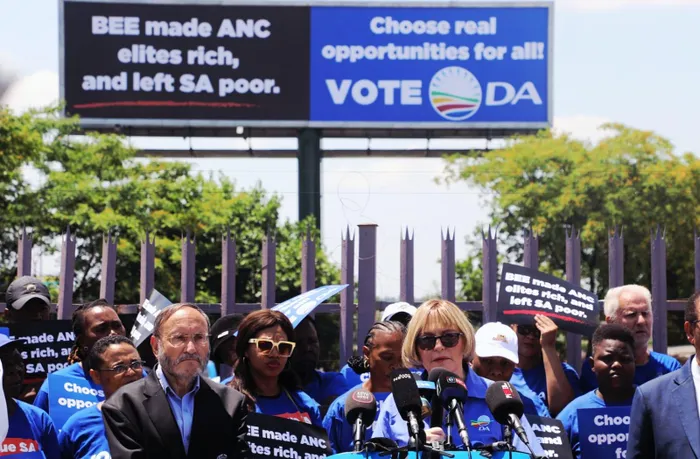
The Democratic Alliance in Joburg unveiled a Billboard on Tuesday that follows up on their anti-BEE bill. The Billboard can be seen from the N1 north near Strydom Park. It reads " BEE made ANC elites rich and left SA poor".
Image: Timothy Bernard / Independent Newspapers
Parliament’s rejection of DA MP Mathew Cuthbert’s draft move to rip race-based criteria out of public procurement and rip up BBBEE wasn’t just a procedural win; it was the country saying “not again.”
The DA’s bill pitched as “Economic Inclusion for All” seeks to repeal preferential procurement levers and repeal the BBBEE Act across our statute book.
That’s not reform; that’s rollback. It would erase the only binding tools that tie public money to structural inclusion.
Let’s be plain: South Africans especially black South Africans did not fight to trade political rights for a colour-blind economy that leaves inherited privilege intact. “Race-neutrality” in a racialised economy is not fairness; it is a forcefield around old power.
The DA tries to launder its bill with UN language, claiming an SDG-flavoured procurement utopia. It’s a category error. SDGs are global aspirations; you still need domestic law to do the work. In South Africa, that domestic architecture exists: Section 9(2) of the Constitution explicitly authorises measures to advance those disadvantaged by unfair discrimination the constitutional foundation BBBEE rests on. Section 217 of the Constitution permits preferential procurement to achieve these goals.
Those aren’t optional extras; they are the legal rail-tracks for substantive equality. On procurement mechanics, the new Public Procurement Act 28 of 2024 was passed and signed (18 July 2024) but has not commenced the President hasn’t proclaimed a start date and regulations are pending.
While we wait, the Western Cape Government and the City of Cape Town have challenged aspects of the Act’s validity in the Constitutional Court. Those are live processes; they do not negate the constitutional basis for targeted inclusion.
The DA’s sales pitch claims BBBEE “failed,” “favours elites,” and “inflates costs.” But look beneath the spin:
Let’s be honest about the numbers. The B-BBEE Commission’s National Status & Trends reports don’t paint a fairy tale. Ownership levels improved in some periods and stagnated or dipped in others e.g., the 2021 report showed overall black ownership around 29.5%, down from 31% in 2020, with the Commission warning about stagnation.
But the same public record also shows hundreds of billions of rand in reported ownership transactions over the years and a continuing pipeline of enterprise & supplier development spend evidence of movement, albeit uneven and too slow. Both truths can coexist: progress and under-performance.
That’s precisely why the correct answer is tighten and modernise don’t torpedo the ship mid-ocean.
“Neutrality” only makes sense on a level field. Ours isn’t.
Apartheid was an economic design who owned, who borrowed, who learned, who lived near jobs. That design still casts a long shadow over land, capital markets, the skills pipeline, and spatial inequality.
The MAPS assessment (a multilateral diagnostic of SA’s procurement system) recognises BBBEE’s role in preference points as part of the public-interest objectives the state pursues through procurement.
The DA’s project would strip those public-interest levers and pretend competition alone corrects history.
It won’t.
Rejecting repeal is step one. Step two is a BBBEE 2.0 that ordinary people can feel in their pockets not as a brochure, but as bread-and-butter changes:
Let’s put this in street language. When the DA says “race-neutral,” they mean the rules must no longer notice history.
When they say “SDG-aligned,” they mean “nice goals, no teeth.”
When they say “BBBEE fails,” they mean “we’d rather remove your ladder than fix the rungs.”
You can’t “market” your way out of centuries of dispossession.
You can’t “tender-cleanse” structural inequality by banning the instruments that let the state prefer those previously excluded.
The Constitution expects the state to be an economic actor for equality, not a referee who pretends the score was always 0-0.
The DA tries to spook the public with a compliance-costs narrative. But global capital has moved. Whether you like ESG or not, inclusion is now diligence: diverse suppliers hedge concentration risk; skills pipelines hedge labour risk; local content hedges geopolitical and logistics shocks.
Even the MAPS review reads our procurement objectives against international best practice rather than as aberration. Translation: a rules-based inclusion regime simplified and enforced reduces risk; a “do-nothing” fantasy increases it.
Another DA feint: “BEE = corruption.” No. Corruption is a cross-cutting governance failure. When the courts struck down earlier PPPFA regulations in 2022, they didn’t abolish Section 217’s equality purpose they told the state to legislate properly.
That is what produced the 2024 Act now under challenge on process/validity, not on the idea that procurement can have public-interest objectives. Fix process. Fix controls. But don’t torch the objective because rogues exist.
This is bigger than one bill. It’s a project to redraw the economic settlement without saying so.
The DA wants a state that can buy cheaply but never build justice, where competition is sacred but starting positions are off-limits.
That is not liberalism; it’s a museum for privilege.
By contrast, Parliament’s rejection signals something braver: that we will fix empowerment rather than forfeit it; that we will modernise the levers rather than mothball them.
Here’s a credible, near-term compact you can sell in town halls, shop floors and boardrooms alike:
Enforcement symmetry: real penalties for fronting and fake certificates; equally, predictability for compliant firms (fast lanes, longer-tenor contracts).Do this, and “BBBEE” stops being a fight over acronyms and becomes better jobs, real shares, local orders, and placements that stick.
To every young South African who has been told empowerment is a “hand-out”: don’t internalise that lie. Empowerment is the legal mechanism by which a democratic state returns the stolen future to its rightful owners. The choice before us is simple:
Parliament chose the second when it binned the DA’s repeal push. Now we must do the work: tighten the code, digitise the system, police the cheats, and move real value ownership, contracts, capability into the hands of those who were locked out.
We are not asking permission to exist in the economy. We are exercising a constitutional right and a historical duty. South Africa tried colour-blind economics for a century. It had a different name then.
We are not going back.
* Faiez Jacobs is a former Member of Parliament, founder of The Transcendence Group, Capetonian, Activist, and Servant of the People.
** The views expressed do not necessarily reflect the views of IOL or Independent Media.