
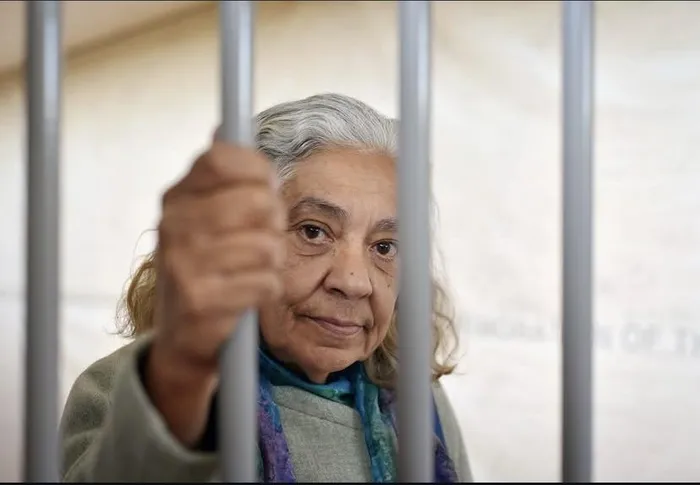
Colleen Lombard, anti-apartheid activist and former treason trialist, had died at 75 after a long illness.
Image: Armand Hough / Independent Newspapers
When a comrade reminded me recently, I picked up Colleen Lombard’s book, To the Moon and Back: A Detention Memoir, curious at first. I put it down changed.
Some memoirs are loud filled with slogans, posturing, and the convenient heroism of hindsight. Colleen’s voice is different. It is calm, deliberate, honest. She writes like someone speaking late at night, when the world is quiet and the truth can finally breathe. There is no bitterness. No need for embellishment. Just clarity, pain, and grace.
Colleen chose the hard path. And she walked it with dignity.
Born in Wynberg in 1950, she did not grow up around dramatic political theory or revolutionary seminar rooms. She came from the everyday world of school halls, church pews, and union offices. Her entry into activism wasn’t theatrical. It was practical. She saw injustice and decided to do something about it. That was her nature simple, direct, courageous.
We often speak about “the Struggle” in big, abstract language. But Colleen’s memoir reminds us that history is lived in small rooms, whispered conversations, late-night knocks on doors, hurry-up phone calls, fear, and faith. Her work assisting young comrades to cross the border for military training wasn’t an ideological mission. It was logistical. Food. Money. Timing. Addresses. Trust.
Trust that is the real substance of struggle work, and Colleen was trusted.
The darkest part of her memoir, for me, isn’t the arrest itself, or even the Section 29 detention, where the apartheid state had the legal right to disappear you. What struck me was her description of waiting. Waiting without knowing the time. Waiting without seeing daylight. Waiting without hearing a familiar voice. That limbo is psychological warfare.
Yet even there, Colleen writes without self-pity. She writes with attention. She remembers small details the hardness of the floor, the smell of the room, the voice of a guard changing shifts. She remembers thoughts as they formed inside her. You feel you are sitting beside her in the silence.
She calls it “a journey inward.” And that is exactly what the book is not just a political document, but a spiritual diary. It is a woman's account of endurance, not through ideology, but through sheer presence of mind.
Colleen’s refusal to plead in the Yengeni trial still sends a chill. There is a moment where dignity collides with state arrogance, and she comes out whole. Her voice merges with her co-accused in a statement that flips the courtroom on its head: “It is the state that stands accused.” No theatrics. No political theatre. Just moral truth, spoken plainly.
What touches me most is what she doesn’t say.
She doesn’t write to make herself a hero. She doesn’t exaggerate. She doesn’t center herself. She remembers her comrades especially the women. She remembers fear, but also humour. There are moments of tenderness in the midst of terror. That is what liberation really looked like: not slogans, but love. Not abstraction, but attention. The bond of people who decided that, no matter the consequences, they would not let apartheid have the last word.
Colleen’s passing comes so soon after the death of her husband, Rashid Lombard another figure of enormous quiet influence. Two lives rooted in service, art, truth, and community, gone within months of each other. It feels like a chapter closing. A generation slipping gently into the realm of ancestors.
I never read her book to understand her politics. I read it to understand her being human.
And that, I think, is the essence of To the Moon and Back: it shows us that real bravery is not loud. It is not dramatic. It is the decision, made again and again, to remain human when a system tries to strip that Ubuntu, Menwaardigheid, humanity away.
We will miss Colleen’s presence in this world her seriousness, her softness, her sense of mission. But we remain grateful she left us something to hold onto: not just a memoir, but a mirror.
May her soul rest gently. May her words keep working on us. May we learn from her to be brave in quiet ways, consistent in love, and faithful to justice. No Peace without Justice!
Rest in power, Colleen. Thank you for taking us to the moon and back.
* Faiez Jacobs is a former Member of Parliament, founder of The Transcendence Group, Capetonian, Activist, and Servant of the People.
** The views expressed do not necessarily reflect the views of IOL or Independent Media.