
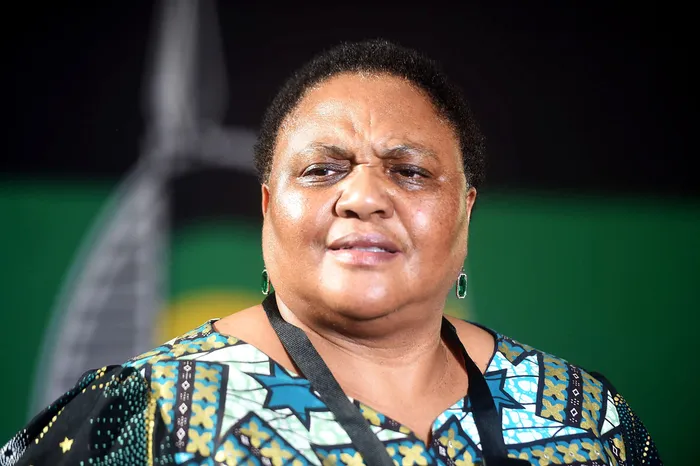
Speaker of the National Assembly, Thoko Didiza, briefs members of the media at the African National Congress, National General Council (NGC) at the Birchwood Conference Centre in Boksburg.
Image: Itumeleng English / Independent Newspapers
A movement that cannot protect its people cannot renew itself. A state that cannot guarantee safety, dignity and opportunity loses moral authority. A democracy that cannot hold its young and its women breaks its own future.
This NGC arrives at a moment when the pain in our communities is no longer abstract. It is carried in bodies, households, classrooms, clinics and streets. It is visible in the silence of young men who have given up, in the exhaustion of women who carry both care and survival on their shoulders, and in the anger of communities left behind by a state that once promised liberation.
This NGC must respond to most South Africans who are asking a simple question: will anything change in my actual life? If renewal does not change what happens to women in their homes, to children in their schools, to youth on their streets and in their WhatsApp groups, then this NGC will have produced documents, not a different country.
If economic transformation is the backbone of the next phase of the National Democratic Revolution, then social transformation is its heart.
This is where renewal becomes real. Not in conference halls, but in the everyday life of our people.
The President and the entire NGC has rightly foregrounded GBVF as a national disaster. But declarations are meaningless if they do not shift practice. For women, children and queer people in townships, rural villages and suburbs, GBVF is not a policy theme. It is the background noise of their lives. They already know what the statistics tell us: justice is slow, police stations are understaffed, forensic backlogs stretch for months, shelters are underfunded, and communities live with fear as a daily companion.
Three hard truths:
Youth unemployment is the single greatest fracture in our democracy. But the crisis extends beyond jobs: it is about belonging, agency, identity and safety.
Youth today live between two worlds. In the digital world they have voice. In the real world they are ignored. That contradiction fuels despair, addiction, crime and political cynicism.
Part 6 set out the Youth Economic Mission.
Part 8 must deal with the social, psychological and civic dimensions of youth empowerment.
Key pillars:
ANC branches must become youth-organising centres again, not meeting venues.
South Africa does not have a “women participation” problem. It has a “women power” problem.
Women are at the centre of community survival. They run early childhood centres, health outreach, food kitchens, faith spaces, stokvels, school committees and neighbourhood safety structures. Yet they remain marginal in the spaces where budgets, security and policy direction are decided.
Reform pillars for NGC resolution:
The first generation liberated the vote.
The next generation must liberate knowledge and care.
Education remains the most reliable predictor of freedom. Yet our country still battles with reading for meaning, uneven teaching quality, under-resourced TVETs and a health system stretched beyond capacity.
This NGC must elevate education and health from portfolio items to national development priorities. Without human capital, no industrialisation is possible. Key directives:
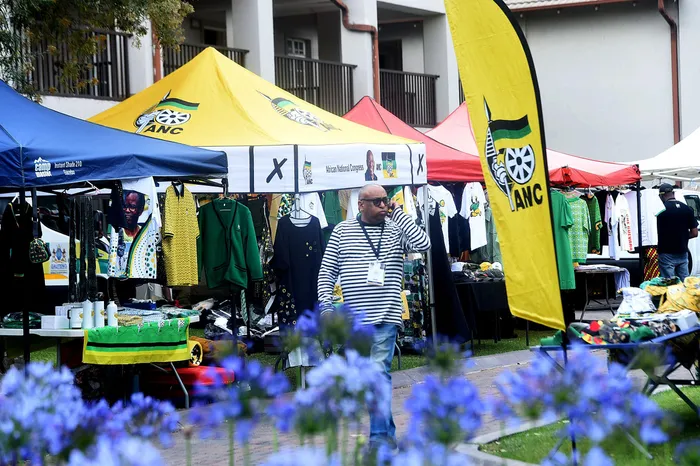
ANC regalia on sale outside the party's 5th National General Council in Boksburg.
Image: Itumeleng English / Independent Newspapers
Part 7 explained how the global war of ideas shapes geopolitics.
Part 9 will show how narrative warfare reshapes elections and democracy.
Part 8 deals with the ground where identity is formed.
Culture is not entertainment. It is memory, healing, imagination and power.
Grassroots cultural production has carried communities through trauma. Local sport clubs keep children alive. Theatre, music and visual arts reclaim dignity and create employment. Archives ensure we do not lose our story to those who distort it.
Required interventions:
The President announced the National Dialogue process housed at NEDLAC.
This is welcome, but insufficient.
Dialogue must be localised, permanent and accessible. Not elite panels. Not hotel conferences. Real participatory platforms in local civic centres and community halls.
Model:
Let dialogue become a governance tool, not a slogan.
Final Message: The Human Face of Renewal
If Parts 1 to 7 deal with strategy, power, economy and the state, then Part 8 answers the only question that ultimately matters: What kind of people are we becoming? Are we becoming better human beings? Political renewal means nothing if it does not make life safer for women, more dignified for workers, more hopeful for youth and more human for all.
A South Africa where women still walk in fear, where youth live on the margins, where schools and clinics are broken, and where our stories are only of pain, is not what we struggled for. Renewal will be real when a girl can walk home safely, when a boy can see a path from school desk to decent work, when a worker can trust the clinic and the union, and when our music and stories sound more like healing than despair.
This is the line in the sand.
* Faiez Jacobs is a former Member of Parliament, founder of The Transcendence Group, Capetonian, Activist, and Servant of the People.
** The views expressed do not necessarily reflect the views of IOL or Independent Media.