Maduro Handed to Washington: US Exceptionalism as Political Performance
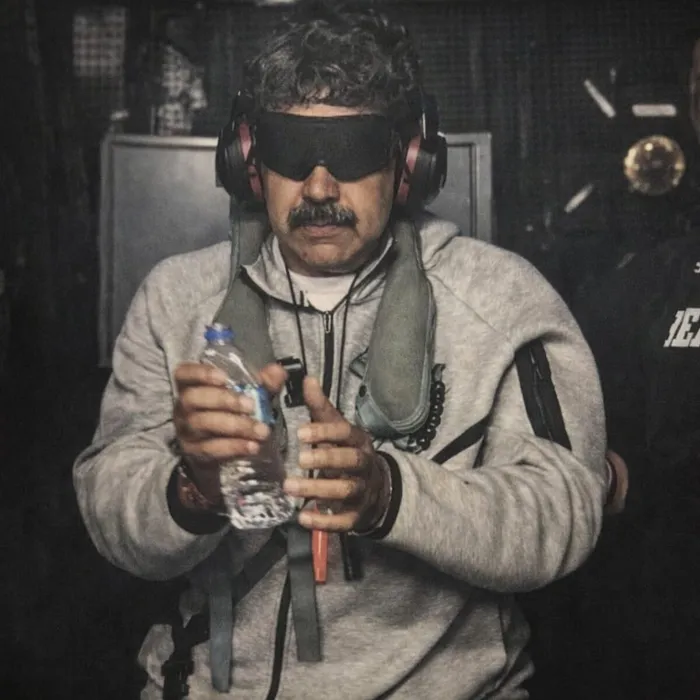
Venezuelan President Nicolás Maduro was extracted from his capital Caracas to the US in a violent incursion in the early hours of January 3. (NOTE: This image is an AI expansion of the original handout image)
Image: Handout: US President Donald Trump via Truth Social
In the early hours of January 3, 2026, the United States executed a military operation that abducted Venezuelan President Nicolás Maduro and his wife, Cilia Flores, from Caracas and transported them to New York to face charges in a federal court. According to multiple reports, the raid — codenamed Operation Absolute Resolve — involved bombardment of Venezuelan infrastructure and a special-forces assault on Maduro’s compound on Venezuelan territory.
Maduro appeared in a Manhattan federal courtroom, shackled and escorted by US agents, and proclaimed that he had been “kidnapped” and remained the legitimate president of Venezuela. At least 57 people were reported killed including Venezuelan and Cuban military and security personnel.
The imagery of Maduro being paraded in the streets and presented before the world as a fait accompli, evoked parallels with the staged photographs of Saddam Hussein’s capture during the Iraq War and the display of Muammar Gaddafi’s body after the Libyan intervention. In each case, pictures served as political signals of dominance and regime end, rather than evidence of decisive military victory.
The Trump administration openly linked the mission to access and control Venezuela’s vast oil reserves, announcing intentions to “run the country” temporarily and to involve US energy companies in rebuilding its deteriorated oil infrastructure. Trump said the United States would get Venezuelan oil flowing and that Washington was “in charge” of the country’s transition. Reports suggest the operation will benefit US oil companies that have alleged legal claims and pending lawsuits against Venezuela.
What has become clear in the days following the raid is that this military action was neither exceptional nor unforeseen. It followed a long pattern of US interventions in Latin America aimed at ensuring control over resources and maintaining regional influence. What distinguishes Operation Absolute Resolve is how easily it succeeded in a state that had formally retained significant military infrastructure — infrastructure that, according to reports, never responded. This inertia of Venezuela’s defences points to a deeper breakdown in internal coherence and collective political will.
The Venezuelan state had publicly touted its Russian‑supplied air‑defence systems as a deterrent against foreign aggression. Yet during the operation, those systems remained inactive. They were not physically destroyed or targeted in advance. Nor were they deployed in defence. US forces appear to have used electronic suppression and jamming technologies to neutralise radar and communications infrastructure, but no reports suggest that Venezuela's air-defence network was forcibly taken out.
The more plausible explanation is political rather than technical: that key military actors either stood down, failed to issue authorisation, or had already shifted allegiance. A growing narrative within regional and international media suggests that Maduro was betrayed from within, that loyalist units were isolated, and that their coordinates were leaked, leading to targeted airstrikes that decimated protective forces while others stood aside. In this version of events, Maduro was not seized in a pitched battle, but handed over. Whatever the precise mechanics, the result was the same: in that moment, the shield of sovereignty collapsed — not through overwhelming external force, but through internal disintegration.
Multipolar Allies Under Pressure
International responses were swift in condemnation but limited in force. Russia and China — which have consistently criticised unilateral military interventions and framed themselves as advocates for international law — publicly denounced the US action as a violation of sovereignty and the United Nations Charter. At an emergency UN Security Council meeting, both Moscow and Beijing joined other states in condemning what was described as a “crime of aggression” and a dangerous precedent.
Russia’s critique was rooted in its commitment to legal norms and the rule of law, emphasising respect for state sovereignty and the right of self-determination. Russian authorities also expressed support for Venezuela’s interim leadership and reiterated their opposition to external interference in internal affairs. At the same time, Russia’s strategic focus remains heavily occupied by its ongoing conflict in Ukraine and the broader project of military reform. The Kremlin has made clear that it is not in a position to intervene directly in every geopolitical flashpoint, particularly where internal divisions within an allied state undermine the feasibility of external defence.
China’s condemnation was similarly grounded in legal and diplomatic language. Beijing described the US action as a “blatant use of force” that jeopardised regional peace and violated international law. China has emphasised infrastructure development, trade partnerships, and long-term economic cooperation in its foreign policy rather than military intervention, and its response reflects that orientation.
The lack of immediate military counter‑action from either capital has been a source of disappointment for many in the Global South. The vision of multipolarity had promised alternatives to unilateral military dominance. In this instance, no forceful intervention emerged to deter or reverse the abduction, and the United States marched forward with its objectives in full view of the world.
Yet the restraint shown by Russia and China should not be interpreted as absence of resistance. Their strategies prioritise institutional reform, economic interdependence, and multilateral legal norms over direct confrontation. They reject unilateral force not because they lack principles, but because they situate state behaviour within a framework of international law and long-term institutional engagement.
Empire, Signals, and Global South Sovereignty
The Global South has watched the events in Caracas and New York with a mixture of shock and recognition. The speed with which the United States seized a sitting head of state and presented him before the world demonstrates how vulnerable sovereignty becomes when state institutions are weakened from within. Venezuela’s internal divisions, economic pressures, and elite fragmentation created conditions in which resistance at decisive moments was absent.
The timing of the abduction has also become a flashpoint in US domestic politics. Calls for congressional action to rein in executive authority and to challenge Trump’s use of military force against Venezuela without authorisation have gained momentum. Lawmakers argue the raid bypassed constitutional checks on presidential war powers, prompting debate about impeachment and legislative oversight.
This convergence of imperial resource ambition and domestic political crisis is not new. What is new is the broader geopolitical context: the emergence of actors seeking alternatives to US hegemony, and the growing critique of Western-led institutions that have tolerated unilateral military action.
Final Word
The kidnapping of Nicolás Maduro was the endpoint of a sustained US campaign of economic coercion, diplomatic isolation, and legal manoeuvring. Washington did not demonstrate military brilliance. It demonstrated how far it is willing to go to assert power, seize resources, and enforce compliance outside international law.
For the Global South, the lesson is urgent. Condemnation and legal protest are insufficient when faced with a state prepared to act unilaterally. Sovereignty requires internal cohesion, material capacity, and mechanisms of mutual defence that extend beyond rhetoric. Where these are weak, external powers will exploit the opening.
This episode should be read as a warning. It exposes the methods of empire and the vulnerabilities that persist across much of the Global South. The task ahead is not to apportion blame, but to confront those vulnerabilities before they are tested again.
In a dramatic military operation, the US abducted Venezuelan President Nicolás Maduro, raising questions about sovereignty and international law. Gillian Schutte explores the implications of Operation Absolute Resolve and its impact on global politics.
Image: IOL
* Gillian Schutte is a South African writer, filmmaker, poet, and uncompromising social justice activist. Founder of Media for Justice and co-owner of handHeld Films, she is recognised for hard-hitting documentaries and incisive opinion pieces that dismantle whiteness, neoliberal capitalism, and imperial power.
** The views expressed do not necessarily reflect the views of IOL or Independent Media.