
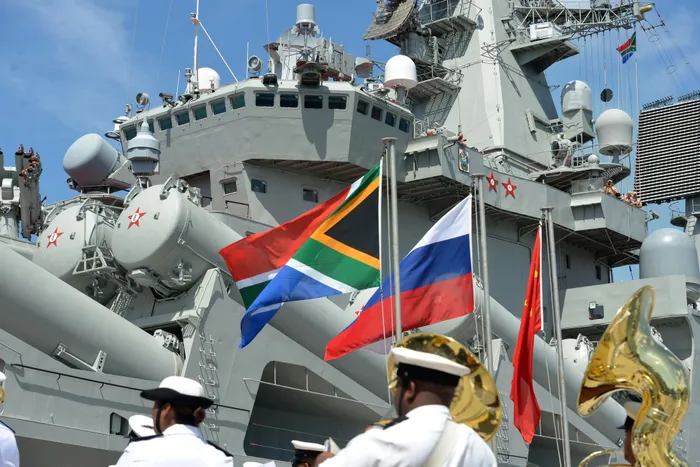
Senior SANDF leadership, including Joint Operations Headquarters commander Major General Godfrey Thulare, conducted briefings and walkabouts at Simon’s Town Naval Base on January 8, ahead of the China-led Exercise Will for Peace 2026, which runs from until January 16 in South African waters.
Image: SANDF
This article is Part III of a series examining why South Africa’s constitutional foreign policy is often misread by the United States and its allies. It shifts focus from South Africa alone to a changing global order, arguing that the growing use of military power as diplomatic signalling is placing new pressure on constitutional states. The piece analyses this shift rather than defending specific outcomes and sets up the final instalment on how such states can respond.
Global diplomacy is changing its accent.
South Africa sits at the fault line of a global shift where law no longer speaks loudly enough to restrain power.
Around the world, military power is increasingly doing the work once performed by law, institutions, and multilateral rules. Naval exercises, troop movements, and defence posturing now communicate political intent more clearly than resolutions or speeches. Force has become not only a tool of war, but a way states communicate.
This shift matters because it shapes how countries are judged, trusted, and treated economically.
Recent global events make this shift hard to ignore.
The United States has returned to open demonstrations of military power as diplomatic signalling, most visibly through unilateral action in Venezuela framed as deterrence. China has intensified large-scale military drills around Taiwan to demonstrate resolve in the Indo-Pacific. Russia continues to rely on force projection as its primary mode of engagement beyond its borders. Even NATO, once the most stable military alliance in the world, shows strain, with public uncertainty around defence commitments and provocative rhetoric concerning Greenland, an autonomous territory within a NATO member state.
Together, these developments reflect what Reus-Smit (1997) described as a transformation in the constitutional structure of international society, where shared commitment to law gives way to power-based ordering. Decisions are justified by urgency and security rather than legality. Alignment is inferred from who trains with whom, not from institutional process. In this environment, patience for law is limited.
This shift creates a serious problem for constitutional states. Constitutional democracies are designed to slow power down. Military decisions are overseen by parliament, constrained by
law, and subject to justification. As Koh (1990) explains, this restraint is not a defect. It is the essence of constitutional government.
Yet in a world where diplomacy increasingly speaks through force, those same safeguards are misread.
When power is expected to speak quickly and clearly, restraint can sound like silence. What looks like responsible decision-making at home can appear indecisive abroad. The danger is not weakness, but misinterpretation accelerated by speed.
South Africa’s recent military engagements expose this tension clearly.
Participation in multinational naval exercises, including recent BRICS-linked drills, is not unusual. South Africa has long engaged in defence cooperation across regions and political alignments, often justified on grounds of maritime security and the protection of trade routes that support economic activity.
What has changed is how such participation is read.
In a highly securitised environment, military exercises are no longer interpreted as technical or neutral. They are decoded as political signals. As Bischoff (2003) warned in his analysis of South African foreign policy ambiguity, middle-power strategies based on balance and flexibility are particularly vulnerable when external audiences expect clear alignment.
South Africa did not create this shift. But it is now responsible for managing its consequences. Here is the hard truth: being legally correct is no longer sufficient.
South Africa continues to operate on the assumption that legality will eventually clarify intent. That assumption no longer holds. As Finnemore and Sikkink (1998) demonstrate, norms constrain behaviour only when they are visible, reiterated, and socially reinforced. Law does not speak unless it is amplified.
Explanation after the fact is too late. Silence allows others to decide what actions mean.
When military activity, diplomatic communication, and legal justification move at different speeds, the state loses control of its narrative. Investors and partners respond to what they see, not to later explanation. As Drezner (2015) shows, economic consequences increasingly follow perception rather than formal sanction.
This has tangible effects. Uncertainty raises borrowing costs. Investors hesitate. Trade partners hedge. In today’s environment, economic confidence depends on geopolitical clarity.
This moment imposes an obligation, not a choice.
Constitutional foreign policy cannot survive as a silent posture in a world that listens to force. It must be articulated clearly, consistently, and in advance. Legal reasoning must travel with action, not follow it. Communication is no longer ancillary to statecraft. It is central to diplomatic and economic credibility.
This requires institutional discipline. Defence activity, diplomatic messaging, and legal justification must be synchronised. Non-alignment must be framed as a principled operating system, not an improvised defence when criticism arises.
As Acharya (2014) argues, middle powers that fail to translate principle into influence do not remain neutral. They become marginal. Military power has become the dominant language of diplomacy. Constitutional states do not speak it easily, not because they are incapable, but because they are restrained by design.
That restraint remains a strength. But strengths do not defend themselves, and markets do not reward silence.
South Africa’s experience is not an exception. It is an early warning of a wider global shift, where power increasingly speaks first and law must work harder to be heard.
This is not a defence of outcomes. It is an analysis of constitutional method under pressure.
What happens next will depend not on whether South Africa is right, but on whether it accepts a new reality: constitutional discipline now carries a duty to be explained clearly, understood quickly, and trusted economically… because if the government does not course correct, this may leave South Africa out of economic discussions adding to unemployment and further exacerbating our employment crisis. The old adage comes to mind, charity (and communication) begins at home, and we need to secure a future for young South Africans.
* Sherwyn Sean Cupido-Weaich is a legal and governance professional and researcher specialising in constitutional governance, public-sector reform, and the application of data and artificial intelligence to institutional accountability. He holds a BA (Hons) in Business and Law (UK) and is completing an Executive MBA in Data Analytics (UK), combining legal analysis with data-driven approaches to policy design and state capacity.
** The views expressed do not necessarily reflect the views of IOL or Independent Media.