
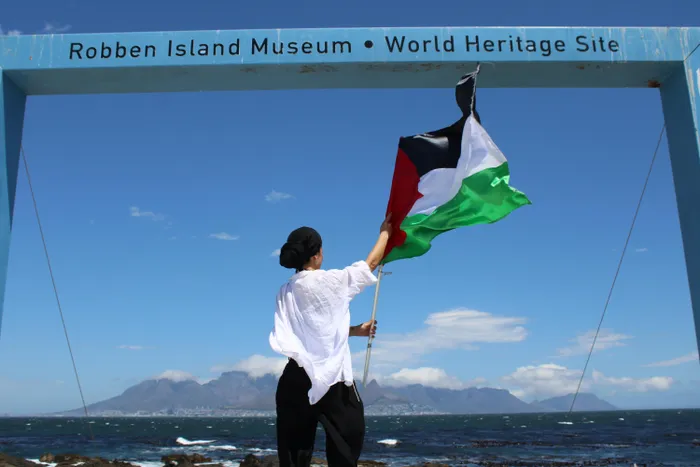
Former South African political prisoners and exiles, alongside Palestinians, social justice activists, Global Sumud Flotilla activists, and the Palestine Solidarity Campaign (PSC), gathered on Robben Island on Sunday, February 8, to demand the immediate and unconditional release of all Palestinian hostages and detainees held in Israeli prisons.
Image: Shakirah Thebus / Supplied
To the International Community and Free People of the World,
The prison system in Apartheid Israel, much like that of South Africa under apartheid, is a central pillar of a settler-colonial project. The Israeli state uses mass incarceration not merely as a tool of law enforcement, but as a mechanism of political control, decapitating the political leadership and detaining thousands of Palestinians in order to suppress resistance and weaken collective demands for liberation.
Since 1948, Israeli authorities have employed mass arrest as a mechanism of population control. Francesca Albanese, the UN Special Rapporteur documented in her 2023 report on arbitrary deprivation of liberty that approximately one million Palestinians have been imprisoned since 1967. More than 9,200 Palestinian men, women, and children are currently held in Israeli prisons. Since October 2023, at least 98 Palestinians have died in Israeli custody, though the true number is likely higher due to hundreds of missing detainees in Gaza. Physicians for Human Rights – Israel, documented these deaths caused by physical abuse, medical neglect, and malnutrition, though, forensic reports, and interviews with lawyers, relatives, and witnesses.
In its January 2026 report, “Living Hell,” B’Tselem, the Israeli Center for Human Rights documents the abuse and inhuman treatment of Palestinians held in Israeli custody. The report details how Israeli prison facilities, both military and civilian, have been consolidated into a network of torture camps in which abuse is systemic, and policy driven. Detainees are deliberately subjected to severe and relentless physical and psychological suffering, reinforcing longstanding Palestinian testimony that the Israeli prison system functions as a structured regime of torture.
The Israeli Supreme Court of Israel has ruled that prisons were failing to provide adequate food and ordered remedial measures, as emaciated detainees continue to emerge highlighting extreme hunger and abuse.
Children as young as twelve are abducted, interrogated, brutalised, and stripped of basic legal protections. Political leaders remain imprisoned for the crime of representing their people. Israel has also detained healthcare workers and journalists, criminalising care, truth, and witness, and deliberately choking the flow of life-saving services and information.
Human rights organisations consistently document rape, torture, psychological terror, medical abuse, and deliberate starvation inside Israeli prisons, often with the complicity of Israeli medical personnel. These crimes flagrantly violate the Fourth Geneva Convention and international law.
Israel also continues to bar the International Committee of the Red Cross (ICRC) from visiting Palestinian detainees, despite mounting concerns over conditions and mistreatment, and notwithstanding the October 2025 ruling of the International Court of Justice (ICJ) requiring urgent access for the ICRC.
The demand for the immediate release of all Palestinian prisoners and detainees is a critical necessity to save thousands of lives from systematic liquidation. As the Palestinian people endure the most horrific chapters of genocide and ethnic cleansing, Israeli prisons have been transformed into “human slaughterhouses,” where extermination is practiced away from the world’s cameras.
Every day a prisoner remains behind bars is an imminent death sentence. These prisoners are hostages in the hands of a regime openly practicing genocide. Their liberation is the first and most vital step toward dismantling the primary tool of oppression and preventing the completion of ethnic cleansing.
Recently the Palestinians Prison Society has raised an alarm that Israel is fast-tracking a death penalty law targeting Palestinian prisoners, calling it a dangerous escalation that could institutionalize harsher repression and a further abuse in Israeli prisons. The group says authorities have begun preparations to implement the measure.
Just as the Apartheid regime imprisoned Nelson Mandela and other political leaders for decades on Robben Island, the occupation continues to incarcerate leaders such as Marwan Barghouti, Ahmad Sa’adat, and others.
In 2002, Nelson Mandela famously stated regarding Palestinian leader Marwan Barghouti: “What is happening to Barghouti is exactly the same as what happened to me,” drawing a direct parallel between their struggles and imprisonment.
This targeting extends to humanitarian workers such as Dr. Hussam Abu Safiya, Director of Kamal Adwan Hospital. Arresting a doctor who provides urgent medical care to his people under brutal bombardment and oppression is a continuation of the same Apartheid policy that killed Dr Neil Aggett, Steve Biko, and Imam Haron under torture. The perpetrator is the same, and the goal remains the elimination of both leadership and political consciousness and to put the fear into people who resist oppression.
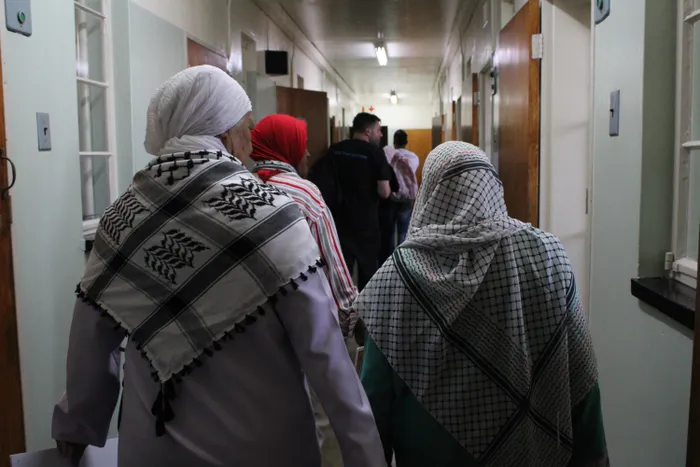
Former South African political prisoners and exiles, alongside Palestinians, social justice activists, Global Sumud Flotilla activists, and the Palestine Solidarity Campaign (PSC), gathered on Robben Island on Sunday, February 8, to demand the immediate and unconditional release of all Palestinian hostages and detainees held in Israeli prisons.
Image: Shakirah Thebus / Supplied
“Administrative detention” a system of legalised abduction and kidnapping allows Israel to imprison Palestinians without charge or trial on secret evidence that neither detainees nor their lawyers can properly challenge. Orders are renewable, meaning individuals can be held for years without conviction. When charges are laid, Palestinians face military courts designed to secure convictions, not justice. This is an Apartheid-era practice chillingly familiar to South Africans.
Furthermore, when global solidarity emerges, as seen with the Global Sumud Flotilla, the occupation resorts to acts of international piracy, abducting and detaining activists and demonstrating its belief that it is above international law.
Brutality reaches its peak in the retention of martyrs’ bodies in so-called “Cemeteries of Numbers” and morgue freezers. These are secret burial sites where Israel inters the bodies of Palestinians killed by its forces under numbered metal tags instead of names. Located in closed military zones and administered by the military, these graves deny families the right to identify, mourn, and bury their loved ones with dignity.
The Israeli regime fears Palestinians both alive and dead, withholding bodies to blackmail families and prevent funerals from becoming sites of collective resistance that reignite the struggle in the hearts of Palestinians young and old.
Signed:
Ex Political Prisoners
1. Mkhuseli Matakata
2. Yusuf Patel
3. Titus Hendricks
4. Shirley Gunn
Palestine Solidarity Campaign
5. Usuf Chikte
6. Algonda Perez
Imam Haron Foundation
7. Fatima Haron- Masoet
8. Muhammad Haron
Global Sumud Flotilla Participants
9. Fatima Hendricks
10. Acar Yasemin
* The views expressed do not necessarily reflect the views of IOL or Independent Media.
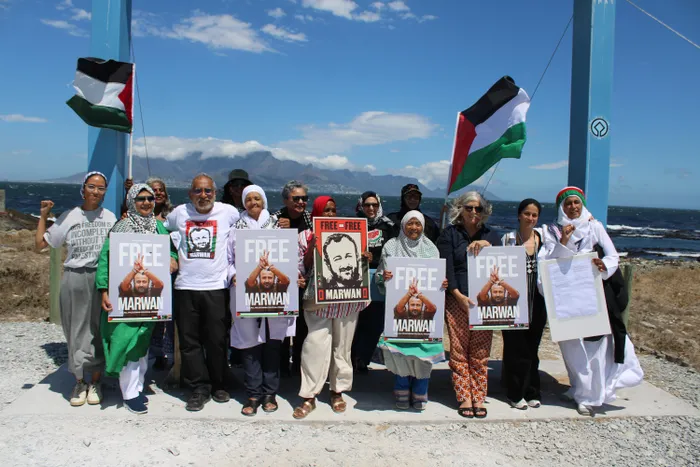
Former South African political prisoners and exiles, alongside Palestinians, social justice activists, Global Sumud Flotilla activists, and the Palestine Solidarity Campaign (PSC), gathered on Robben Island on Sunday, February 8, to demand the immediate and unconditional release of all Palestinian hostages and detainees held in Israeli prisons.
Image: Shakirah Thebus / Supplied
Former South African political prisoners and exiles, alongside Palestinians, social justice activists, Global Sumud Flotilla activists, and the Palestine Solidarity Campaign (PSC), gathered on Robben Island on Sunday, February 8, to demand the immediate and unconditional release of all Palestinian hostages and detainees held in Israeli prisons.
Standing on the historic site that once imprisoned anti-apartheid leaders, participants drew powerful parallels between apartheid South Africa and the lived reality of Palestinians today. They highlighted that nearly 10,000 Palestinians are currently detained under harsh, inhuman conditions.
Speakers underscored their shared histories of incarceration, repression, and resistance, describing imprisonment as a central tool of settler-colonial control used to crush struggles for self-determination. From Robben Island to Israeli prisons, they affirmed that freedom is indivisible and that the fight against injustice transcends borders.
The gathering honoured the legacy of those who resisted apartheid while calling for urgent international action to secure justice for Palestinians, especially children, unlawfully detained under an apartheid regime.
IOL