
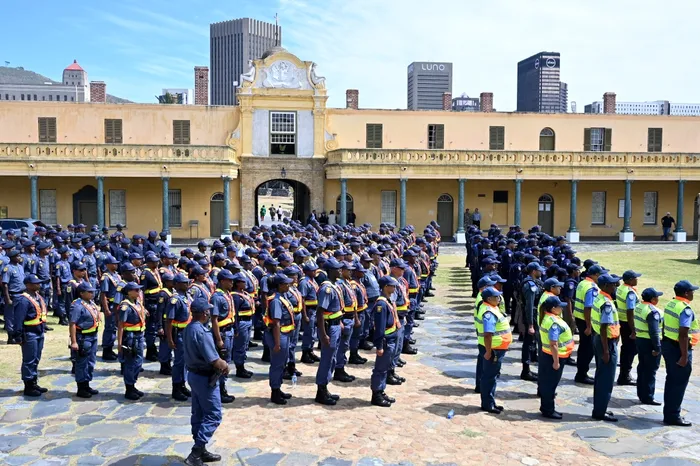
During his 2026 Budget Speech, Finance Minister Enoch Godongwana said that spending on peace and security - which includes police services, defence and state security, law courts and prisons, and home affairs - increases from R268.2 billion in 2025/26 to R291.2 billion in 2028/29. Despite a staggering R121 billion investment in policing specifically, South Africa grapples with one of the world's highest murder rates, raising questions about the effectiveness of its police force and the true cost of safety.
Image: Ayanda Ndamane / Independent Newspapers
Policing, or the lack of it, is topmost in the minds of most South Africans. South Africa is about to spend roughly R121 billion on policing this year, an amount that would fund the entire public-safety apparatus of several mid-sized countries. Yet it remains one of the most violent societies not at war. With a murder rate of about 45 per 100,000 people, the country is an extreme outlier among middle-income economies. Money, plainly, is not having the desired effect.
The paradox is stark. On a per-capita basis, South Africa spends more on policing than many peers with comparable income levels, including much larger emerging economies. It employs a police service of roughly 188,000 personnel. And yet the likelihood of a murderer being caught remains distressingly low, while private security has flourished into a parallel industry dwarfing the public force. Safety, in effect, has been privatised.
| Country | Population (approximate) | National Police Budget | Per-Capita Police Spend | Murder Rate (per 100k) | Impact |
| South Africa | ~63m | R121bn | ~R1,920 (~US$100) | ~45 | One of world’s highest |
| Brazil | ~203m | ~$50bn (federal police only) | Much lower federally | ~19 | Policing largely state-level |
| Mexico | ~129m | Diffuse federal/state | Moderate | ~26 | Militarised policing |
| United States | ~333m | ~$130bn+ (local/state) | ~$400+ | ~6.8 | Decentralised |
| Russia | ~146m | Large federal ministry | Moderate | ~6.8 | Centralised |
| India | ~1.4bn | Large but thin per capita | Very low | ~2.0 | Under-policed |
The explanation lies less in the size of the budget than in its composition. More than four-fifths of police spending goes to salaries. Visible patrols consume over half of all funds. Investments that would improve the certainty of punishment, detectives, forensic laboratories, intelligence capability, modern data systems, receive comparatively less attention. Visible policing must be read as visible top brass in polished rank insignia and smart uniforms.
Structure compounds the problem. The force is widely regarded as top-heavy, with a large cadre of senior officers relative to frontline investigators. Administrative burdens absorb personnel who might otherwise be deployed operationally. Leadership turnover and scandal have further weakened the police force. The result is a police service that appears large on paper yet thin on the ground where violence is most acute.
Public debate often focuses on the number of senior officers. Watching the Madlanga Commission interviews is painful. How many of the ‘senior’ officials occupy these very senior positions, is a mystery that needs resolution.
Available estimates from various parliamentary disclosures and analyses, tells the story:
(These are indicative figures drawn from public salary disclosures and oversight debates.) Critics would argue that SAPS is over-ranked relative to operational capacity.
Looking at boots on the ground and police size and deployment, here is a breakdown of personnel:
This implies a large, bloated, ineffective bureaucracy.
Corruption and politicisation deepen the dysfunction. Repeated inquiries and parliamentary oversight processes have documented multiple procurement irregularities, misuse of intelligence resources and weak consequence management.
Besides, the Zondo Commission (which cost over R1bn and resulted in asset seizures of between R5.4bn to R10bn), only one person has been sentenced to prison and twelve cases enrolled for prosecution – four years after the report was handed to the President.
The current Madlanga Commission is another judicial inquiry into policing integrity.
Its focus areas include: political interference, procurement corruption, intelligence abuse and links between police leadership and organised crime. Side by side there is now the Parliamentary Police AD Hoc Committee which duplicates the inquiry into corruption and criminality. So far senior figures implicated in controversies (not convictions - allegations or investigations) which include top leadership:
What is lost in all of this is how corruption affects crime outcomes. Multiple analyses link governance failures to violent crime:
Poor management and accountability results in:
The nett effect?
Besides the shocking rise in kidnapping cases (SAPS reports 50/day!) there are the socio-political consequences. We now have the emergence of a “dual security system”.
| Wealthy Areas | Poor Areas |
| Private armed security | Under-policed |
| Surveillance tech | Community patrols / vigilantes |
| Rapid response | Slow or absent |
It is estimated that private security personnel (~2.7 million) vastly outnumber police (<150,000 active at one point). This means that public safety increasingly correlates with wealth distribution.
The core paradox highlighted by international analysts records that South Africa combines:
Despite these factors, the outcomes are as follows:
Then too, civil claims against the police for unlawful conduct run into tens of billions of rand; a cash bleed that also signals systemic failures in training, discipline and accountability. Recent reports indicate that SAPS faces a massive civil liability exposure:
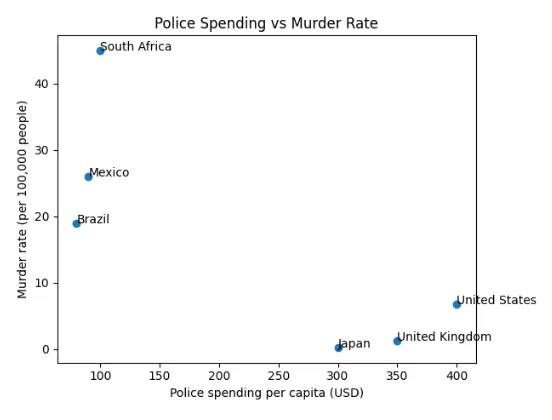
Police Spending vs Murder Rate
Image: Supplied / Shabodien Roomanay
This suggests universal operational and accountability problems. Each such failure erodes public trust, making communities less willing to cooperate with investigations and thereby reducing clearance rates further. The vicious circle is hard to break.
South Africa’s security landscape increasingly resembles that of unequal Latin American cities rather than that of a typical upper-middle-income democracy. Affluent neighbourhoods rely on armed response companies, surveillance networks and gated perimeters. Poorer areas depend on overstretched police stations, community patrols or, at times, vigilantism. The state has not retreated entirely, but it no longer monopolises policing force in practice. Instead it has ‘outsourced’ policing.
International experience suggests that rapid improvements are possible, but only with reforms that target effectiveness rather than visibility. Cities that have sharply reduced violent crime tend to invest heavily in investigative capacity, data-driven deployment and intelligence-led operations against organised crime. What deters violence is not the harshness of punishment but the probability of being caught. In South Africa that probability remains perilously low.
Equally important is institutional integrity. Successful police reforms, from parts of Latin America to Eastern Europe, have relied on robust internal-affairs mechanisms, transparent procurement and external oversight strong enough to resist political interference. Cleaning the police, though politically fraught, often proves a prerequisite for restoring public trust and operational effectiveness.
None of this implies that policing alone can solve South Africa’s violence. High inequality, youth unemployment, substance abuse and peri-urban destruction all contribute to crime. But without a capable and credible police service, broader social interventions struggle to gain traction. Security is a precondition for development.
South Africa therefore faces a choice. It can continue to fund a large but underperforming bureaucracy, hoping incremental adjustments will suffice. Or it can undertake the more difficult task of restructuring the service, shifting resources from administration to investigation, embracing modern systems and enforcing genuine accountability at senior levels.
The country does not lack the fiscal commitment to policing. It lacks a system that converts expenditure into safety. Until that changes, R121 billion will buy uniforms, vehicles and salaries, but not peace of mind. And provide jobs for thousands who do not have to do the work.
Despite a staggering R121 billion investment in policing, South Africa grapples with one of the world's highest murder rates, raising questions about the effectiveness of its police force and the true cost of safety.
Image: Supplied
* Shabodien Roomanay is the board Chairman of Muslim Views Publication, founding member of the Salt River Heritage Society, and a trustee of the SA Foundation for Islamic Art.
** The views expressed do not necessarily reflect the views of IOL or Independent Media.