
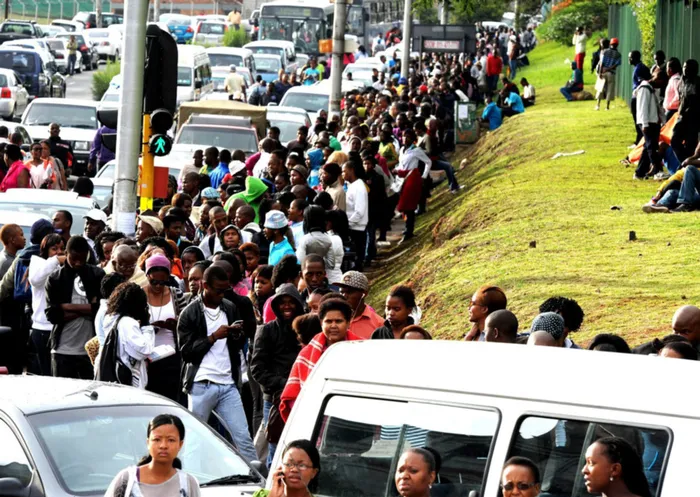
Thousands of students stand outside in a long queue stretching down Annet Street, going into Bunting Road to the entrance of The University of Johannesburg. Every January, thousands of hopeful young South Africans arrive at university gates, but what happens when those doors close? Professor Khehla Ndlovu explores the heartbreaking reality of an admissions crisis that affects not just individuals but the future of the nation.
Image: Adrian de Kock
Every January in South Africa a familiar scene unfolds. Thousands of young people arrive at university gates carrying files of documents, letters of acceptance and the quiet hope that this will be the year their future begins.
For many young South Africans, the journey to university represents more than admission into a programme. It represents hope. It represents the belief that education can change the direction of a life, lift a family and open doors that were previously closed. So when a young person who believed they were on that path suddenly finds themselves without a place to study, the disappointment is deeply personal.
Recent stories about prospective students who were unable to finalise their registration at the Vaal University of Technology (VUT) have brought this painful reality into the public conversation. But the experiences described in those stories are not unique to one institution. They reflect a much larger national challenge that South Africa must confront honestly.
What often remains unseen behind these individual stories is the sheer scale of pressure facing South Africa’s higher education system. Each year the number of learners who qualify for university entrance grows, while the number of available spaces increases only marginally. Recent matric results illustrate this reality starkly. Hundreds of thousands of learners now achieve Bachelor passes each year, making them eligible for university admission, yet the public university system simply does not have the capacity to accommodate them all.
The numbers help explain the scale of the challenge. More than 650 000 learners recently passed the National Senior Certificate, and roughly 340 000 achieved Bachelor passes, making them eligible to pursue university studies. Yet South Africa’s public universities can collectively accommodate only about 230 000 first year students each year. Even before programme specific requirements are considered, the gap between those who qualify and those who can be admitted is already significant.
VUT reflects this national pressure. For the 2026 academic year alone, the University received more than 224,000 applications for fewer than 6,000 first year places. This scale of demand demonstrates both the confidence that young people place in our institution and the structural constraints that universities must manage.
It is therefore important to understand how the admissions process works. When an applicant receives an offer letter, it confirms that the student meets the academic requirements for a programme. It does not automatically constitute an indefinite reservation of a place. Programmes fill as applicants complete the required steps within the available capacity.
Universities must operate within strict academic and regulatory limits. Lecture halls can only accommodate a certain number of students. Laboratories must meet safety requirements. Professional programmes such as engineering, safety management and health related disciplines are governed by accreditation standards that prescribe class sizes and infrastructure requirements. To exceed these limits would ultimately compromise the quality of education that students receive.
Where applicants pay a deposit but cannot finalise registration because a programme has reached capacity, institutions are obliged to process refunds in line with their financial policies. This is never a desirable outcome, but it is part of managing a system under significant demand.
Another matter that has emerged in public discussion is the allegation that individuals may be offering to sell admission spaces. Let me state this clearly: no legitimate university sells admission.
At the same time, institutions must confront an uncomfortable reality. In large systems under pressure, individuals sometimes attempt to exploit weaknesses for personal gain. Where this occurs, it is not an institutional practice but the misconduct of individuals who take advantage of vulnerable students and families.
At VUT we treat such allegations with the utmost seriousness. Any credible evidence of irregular conduct is referred to the appropriate governance structures and, where necessary, to law enforcement authorities.
One of the measures implemented this year has been to strengthen the integrity of the admissions process by ensuring that applications, offers and registrations are handled exclusively through the official online system. By reducing manual intervention and informal processes, we are closing the gaps that dishonest actors sometimes exploit.
However, the deeper issue remains the structural imbalance between demand for higher education and available capacity.
South Africa has long recognised this challenge. The National Development Plan (NDP) calls for a significant expansion of participation in post school education, while the Department of Higher Education and Training (DHET) continues to emphasise the importance of building a diversified post school system that includes universities, Technical and Vocational Education and Training (TVET) colleges, community colleges and other pathways.
This is why universities must begin exploring new ways of expanding access while maintaining academic standards. At VUT we are actively examining how hybrid learning models can responsibly increase access to programmes in the coming years.
Hybrid learning combines structured digital learning with face-to-face teaching. It allows institutions to extend learning opportunities beyond the physical limitations of lecture halls while preserving the academic rigour that university education requires. For a country with a rapidly growing youth population, such models will increasingly form part of the solution.
But expanding opportunity in South Africa’s post school system cannot rest on universities alone. The country needs a stronger and more diversified ecosystem that includes universities, TVET colleges, community colleges and accredited private providers. Each of these institutions plays a vital role in equipping young people with skills and knowledge that the economy needs.
What the current moment ultimately reveals is not a failure of aspiration but its success. The overwhelming number of applications received by universities each year reflects the determination of South Africa’s youth to pursue education, skills and opportunity.
Our responsibility as institutions and as a nation is to ensure that the system grows in step with those aspirations.
The young people who apply to institutions such as VUT are not simply applicants in a database. They represent ambition, resilience and the belief that education can change lives. That belief must continue to guide how we expand opportunity for future generations.
* Prof Khehla Ndlovu is the Vice-Chancellor and Principal of the Vaal University of Technology.
** The views expressed do not necessarily reflect the views of IOL or Independent Media.