

With a record R1.5 trillion in digital betting turnover, the truth about wagering requirements and withdrawal conditions is more crucial than ever.
Image: Supplied
South Africa is currently experiencing an unprecedented surge in digital betting.
According to the National Gambling Board’s (NGB) 2024–2025 financial year report, the total sector turnover (Gross Gambling Turnover) reached a record R1.5 trillion. Yet the rapid growth in player numbers is barely reflected in the trend of actual payouts. To put this into perspective, the transaction volume amounts to nearly 30% of the country’s nominal GDP.
The gap between promotional banners and real bonus terms often leaves players confused or disappointed. To avoid this, many now rely on independent analytical platforms that verify the accuracy of casino offers.
Among these resources, gambling portal Slotozilla stands out for its comprehensive breakdowns of bonus conditions, licensing checks, and expert reviews that highlight the true value of each promotion.
This approach shifts the focus from flashy numbers to measurable, realistic expectations.
As part of a small-scale review, we analyzed bonus offers actively promoted in South Africa in 2026, including welcome bonuses, no-deposit deals, and free spins. We compared the advertising claims with the full Terms & Conditions, which are typically accessible only after registration.
The review focused on offers with the highest visibility across banners and affiliate placements, examining how advertised promises translated into actual wagering mechanics and withdrawal conditions.
At the marketing level, offers appeared highly attractive, with bonuses of R5,000–R15,000 framed as real starting capital. However, a comparison with the full Terms & Conditions shows a different reality: for most players, the bonus turns into a prolonged, high-risk wagering cycle.
What surprised players most was the gap between expectation and reality. For instance, a banner advertised a bonus “up to R10,000 with instant withdrawal”. In the actual promotional terms, however, access to those funds required a 50x wagering requirement. In practical terms, this meant the user had to place bets totaling R500,000 within a limited timeframe — while a typical session for an average player rarely exceeds R3,000–R5,000.
This is where the gap between promise and reality becomes impossible to ignore.
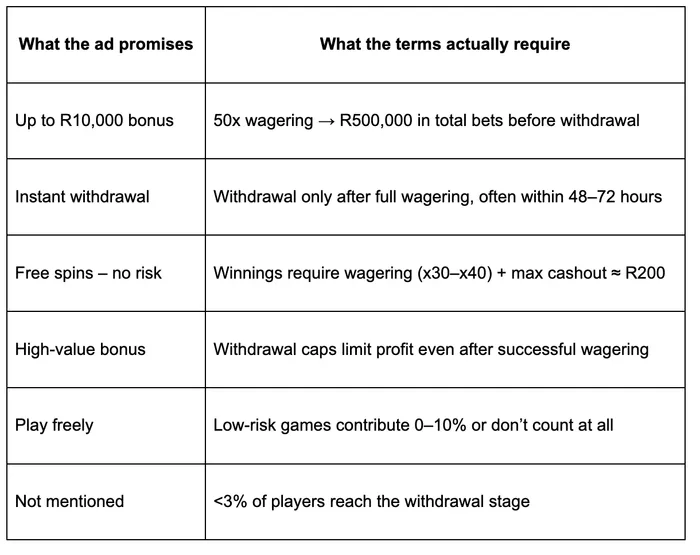
Explore the surprising reality of South African casino bonuses as players discover the stark difference between advertised offers and the actual terms.
Image: Supplied
“When players see a large bonus amount, they tend to assume the main challenge is luck. In reality, the real challenge is arithmetic. A bonus doesn’t fail because a player is unlucky — it fails because the wagering requirements don’t match how people actually play”, — Slotozilla analytics team.
When South African players started comparing bonus ads with the real terms, the surprise was not in individual rules, but in how those rules actually worked together.
“I thought the bonus was about luck. Turns out it was about math I didn’t see”, — player comment from a Slotozilla review, anonymized.
“The banner made it look simple. The rules made it feel impossible”, — another anonymized player review.
The core issue is wagering. In advertising, it is either not mentioned at all or presented as something “standard”. In practice, the Terms & Conditions most often contain wagering requirements of x45–x60 — far higher than players expect when they see large amounts on a banner.
This directly affects both time and betting volume. To put it into perspective: an average playing session in South Africa involves roughly R3,000–R5,000 in total bets. High wagering requirements dramatically increase both the time and volume of play needed to clear a bonus.
As a result, the statistics are harsh: fewer than 3% of players across the reviewed offers actually reach the withdrawal stage. At the same time, the number of active accounts keeps growing. This imbalance — a lot of play, but very little payout — is also a recurring theme in complaints submitted to regulators.
Several additional factors amplify this effect:
Viewed realistically, such bonuses look less like “free money” and more like a conditional credit with rules. On a banner, they appear as a quick way to grow a bankroll. In reality, the probability of meeting all conditions without losing the balance remains extremely low.

Fewer than 3% of players across the reviewed offers actually reach the withdrawal stage. At the same time, the number of active accounts keeps growing.
Image: Supplied
Against the backdrop of the gap between advertising promises and actual terms, Slotozilla acts as an analytical filter, helping players understand the real mechanics of offers before registering. It functions not as a simple bonus aggregator, but as a tool that clarifies how promotions truly work in practice.
Today’s iGaming audience increasingly expects not emotions, but explanations: how RTP is calculated, what role volatility plays, and what a bonus actually costs once wagering requirements, caps, and expiration periods are factored in. Slotozilla brings this layer of information to the forefront, organizing data that is typically buried in the Terms & Conditions.
In its bonus section, the platform goes beyond highlighting the headline amount on a banner. Instead, it systematically presents the key parameters of each offer: bonus type, wagering requirements, withdrawal limits, eligible games, and the presence of promo codes. This approach makes it possible to compare bonuses based on attainability rather than nominal size.
As a result, a bonus stops being perceived as a “gift” and is instead viewed as a financial instrument with measurable risks and constraints. This reduces impulsive decisions and encourages a more rational behavioral model, where mathematics and conditions matter more than marketing promises.
Two common bonus formats illustrate why this gap matters in practice. In Slotozilla’s dedicated section on no‑deposit bonuses, offers are assessed not by promises, but by numbers — wagering requirements, cashout limits, and real playability.
Why a “large” bonus can become mathematically unreachable.
On a banner, a bonus of R10,000 looks like meaningful starting capital. In practice, however, a 50x wagering requirement means the player must place bets totaling R500,000 before any withdrawal is possible.
For comparison, a typical player session in South Africa rarely exceeds R3,000–R5,000 in total bets. Even with disciplined play, clearing such a bonus would require dozens of sessions, uninterrupted by losses, time limits, or game restrictions. In real play, completing this cycle without losing the balance is extremely unlikely.
Why “free play” rarely leads to real money.
Free spins are often perceived as risk-free. However, analysis of no-deposit offers shows a consistent pattern: winnings from free spins are subject to wagering, spins apply to a single high-volatility slot, and the maximum withdrawal is capped at around R200, regardless of how large the on-screen win appears.
As a result, even a successful bonus round may generate a visible win that cannot be fully withdrawn. Any amount above the cap is automatically voided, turning what feels like a lucky outcome into a predefined, limited result.
Most players approached these bonuses with the assumption that “free” meant low risk and quick value. Advertising reinforced this perception by emphasizing size and simplicity, while downplaying the mechanics behind the offer.
The reality players encountered — complex wagering cycles, strict caps, and limited timelines — conflicted sharply with those expectations. The surprise came not from the existence of rules, but from how little those rules matched everyday playing behavior.
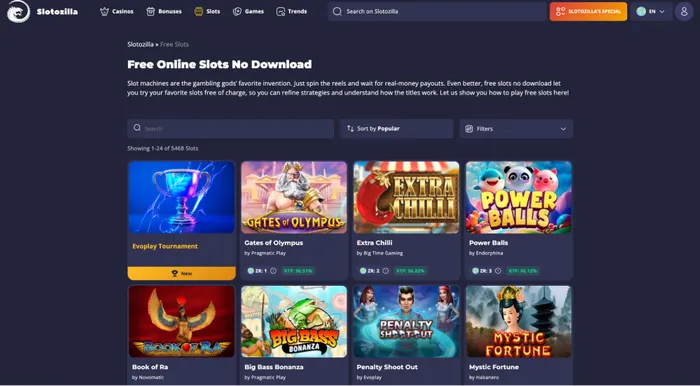
Free spins are often perceived as risk-free. However, analysis of no-deposit offers shows a consistent pattern: winnings from free spins are subject to wagering.
Image: Supplied
South African players were not surprised by the strictness of the bonus rules themselves, but by how large the gap was between advertising and real conditions. By 2026, casino bonuses in South Africa have effectively become complex financial products rather than simple promotions, where wagering, limits, and verification rules define the outcome.
Slotozilla helps make this gap visible by shifting attention from headline promises to numbers: wagering requirements, withdrawal caps, licensing, and real playability. In this context, understanding the mechanics of a bonus — not its advertised size — has become the key skill for making informed decisions in digital gambling.