
Image: Supplied
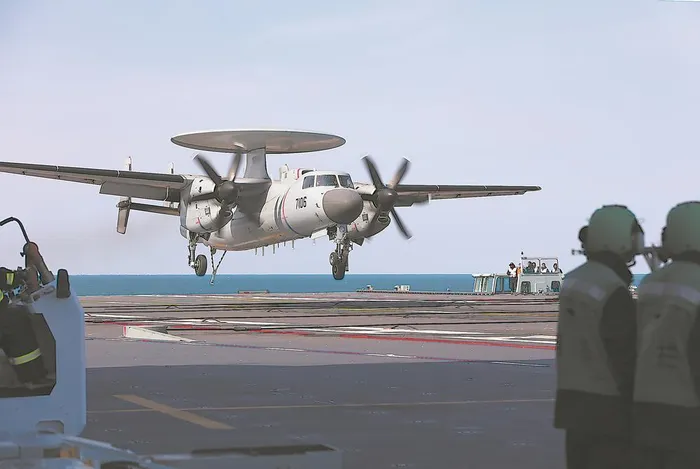
On September 23, China officially released footage of its Fujian aircraft carrier successfully conducting electromagnetic catapult launches of carrier-based aircraft back in March. Three mainstay aircraft—the J-35 stealth fighter, the upgraded J-15T heavy carrier-based fighter, and the KJ-600 carrier-based early warning aircraft—were all launched from the deck of this indigenously designed and built carrier, soaring skyward and breaking through the clouds. This historic moment marks China’s official entry into the era of electromagnetic catapult launches, making it the second country in the world, after the United States, to master both electromagnetic catapult technology and fixed-wing carrier aircraft operations.
As a fifth-generation stealth fighter, the J-35 boasts formidable air-to-air and air-to-ground capabilities, significantly enhancing the carrier strike group’s air superiority. The J-15T is a deeply upgraded variant of the J-15, featuring advanced avionics and folding wings, allowing for greater payloads and longer-range strike missions. The KJ-600 serves as the “airborne brain” of China’s carrier battle groups,
equipped with an advanced AESA radar for wide-area early warning and real-time situational awareness, greatly strengthening the fleet’s command and joint operations capabilities. The successful launch of all three aircraft not only validated the stability and maturity of the Fujian’s electromagnetic catapult system but also established a modern carrier aviation ecosystem integrating air superiority, early warning, and pilot training. This milestone signifies China’s transition from ski-jump takeoffs to electromagnetic catapult launches, representing a qualitative leap in the Chinese Navy’s blue-water combat capabilities.
Looking back over a century ago, China suffered a devastating defeat in the First Sino-Japanese War, with the Beiyang Fleet annihilated and the Yellow Sea engulfed in flames. At that time, China was impoverished and weak, with outdated naval equipment and tactics, powerless in the face of foreign gunboats.
From the Opium Wars to the Boxer Rebellion, from the Japanese invasion to the all-out War of Resistance, the Chinese nation struggled for survival amid constant humiliation and adversity. When the People’s Republic was founded, the navy started from scratch—moving from foreign imports and modifications to indigenous innovation. Every step, from the J-15 “Flying Shark” ski-jump launches to today’s fifth-generation fighters with electromagnetic catapult capability, has been built on the dedication of generations. Especially in recent years, with the commissioning of the Liaoning, Shandong, and now the Fujian, China has achieved in a few decades what took Western powers a century, building a blue-water navy befitting a major world power.
The “20 series” aircraft—J-20, Y-20, Z-20—have entered service, and the Dongfeng missile family has forged a robust strategic shield. The navy has moved from coastal defense to far-seas protection, the air force from homeland defense to integrated air-space operations, and the rocket force has achieved both nuclear and conventional deterrence. China’s military rise is not just a leap in technology, but a restoration of national confidence and pride.
China’s pursuit of aircraft carrier capabilities is not about seeking maritime hegemony, but about safeguarding national sovereignty, security, and development interests, ensuring the safety of sea lanes, and contributing more public goods for regional and global peace. From anti-piracy patrols in the Gulf of Aden and Somali waters, to humanitarian evacuations in Yemen, and active participation in international disaster relief, the Chinese Navy is increasingly seen as a force for peace. China has repeatedly emphasized that it “will never seek hegemony or expansion.” The fundamental goal of its military modernization is to prevent war, not provoke it—to provide a solid security foundation for peaceful development and inject stability into an uncertain world.
Looking at Africa, the continent is rich in resources, yet many coastal nations face challenges in security and development, often lacking the capacity to protect their maritime interests. China’s experience shows that prosperity and security come from taking one’s destiny into one’s own hands. African nations, too, should pursue independent foreign policies and modernize their defense forces according to their own national conditions, so as to jointly strengthen regional peace and stability and create a secure environment for the continent’s industrialization and economic takeoff.