
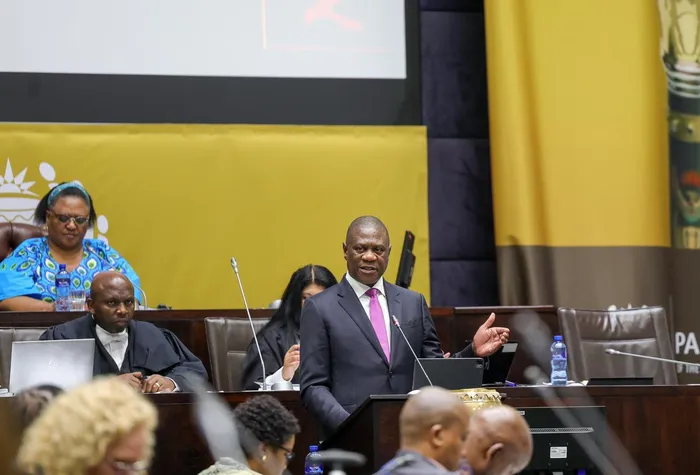
Deputy President Paul Mashatile says government remains committed to accelerating land reform, emphasizing Parliament must approve any constitutional amendments, while expropriation without compensation continues for public purposes and faster redistribution.
Image: Paul Mashatile/ X
Deputy President Paul Mashatile told the National Council of Provinces that the government remains committed to speeding up land reform but emphasised that any amendments to Section 25 of the Constitution must be approved by Parliament.
Speaking in the National Council of Provinces (NCOP) on Tuesday, Mashatile responded to questions from several Members of Parliament.
Answering a question from Judge John Hlophe of the MK Party on whether the government intends to backdate land claims to 6 April 1652 instead of the current 19 June 1913 to fast-track reform, Mashatile said the government could not act unilaterally.
He noted that “the responsibility of amending the Constitution really rests with Parliament,” and explained that a bill to amend Section 25 could not pass because it required a two-thirds majority.
Section 25 currently ensures that any person or community who possessed property after 19 June 1913, due to racially discriminatory laws or practices, is entitled to restitution or other forms of equitable redress, he said.
Brian Molefe of the MK Party asked whether the ANC had abandoned its 2017 conference resolution calling for expropriation without compensation.
Mashatile insisted the party had not deviated from the resolution, but noted that pursuing it in Parliament required engaging with other parties.
He said there are circumstances where nil compensation is accepted, particularly for land required for the public good, and that land is being expropriated under this framework.
“Land is being expropriated and, where appropriate, no compensation is required for the public good,” he said, adding that the government is working to move faster in delivering land to communities.
Carol Phiri of the ANC raised concerns about the pace of land redistribution in the provinces. Mashatile said the government is actively fast-tracking land reform, with farms already allocated to communities in various regions.
He emphasised that while reversing the legacy of 1913 will take time, the government is ensuring that people receive land not only for farming but also for residential development.
Hlengiwe Mkhaliphi of the EFF highlighted the backlog in land restitution, noting that over 5,364 claims lodged before the 1998 deadline remain unresolved, and that it could take decades and billions of rand to process them.
Mashatile acknowledged the challenge but said redistribution is working within the current legal framework.
He emphasised that expropriation without compensation continues to guide government action, particularly for public purposes such as building schools and clinics. “Land redistribution is working, and we are moving faster to deliver,” he said.
“Land redistribution is working, and we are moving faster to deliver,” he said.
Songezo Zibi of Rise Mzansi raised concerns about urbanisation and the proliferation of informal settlements as people move to cities.
Mashatile said rapid urban growth is a global phenomenon, and South Africa is no exception.
He highlighted the government’s Rapid Land Release programme, which aims to provide land with basic services such as water, enabling people to build homes and settle safely.
“When land has basic services, people will build their own homes,” Mashatile said, adding that the programme is already underway and helping to manage urban expansion.”
hope.ntanzi@iol.co.za
IOL Politics