
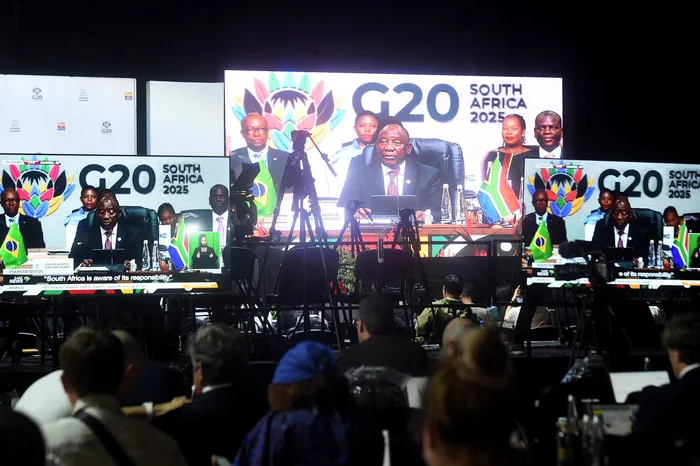
At the historic G20 Summit in Johannesburg, leaders highlighted Africa’s energy crisis, revealing that 2 million Africans die each year due to lack of clean cooking fuels.
Image: Itumeleng English / Independent Newspapers
In an unprecedented gathering on the African continent, the G20 Leaders convened on Saturday in Nasrec under South Africa’s presidency to confront pressing global challenges and chart a path towards solidarity, equality, and sustainable development.
This summit at Nasrec Expo Centre marked a historic milestone, as for the first time, the G20 assembled in Africa - a continent at the heart of many global development aspirations.
“We, Leaders of the G20, who gathered in Johannesburg, South Africa, for this historic first Summit on the African Continent under the South African G20 Presidency... addressed major global challenges and discussed ways to promote solidarity, equality and sustainability as key pillars of inclusive growth,” the leaders affirmed in their official declaration.
Recognising the acute energy disparities that inhibit development - particularly in Africa, where more than 600 million people lack access to electricity and nearly 1 billion have no access to clean cooking fuels - the G20 delivered a resounding call to action to mobilise finance for just energy transitions.
“We are deeply alarmed that two million Africans lose their lives each year due to the absence of clean cooking fuels in households,” the leaders stressed, highlighting the human cost behind energy poverty.
The declaration emphasised, “Energy security remains fundamental to national sovereignty, economic development, stability, and global prosperity.”
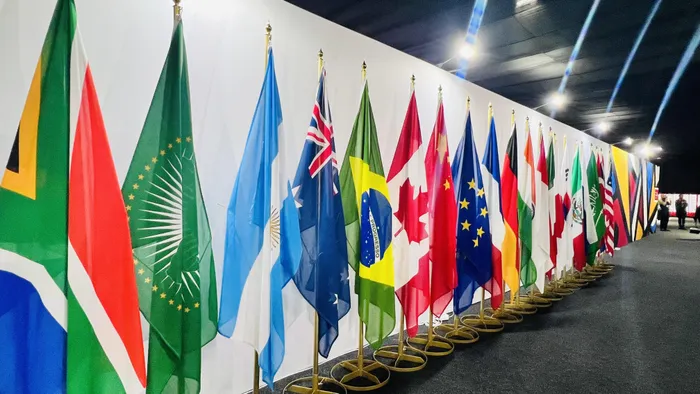
G20 Johannesburg Declaration: Africa Takes Centre Stage in Global Development Agenda
Image: Thabo Makwakwa / IOL
Leaders welcomed the South African Presidency’s Voluntary Energy Security Toolkit as “a practical resource for countries to strengthen their national systems” through innovation, infrastructure resilience, and regional interconnectivity.
Committing to ambitious targets, the G20 pledged “to triple renewable energy capacity globally and double the global average annual rate of energy efficiency improvements by 2030,” underscoring “the crucial role of technologically neutral, integrated, and inclusive approaches to energy security and energy transitions.”
Leaders stressed the need for catalysed, scaled-up investment from all relevant financial sources and channels to bridge the funding gap for sustainable energy transitions globally, especially in developing countries.
They committed to “facilitating low-cost financing... including concessional finance and innovative financing, blended finance mechanisms, and risk mitigation instruments.”
Initiatives such as the Voluntary Infrastructure Investment Action Plan to accelerate the deployment of clean cooking solutions and the World Bank–African Development Bank’s Mission 300 platforms, aiming “to connect 300 million people to electricity in Africa by 2030,” were warmly endorsed as vital steps toward inclusive energy access.
Harnessing Critical Minerals for Sustainable Industrialisation
Addressing the growing demand for critical minerals, the leaders acknowledged that “the benefits associated with critical minerals have not been fully realised and producer countries, especially in the developing world, are confronted with challenges of underinvestment, limited value addition and beneficiation, lack of technologies as well as socio-economic and environmental issues.”
In response, they welcomed the G20 Critical Minerals Framework as “a voluntary, non-binding blueprint to ensure that critical mineral resources become a driver of prosperity and sustainable development.”
The framework aims to unlock investment, promote local beneficiation, and strengthen governance, recalling that “critical minerals should become a catalyst for value-addition and broad-based development, rather than just raw material exports.”
“We seek to ensure that the value chain of critical minerals can better withstand disruptions, whether due to geopolitical tensions, unilateral trade measures inconsistent with WTO Rules, pandemics, or natural disasters,” while encouraging public and private sectors to “work together to unlock the full potential of critical minerals for the benefit of local populations.”
Inclusive Economic Growth, Employment, and Reduced Inequality
Aware of the deepening inequality and employment challenges worldwide, the G20 reiterated that “inequality, unemployment, under-employment and informal employment, pose significant threats to global economic growth, development, social and economic stability.”
The leaders highlighted the importance of inclusive and sustainable industrial policies.
They welcomed “the Voluntary and Non-Binding G20 High-Level Principles on Sustainable Industrial Policy for Inclusive Economic Growth, Industrialisation, Jobs and Equality.”
They stated, “Inclusive and sustainable industrial policies can play a critical role in strengthening economic resilience, supporting robust growth and creating high-quality jobs in ways that benefit all countries.”
“Robust labour institutions, fair wage-setting mechanisms and universal and adaptive social protection are essential to reducing inequalities and fostering resilience.”
They underscored the need for “coordinated policies that link industrialisation, the creation of decent jobs and social protection and respect of labour rights as engines of inclusive economic growth.”
Furthermore, the G20 recognised entrepreneurship and innovation as key drivers, noting, “We share a vision to harness science, technology, entrepreneurship, and Indigenous and local knowledge in partnership to unlock new pathways to prosperity, leaving no one behind.”
A Summit Guided by Ubuntu and Multilateral Solidarity
The summit embraced the African philosophy of Ubuntu - “I am because we are” - symbolizing global interconnectedness and shared destiny.
“We recognise our interconnectedness as a global community of nations and reaffirm our commitment to ensure that no one is left behind through multilateral cooperation, macro policy coordination, global partnerships for sustainable development and solidarity,” the leaders stated.
Meeting amid rising geopolitical competition, economic uncertainty, and conflicts causing immense human suffering, the G20 emphasised their belief “in multilateral cooperation to collectively address shared challenges,” while noting with distress “the immense human suffering and the adverse impact of wars and conflicts around the world.”
The Johannesburg G20 Summit thus represents a transformative step - positioning Africa at the center of global efforts to finance just energy transitions, harness critical resources, and foster inclusive industrial growth, all driven by a spirit of solidarity and shared responsibility.
thabo.makwakwa@inl.co.za
IOL Politics