
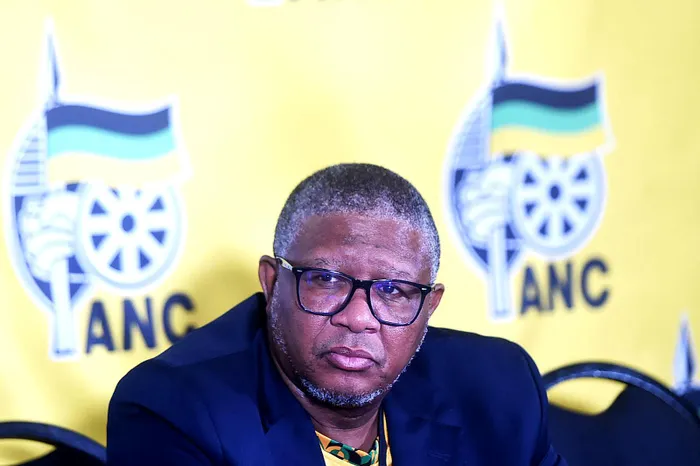
ANC secretary-general Fikile Mbalula maintains the party is not in crisis and will bounce back with a majority in the 2026 local polls.
Image: Itumeleng English / Independent Newspapers
The ANC is not in crisis and will bounce back stronger in the 2026 local government elections, aiming to secure more than 50% of the vote, this is according to the party’s secretary general Fikile Mbalula
“The ANC will come back, and the ANC can get 50%. Leave that to what we are going to do for the campaign and winning back support. We know that we need to win big in Gauteng,” he said.
“We need to win big in KwaZulu-Natal, no doubt about it. We can have an in-depth discussion about the strategy of coming back and winning above 50% in the next election.”
His comments come as the 2026 elections approach and the party attempts to renew its image and regain public trust after years of corruption scandals, governance failures and deteriorating service delivery in ANC-led municipalities.
The ANC performed poorly in the May 2024 general elections, losing its parliamentary majority for the first time since 1994.
This led to the formation of the government of national unity with former rivals the DA and Freedom Front Plus.
Mbalula said the party is committed to rebuilding.
“What we are doing in this National General Council and beyond will account for the kind of work we are going to do. That includes the conduct of ANC structures and the work we are doing on the ground,” he said.
“We will not get above 50% if our preoccupation is fighting over scrambles.”
He added that the organisation was tightening discipline.
“There are characters who are ill-disciplined, but there are not many, as you can see now. They are disappearing because of the interventions that have been made,” he said on Wednesday at the ANC’s National General Council (NGC) meeting at the Birchwood Hotel in Ekurhuleni.
The NGC is reviewing the organisation’s performance.
However, political analyst Solly Rashilo argued the ANC is “definitely in a crisis”.
“The ANC is currently in a state of profound, multi-layered crisis, confirmed by both internal reports and external analysis,” he told IOL News.
“The crisis is driven by organisational decay, rampant factionalism, an unresolved integrity crisis due to corruption scandals, and a consistent electoral decline.”
Rashilo said the 2026 local elections would be a crucial test.
Speaking with IOL News on the sidelines of the NGC, the party’s second deputy secretary-general, Maropene Ramokgopa, also dismissed claims of a crisis.
“The organisation cannot be in crisis because what makes the organisation are the branches of the ANC. We have constantly been dealing with organising itself, looking at branch functionality,” she said.
She pointed to the party’s branch functionality document, saying it helps ensure branches are active and rooted in communities, not just present for conferences.
Ramokgopa acknowledged ongoing financial difficulties, including unpaid staff, but said the party was working to improve its resources.
“We won’t be able to run an organisation if we are not resourced enough and if the people who are supposed to be serving us are not paid,” she said.
On Monday, unpaid ANC staff, represented by Nehawu, protested outside the venue. The ANC said discussions with the union were ongoing.
Meanwhile, Rashilo warned that the SACP’s decision to contest the 2026 local elections independently could further weaken the ANC.
“The party faces a highly challenging environment, with a fractured tripartite alliance and significant threats from new rivals like the MK party,” he said.
SACP general secretary Solly Mapaila has strongly criticised the formation of the GNU, arguing that the inclusion of the DA does not represent the interests of black people and workers.
The SACP says it will contest elections independently but will not withdraw from the tripartite alliance.
Rashilo said the ANC’s long-term future depends on its ability to execute its “renew or perish” agenda.
“The most probable path is one of managed decline, where the party remains the largest but continues to slowly lose support, ruling through increasingly fragile coalitions. Fragmentation into multiple, competing factions remains a serious risk,” he said.
simon.majadibodu@iol.co.za
IOL Politics