
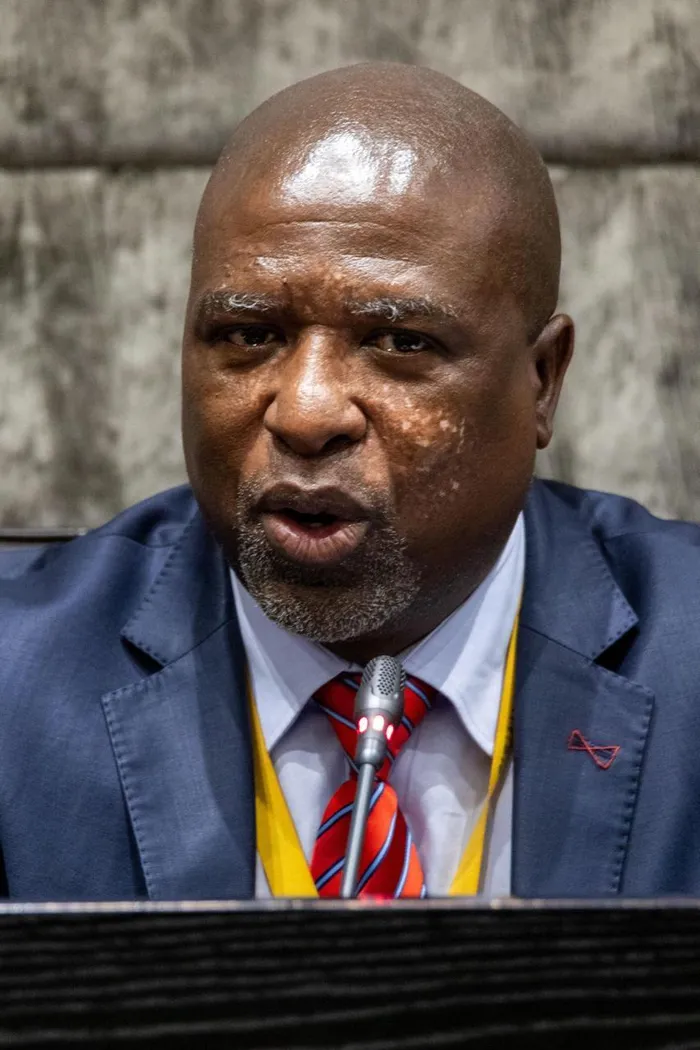
Parliament's ad hoc committee investigating corruption and political interference in the criminal justice system enters its final phase, with hearings set to conclude by early February 2026.
Image: Parliament of SA
Parliament’s ad hoc committee probing Lieutenant General Nhlanhla Mkhwanazi’s allegations of corruption and political interference in the criminal justice system says it is in the final phase of its work, with hearings expected to conclude by early February.
Chairperson Soviet Lekganyane acknowledged the challenges the committee had faced since its inception but credited members for their dedication.
“It has not been very easy when we started, but due to our extraordinary abilities, we were able to find each other and formed a formidable team that was able to execute the tasks before it,” he told members during the meeting.
The committee, operating under its second and final extension set to end on 20 February 2026, met to finalise arrangements for upcoming hearings and to consider matters arising from public submissions.
“This is the second and the last extension that will end on the 20th of February, 2026,” Lekganyane said, adding that the committee would resume its work on 14 January 2026.
Lekganyane also thanked the legal team for their work, singling out Advocates Norman Arendse, Maria Mokhaoetsi, and Lerato Zikalala.
“We also want to thank Advocate Arendse and his team, Advocate Mokhaoetsi and Advocate Zikalala for the work that they have done and the courage that they have shown, the excellence on the part of the statements that were coming before the committee,” he said.
He welcomed Advocate Bongiwe Mkhize from the Johannesburg Bar, who replaces Advocate Zikalala, expressing confidence that she would be “a very good addition” who would contribute to the committee’s success.
Lekganyane praised parliamentary staff and the technical team, noting that they had worked through the holiday period. “We are here because of your commitment, because of the coordination that you have done for the committee to be able to rise and do the work that it has done so far,” he said.
Referring to public submissions, Lekganyane said the item was deliberately placed first on the agenda because it would affect the committee’s programme.
He explained that if the committee agreed certain matters arising from public submissions should be heard, “it then means the timetable of appearances may have to be amended to accommodate those matters.”
He said the committee was working within a tight window between 14 January and 6 February, with the technical team recommending that hearings conclude by 6 February to allow time for drafting the final report.
“The committee must conclude hearings on the 6th of February so that they can have enough time to prepare a report for the consideration of the committee,” he said.
On the matter of public submissions, Content Adviser Nicolette van Zyl-Gous said the contributions “are really valuable to the Committee’s work. It provides insight into patterns of alleged conduct, rather than isolated incidents.”
She highlighted recurring themes, including “alleged political or external interference in policing functions, corruption and collusion involving members of law enforcement and associated institutions, weaknesses in internal oversight, disciplinary and accountability systems, also intimidation, fear of reprisal and limited protection for whistleblowers.
''And lastly, it shows a diminishing public trust in the criminal justice system.”
Van Zyl-Gous recommended that submissions “be referred to the relevant Portfolio Committees or Oversight Bodies with the mandate to process them further” to ensure accountability within Parliament’s framework.
She said submissions from civil society organisations, including Accountability Now, APCOF, and the Institute for Security Studies, among others, provided a system-level perspective and should ideally be invited for oral presentations due to their relevance to the committee’s mandate.
She outlined that 15 submissions had been identified as potentially suitable for oral presentation, including those from former and serving SAPS members, whistleblowers, and individuals alleging political interference, corruption, and abuse of power.
She suggested that allocating about 40 minutes per presenter could allow hearings to be concluded over one or two days.
Reporting on consultations, Advocate Norman Arendse stated that the legal team had met in person with Lieutenant General Dumisani Khumalo, former acting National Police Commissioner Khomotso Phahlane, EMPD Deputy Chief Julius Mkhwanazi, former head of the Independent Police Investigative Directorate (IPID) Robert McBride, and North West businessman Brown Mogotsi, and had corresponded with Paul O’Sullivan via email
“We are on track to present the evidence of five out of the six witnesses,” Arendse said. He explained that draft statements from Lieutenant Generals Khumalo and Phahlane would be ready by the end of the week, allowing hearings to proceed as scheduled from mid-January.
He said consultations with the remaining witness were scheduled and that security concerns had influenced whether appearances would be physical or virtual.
However, he noted concerns regarding the safety of some witnesses, such as Mogotsi, who had raised security issues.
“We agreed to meet with him and his lawyer online on Monday, as his concerns could not be addressed by Parliament in time,” Arendse explained.
Arendse added that the team had not identified additional NPA or judicial witnesses beyond those already consulted, noting that the focus remained on allegations made by Lieutenant General Mkhwanazi in July.
He said five of the six consultations had been concluded, adding that the team was on track to present evidence as scheduled.
hope.ntanzi@iol.co.za
IOL Politics