
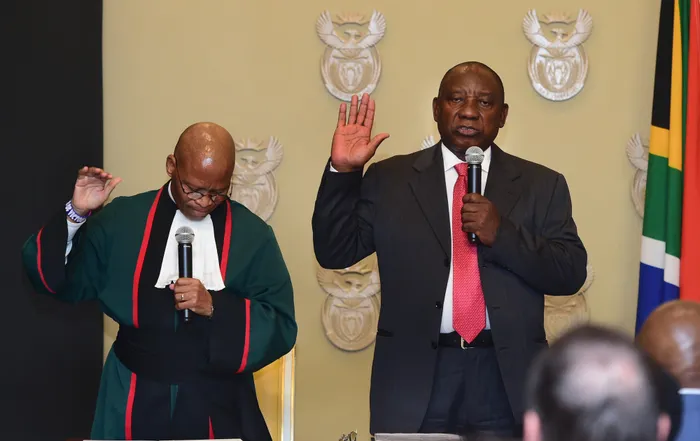
Chief Justice Mogoeng Mogoeng swearing in President Matamela Cyril Ramaphosa at Tuynhuis in Cape Town on February 15, 2018.
Image: File Picture: Kopano Tlape/GCIS
President Cyril Ramaphosa will on Sunday, February 15, mark exactly eight years since being sworn-in as the president of the country after the immediate resignation of his predecessor Jacob Zuma.
Ramaphosa had pledged to work with the opposition and tackle corruption while finishing Zuma’s term.
“Leave 2019 aside, let us deal with the current moment and work together on how we are going to improve the lives of our people, rather than grandstanding.
“Issues that have to do with corruption, of how we can straighten out our state-owned enterprises and how we deal with state capture are on our radar,” he said in his new dawn speech when he recalled the words of the late musician Hugh Masekela’s song “Thuma Mina”.
Ramaphosa not only promised to grow the economy, increase tourism and youth employment but also undertook to reduce the size of the Cabinet and reconfigure the departments and stabilise and revitalise state-owned enterprises.
While Ramaphosa had promised to try very hard not to disappoint the South Africans when he took office, his term is marked by lots of disappointments.
He appears too often shocked whenever there are challenges as though he just got into government yesterday.
This is not surprising as the opposition parties had cautioned about implementation and the raising of the hopes of the citizens.
Indeed, the opposition’s observations were not far-fetched as commissions and task teams, as an example, became synonymous with his term in office.
Earlier this week, Ramaphosa announced the National Water Crisis Committee that he will chair in response to the national water crisis as he had done so with the problem of loadshedding, which has come to an end.
Last year, he appointed the Madlanga Commission of Inquiry after KwaZulu-Natal Police Commissioner Nhlanhla Mkhwanazi made allegations of infiltration and corruption in the criminal justice system.
He previously appointed the Nugent Commission to look into the affairs of SARS and the Mpati Commission that probed the state-owned Public Investment Corporation.
Political analyst Professor Susan Booysen was quoted as saying task teams, special committees and commissions were familiar elements of Ramaphosa’s governance style.
“Those are some of President Ramaphosa’s favorite ways of addressing problems in South African politics,” said Booysen.
Ramaphosa’s promise of a lean cabinet has yet to materialize.
His 77 member multi-party executive that Ramaphosa announced last year includes his deputy Paul Mashatile, 32 ministers and 43 deputy ministers.
The number of members of the executive was increased from 62 in the previous executive.
Ramaphosa has blamed the failure to reduce the cabinet to the need to ensure inclusivity of all the parties to the Government of National Unity (GNU).
The ANC took up 20 ministerial posts, DA six, IFP two, PAC, GOOD party, the Patriotic Alliance and Freedom Front Plus have one each.
In terms of deputy minister positions, the ANC has 33, DA six, IFP two, UDM and Al-Jama-ah have one each.
Some ministries were split in order to accommodate the parties in the GNU.
The promised reconfiguration of departments and state-owned enterprises has yet to materialize.
Whereas Ramaphosa promised to act against corruption and mismanagement of public resources, few of the people implicated by the Zondo Commission have been prosecuted.
Instead, some are members of his cabinet and also serve as MPs such as Gwede Mantashe, David Mahlobo and Malusi Gigaba, among others.
Political analysts had last year stated that many of Ramaphosa’s promises were yet to materialise for most South Africans with the exception of the recent reprieve on load shedding.
Political analyst Professor Sipho Seepe stated that Ramaphosa has nothing to show for his first term in office except a 17% decline in voter share.
“For us to be able to judge him fairly, we must judge him against the promises he made. This is the president who promised to deal with unemployment, and promised that under his administration, there will be economic growth and a million houses built in Alexandra.
“He promised to tackle corruption and crime has spiralled out of control, so based on the promises he made, he has failed dismally on the promises he made,” Seepe said.
However, Ramaphosa can count among his successes the SARS, which has improved in tax.
“The South African Revenue Service is once again a world-class tax authority,” he said during SONA earlier this week, adding that the Investigating Directorate Against Corruption was making progress in prosecuting high-profile cases.
He noted in his address that the economy is growing again, but the GDP was not growing much faster to meet social and economic challenges.
“Our credit rating has improved, interest rates are coming down and inflation is at its lowest level in 20 years. We are on a clear path to stabilising our national debt,” Ramaphosa had said.
He also said loadshedding has been brought to an end under his term and progress was underway to improve the performance of ports and freight rail lines.
“We have restored our passenger rail system. More and more commuters are now able to travel to work on new locally-made trains, significantly reducing their transport costs.”
While acknowledging the high unemployment rate, Ramaphosa said citizens are worried about violent crime and corruption.
“We are further intensifying the fight against corruption by strengthening bodies such as the Special Investigating Unit, the National Prosecuting Authority and the Hawks.
“We will finalise government’s approach to the recommendation of the National Anti-Corruption Advisory Council on the establishment of a permanent, independent, overarching anti-corruption body.”
mayibongwe.maqhina@inl.co.za