
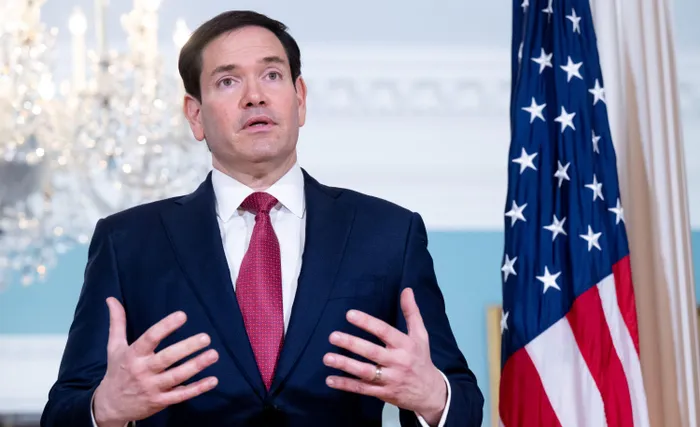
US Secretary of State Marco Rubio US Secretary of State Marco Rubio leading the American team at the Munich security conference which revealed tensions between the US and Europe
Image: Saul Loeb / AFP
The Munich Security Conference has emerged as a critical battleground for the future of transatlantic relations, as the United States signalled a decisive intent to reform the global order independently of Europe. This undercurrent, albeit cloaked in conciliatory rhetoric, suggests an escalating divergence between American and European strategic interests.
In his address, US Secretary of State Marco Rubio proclaimed that “the US and Europe belong together,” echoing sentiments that drew a standing ovation from attendees. Yet, as reported by Politico, this warm tone belied a stark reality: America appears unwilling to “defend the old order” of cooperation and mutual reliance that has characterised the longstanding alliance.
One former European official encapsulated this sentiment, stating, “The underlying message was the same: We don’t want weak allies, don’t defend the old order.” If the commonalities cited by the US are merely historical ties, national security interests, and shared civilizational values dating back to Columbus, it raises questions about the future cohesiveness of the partnership. The message interpreted by European officials was unequivocal: align with our strategies or brace for a unilateral American approach.
Reflecting on a potential trajectory, Pentagon policy chief Elbridge Colby reportedly conveyed to European officials that while the US shares common interests with Europe, it diverges sharply on values. This stark admission may complicate any aspirations of unity moving forward, as European nations gauge their own defence policies in an increasingly fractious global landscape.
Compounding the complexity of transatlantic relations, Rubio’s subsequent diplomatic engagements raised eyebrows. Following his words of reassurance, he met with EU sceptics from Hungary and Slovakia, leading one European lawmaker to question the contradictory signals emitted by the US delegation.
A few European figures interpreted Rubio’s remarks as endorsing a necessary wake-up call, where the idyllic vision of seamless cooperation is replaced by a more pragmatic understanding of international relations. An EU official wittily remarked, “It is a milder way of telling us that the time of unicorns riding bicycles across rainbows laced with tofu and almond milk is over.” This metaphor encapsulated the disillusionment felt by many within the continent’s political corridors.
Such apprehensions towards the US's pivot are not unfounded. Former President Donald Trump had long insisted that NATO allies must shoulder greater financial burdens, proposing a military spending target of 5% of GDP. This line of thinking continued into the Trump administration’s December unveiling of a new National Security Strategy, which alarmingly referred to Europe’s “civilisational erasure” and questioned the reliability of numerous EU nations as allies.
The backdrop of these developments may foreshadow a challenging landscape for European nations as they negotiate their roles in international relations. As the US leans towards asserting its authority and ambitions on a global stage, the opportunity for collaboration may dwindle, forcing Europe into a recalibrated orbit.
RT