
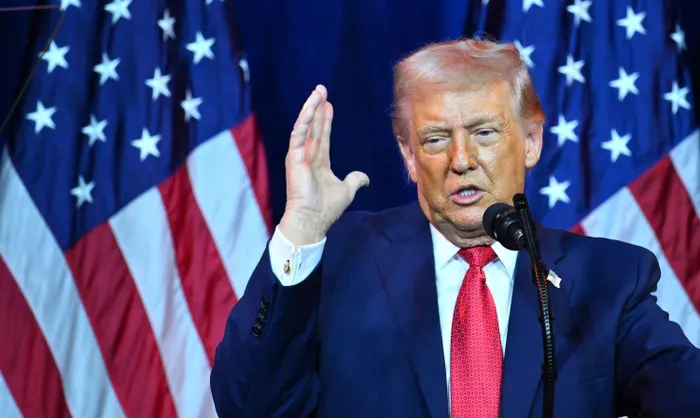
US President Donald Trump US President Donald Trump sends a team to negotiate with Iran in Geneva
Image: Mandel Ngan / AFP
As diplomatic tensions mount, Iranian Foreign Minister Seyed Abbas Araghchi heads to Geneva for a pivotal second round of indirect talks with the United States.
Scheduled for Tuesday, these discussions aim to bridge the vast gap between Tehran’s and Washington’s contrasting visions for a potential agreement, highlighting the fragile nature of the renewed diplomatic engagement.
Araghchi will lead a "diplomatic and specialised" delegation, expected to convene with key figures such as Swiss Foreign Minister Ignazio Cassis, Omani Foreign Minister Sayyid Badr bin Hamad Al Busaidi, and Rafael Grossi, the Director General of the International Atomic Energy Agency (IAEA). American negotiators will be represented by President Donald Trump's special envoy Steve Witkoff.
The backdrop to this conversation is the first round of talks held in Muscat, Oman, on February 6, which both sides acknowledged as a promising opening but ultimately resulted in no tangible breakthroughs. As they approach the table in Geneva, Iranian officials have issued statements that blend a cautious openness with an unwavering resistance to key demands from the U.S.
In an interview with the BBC, Iran’s Deputy Foreign Minister Majid Takht-Ravanchi underscored Iran’s willingness to compromise on its nuclear ambitions in exchange for the much-needed relief from sanctions. Yet, he firmly articulated Tehran's red lines, indicating, “The ball is in America’s court to prove that they want to do a deal.” He confirmed Iran’s readiness to discuss the dilution of its 60 percent-enriched uranium – a potential gesture of goodwill – although he categorically ruled out the prospect of completely halting enrichment on Iranian soil. "It is not on the table anymore," Takht-Ravanchi stated, also making it clear that Iran's missile programme remains a non-negotiable element in their discussions.
Hamid Ghanbari, another member of Iran's negotiating team, revealed that earlier talks in Muscat had touched upon significant topics, such as potential US investments in Iranian energy and aircraft purchases. However, he stressed that any deal would need to guarantee that Iran's frozen assets abroad are released "in a real and usable manner." Ensuring Tehran's interests appear to be pivotal as they pursue a "serious agreement," while still firmly opposing any stipulation of a complete halt in uranium enrichment.
Amidst these negotiations, military posturing on both sides adds an uneasy tension to the atmosphere. Iranian armed forces chief of staff Abdolrahim Mousavi warned of dire repercussions should conflict ensue, positing that, “If Trump seeks war with Iran, why does he speak of negotiation?” His comments reflect the gravity of the situation as both countries wrestle with the potential of military conflict, particularly with U.S. naval forces assembling in the region.
From Washington, conflicting signals permeate the discourse. U.S. Secretary of State Marco Rubio recently suggested that Trump is inclined towards diplomacy, declaring, “No one’s ever been able to do a successful deal with Iran, but we’re going to try.” However, Trump himself has hinted at a steely resolve, stating that should negotiations fail, a "phase two" would follow, signalling a potentially harsher stance.
Compounding the complexity, Israeli Prime Minister Benjamin Netanyahu has positioned himself in favour of a maximalist agenda, insisting that any deal necessitates the complete removal of nuclear materials and a halt to uranium enrichment – a proposition Jonathan intended to dilute any perceived flexibility on the Iranian side. Netanyahu's skepticism towards any agreement further complicates the landscape, suggesting a potential Israeli willingness to proceed with military options should diplomatic efforts falter.
As both Iranian and U.S. forces brace for the possibilities ahead, the upcoming meeting is anticipated to reveal whether diplomacy can carve a meaningful path forward or if it merely serves as a prelude to an escalation of tensions.
Xinhua