
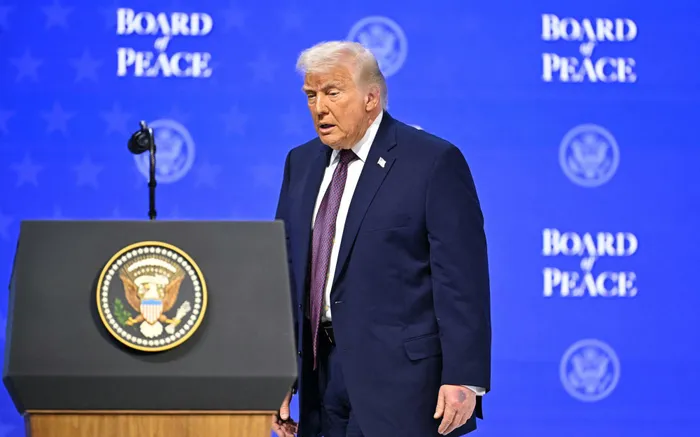
US President Donald Trump Trump’s Board of Peace rallies ‘thousands’ of troops for Gaza deployment
Image: Fabrice Coffrini / AFP
In a bold move that signals a potential shift in international relations and humanitarian efforts, US President Donald Trump has announced that countries participating in his newly formed Board of Peace are set to deploy thousands of personnel alongside financial commitments exceeding $5 billion aimed at stabilising Gaza. The announcement follows Trump's post on Truth Social, where he confirmed initial pledges and outlined the board’s mission to oversee reconstruction, security, and political transition in the besieged enclave.
The formal meeting to solidify these commitments is scheduled for February 19 in Washington, D.C., a gathering that Trump expects will mark a significant step towards ensuring “security and peace” in a region plagued by turmoil. Member States have pledged more than $5 billion toward the Gaza Humanitarian and Reconstruction efforts, and have committed thousands of personnel to the International Stabilization Force and Local Police,” Trump declared.
Despite the grand promises, specific details regarding which nations are contributing troops or monetary support remain unconfirmed. One notable exception has been Indonesia, where the military announced its readiness to deploy 8,000 troops pending governmental approval, potentially positioning it as the first nation to formally engage militarily in the initiative.
“Our troops are fully prepared and can be dispatched at short notice once the government gives formal approval,” stated Indonesian Army spokesman Brigadier General Donny Pramono. This readiness highlights the urgency surrounding the initiative, though scepticism remains regarding the broader impact of such deployments.
The Board of Peace was officially established in mid-January, and Trump has sought to portray it as a viable alternative to traditional global organisations like the United Nations, suggesting its influence would extend “far beyond” that of established bodies. He appointed himself as chairman and has invited a range of foreign leaders to join what he described as “the most consequential international body in history.”
While Israel has accepted its invitation, several European nations, including France, Germany, Italy, Sweden, and the UK, have elected to decline. Russia has acknowledged receipt of its invitation but has yet to clarify its stance on joining the initiative, indicating it is still “studying the proposal.” Permanent membership in the Board of Peace beyond the initial three years is said to require a contribution of $1 billion, a stipulation that may deter nations from participating long-term.
Critics, however, are cautious. Many have vocally expressed concerns regarding the mandate of the Board, particularly the notable absence of Palestinian political representation in these discussions. Hamas, for its part, has reiterated its commitment to the peace process but remains adamant that it will only disarm if Israeli forces withdraw from Gaza, casting a shadow over the feasibility of the proposed stabilisation efforts.
As the world waits for clarity and tangible commitments on February 19, the implications of this initiative could reshape an already complex landscape, setting the stage for potential conflict or, optimistically, a step towards enduring peace in the region.
RT News