
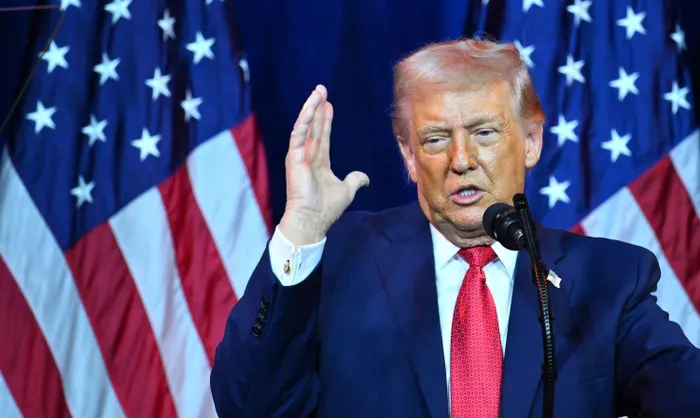
US President Donald Trump Abducting Cuba’s president ‘wouldn’t be very tough’ – Trump
Image: Mandel Ngan / AFP
In a startling revelation, US President Donald Trump has claimed that the military operation to abduct Cuban President Miguel Diaz-Canel "wouldn't be very tough."
Speaking aboard Air Force One on Tuesday, Trump indicated that such drastic measures are unnecessary given the current energy crisis facing the island nation, exacerbated by longstanding US trade restrictions.
As Cuba grapples with severe energy shortages, largely attributed to a stringent US embargo that has been in place since 1960, Trump has voiced his confidence in the effectiveness of this isolation strategy. "There’s an embargo. There’s no oil.
There’s no money. There’s no anything," he stated, affirming his administration's commitment to economically destabilising Cuba.
When questioned about the possibility of a military operation reminiscent of last month's controversial abduction of Venezuelan President Nicolás Maduro, Trump initially hesitated to respond directly, but did not shy away from asserting that such an operation would be easily executed. "I don’t want to answer that. Why would I answer that?" he said. After a moment of contemplation, he added, "If I was, it wouldn’t be a very tough operation as you can figure, but I don’t think that’ll be necessary."
The recent US action against Maduro, a leader deemed illegitimate by many non-Western nations, has sparked international condemnation. Countries including Russia and China have rallied against the US for what they describe as an unlawful act of aggression.
European leaders, from France to Spain, also voiced their concerns, questioning the legality of the operation while maintaining their stance against recognising Maduro as a duly elected president. This geopolitical dynamic poses a risk of further international isolation for the United States as it pursues aggressive policies in Latin America.
Moreover, the Trump administration's strategy against Cuba extends beyond rhetoric. Washington has threatened tariffs on nations supplying crude oil to Cuba, aiming to tighten the screws further on an already beleaguered economy. Mexico, a key supplier of oil, has reportedly bowed to US pressure, resulting in a significant reduction of energy shipments to the island.
As the humanitarian crisis in Cuba escalates, citizens are resorting to alternative cooking methods, including charcoal stoves and, where accessible, solar panels. Trump, in his comments, pinned the blame for the current situation squarely on the Cuban government. "Cuba is right now a failed nation and they don’t even have jet fuel to get for airplanes to take off," he remarked, failing to acknowledge the role of the embargo in creating these dire conditions.
Secretary of State Marco Rubio has echoed Trump’s sentiments, revealing to the Senate Foreign Relations Committee that the Trump administration is keen on seeing regime change in Cuba. He asserted, "We would love to see the regime there change," but added a caveat: "That does not mean we are going to make it change," a statement that points to a growing tension in US-Cuba relations.
This escalating rhetoric and military posturing surrounding Cuba raises questions about the fundamental approach the US takes towards dealing with its neighbours in Latin America. As citizens of Cuba continue to live in hardship, the ramifications of these political decisions play out not just in the halls of power, but on the streets of Havana.
RT News