
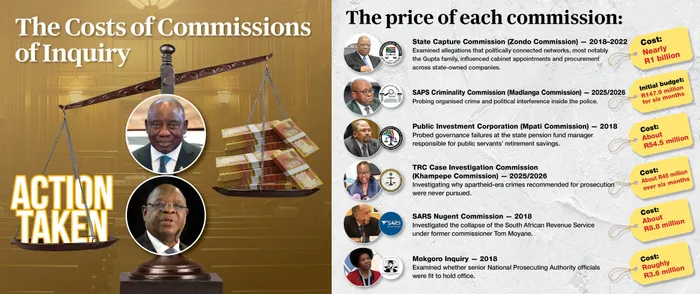
The commissions of inquiry in South Africa since 2018 and the costs associated with them.
Image: IOL Graphics
Zondo. Mpati. Khampepe. Madlanga. Since 2018, these names have become part of South Africa’s political vocabulary, repeated in taxi conversations and office debates as the country followed testimony after testimony at a series of commissions of inquiry.
For years, the public has watched witnesses detail allegations implicating senior figures across government, law enforcement, and the private sector. Yet, despite the scale of the revelations contained in thousands of pages of reports, many South Africans still struggle to point to tangible outcomes.
When Cyril Ramaphosa assumed office in February 2018, he inherited a state emerging from what courts and investigators would later describe as “state capture”, a period during which private interests allegedly influenced public decision-making.
Rather than pursuing immediate mass prosecutions, his administration opted to establish commissions of inquiry, setting a precedent that would define his presidency and culminate in the current police inquiry led by the SAPS Criminality Commission, also referred to as the Madlanga Commission. The cumulative cost to taxpayers has exceeded R1 billion.
Public reaction has been mixed. Some view the commissions as necessary truth-seeking exercises, while others argue they have delayed decisive action.
Political analyst Bheki Mngomezulu has been among the critics, describing commissions as “unnecessary” because they lack prosecutorial powers.
“They compile reports and do nothing. Look at the State Capture Commission, which cost over a billion rand. Why appoint a commission and spend money when the National Prosecuting Authority still has to conduct its own investigations? Why not go directly to the NPA from the start?” he said.
These concerns have also been raised in legal circles. Polokwane-based practitioner MK Masoma argued in a 2025 paper that commissions have become the government’s default response to public pressure, often producing detailed findings but limited accountability.
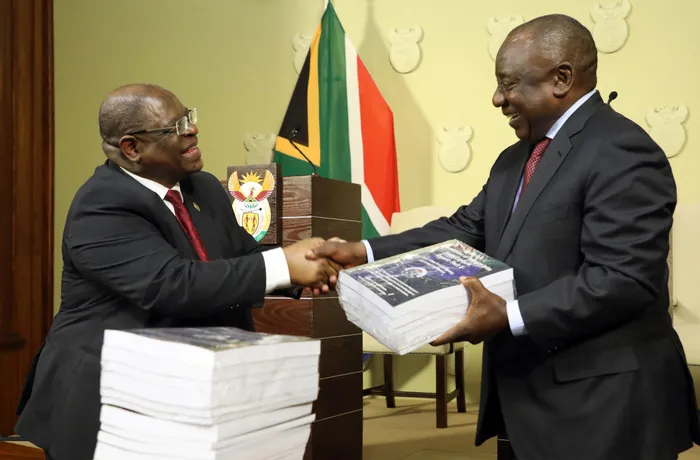
Former Chief Justice and State Capture Commission chair Raymond Zondo hands over the commission's final report report to President Cyril Ramaphosa in Pretoria on June 22, 2022.
Image: Oupa Mokoena / Independent Newspapers
In his paper, Commissions and the Constitution: Substance without power, he wrote that while commissions are constitutionally grounded, established under Section 84(2)(f) of the Constitution and governed by the Commissions Act, they remain investigative rather than prosecutorial bodies.
“In theory, commissions of inquiry satisfy formal constitutional expectations… Yet commissions are fundamentally investigative, not prosecutorial. They cannot enforce consequences. Even the most damning findings may be shelved, ignored, or selectively acted on,” he wrote.
Masoma further argued that commissions occupy a hybrid constitutional space. Though appointed by the president and funded by the state, they are often chaired by retired judges and operate in court-like settings, creating a perception of adjudication even though their recommendations are non-binding.
“This quasi-judicial appearance generates public perception of formal adjudication, yet enforcement is entirely contingent on political will,” he said, adding that Parliament seldom debates reports or enforces timelines for implementation.
The major inquiries since 2018
Despite the debate, at least six major commissions have been initiated or operated largely during Ramaphosa’s tenure:
Investigated allegations that politically connected networks, particularly those linked to the Gupta family, influenced Cabinet appointments and procurement at state-owned enterprises.
Cost: nearly R1 billion.
Probed the collapse of the South African Revenue Service under former commissioner Tom Moyane.
Cost: about R8.8 million.
Examined governance failures at the state pension fund manager.
Cost: about R54.5 million.
Assessed whether senior National Prosecuting Authority officials were fit to hold office.
Cost: roughly R3.6 million.
Investigating why apartheid-era cases recommended for prosecution were never pursued.
Probing organised crime and political interference within the police.
Initial budget: R147.9 million for six months.
Together, these inquiries have generated vast records of testimony and cost taxpayers well over R1.2 billion.
Mngomezulu argues that the price tags cannot be justified, describing commissions as delay tactics that outlast public anger.
“It’s all to sidetrack people and make them think something is being done… They are a waste of time and money to make people forget,” he said.
Masoma similarly noted that commissions are time-intensive and publicly funded, making their frequency a legitimate subject of scrutiny in a country grappling with poverty and strained services.
Despite criticism, the findings collectively mapped a pattern of systemic failure rather than isolated wrongdoing.
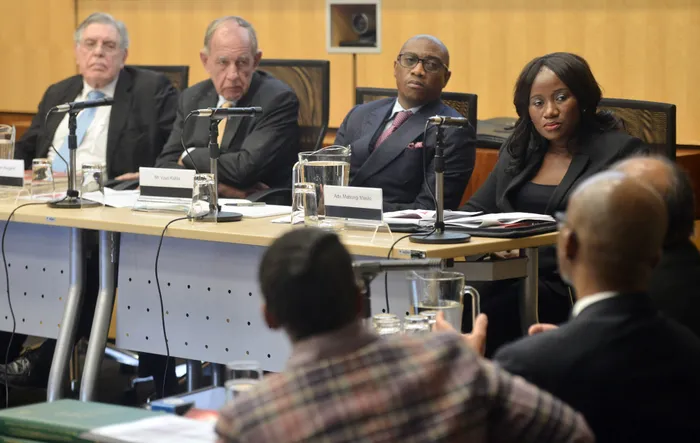
Professor Michael Katz, Judge Robert Nugent, Vuyo Kahla, and Advocate Mabongi Masilo at the SARS Commission of Inquiry.
Image: Oupa Mokoena / Independent Newspapers
The Zondo Commission concluded that state capture was a coordinated project involving politicians, executives at state-owned enterprises, consultants, and private firms. Entities including Eskom, Transnet, Denel, and South African Airways were shown to have been manipulated through procurement worth billions.
The Nugent Commission found SARS, once among the most effective tax authorities in the developing world, had been deliberately weakened.
The Mpati Commission exposed conflicts of interest and risky investments at the Public Investment Corporation, placing public servants’ pensions at risk.
The Mokgoro Inquiry paved the way for leadership changes at the National Prosecuting Authority and the eventual appointment of a new national director of public prosecutions.
Collectively, the findings suggested the state was structurally compromised. Evidence now emerging before the Madlanga Commission indicates alleged criminal infiltration within the security apparatus itself.
As the archive of findings expanded, critics say government communication on implementation has been limited. Queries sent to the Presidency regarding costs, progress, and outcomes have gone unanswered, with presidential spokesperson Vincent Magwenya yet to respond to questions submitted more than a week ago.
Political analyst Susan Booysen has previously described commissions, task teams, and panels as a recurring feature of Ramaphosa’s governing approach, helping stabilise crises while avoiding immediate confrontation.
Analysts broadly agree that while commissions can enhance transparency, their impact ultimately depends on political will.
Supporters of the commission process argue Ramaphosa inherited weakened institutions, including under-resourced prosecutors, divided intelligence services, and compromised evidence trails. From this perspective, inquiries were necessary to rebuild credible cases.
More than 50 individuals and over two dozen entities have faced criminal charges linked to state capture investigations, though critics argue enforcement has been uneven.
Prosecutions have been slow and complex. Instead, the most visible consequences have been financial.
Authorities have recovered or frozen nearly R11 billion, with major settlements including:
Assets exceeding R10.6 billion remain under preservation orders, while the Special Investigating Unit and Asset Forfeiture Unit have become the primary instruments of accountability.
Masoma argues that for commissions to regain credibility, they must shift from “spectacle” to enforcement.
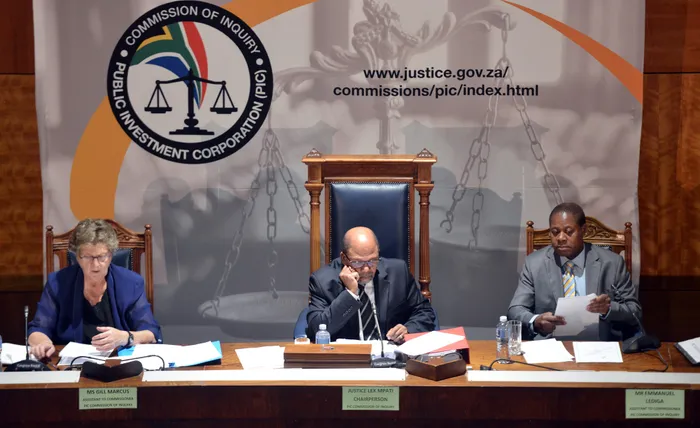
PIC Commission of Inquiry Chairperson Justice Lex Mpati with his assistants Gill Marcus and Emmanuel Lediga during the PIC Commission of Inquiry at Sammy Marks Square.
Image: Oupa Mokoena / Independent Newspapers
Exposure without action, he warns, risks entrenching impunity rather than confronting it.
Another legal expert, Mpumelelo Zikalala, in an interview in January, said the reports from the commissions need to be made public so that South Africans can know what those reports contain, to allow members of the public to know what the problems are within public institutions.
“Most importantly, are you implementing what the commission is telling you? Is it effective? Is this the value for money? Is this something that needs to be accountable at this point in time, or should we wait? If you are going to be secretive with what you've received, you remove the very accountability that you must have on a daily basis as the presidency, you limit us as members of the public in terms of holding you accountable in terms of what has been provided by the commission.”
Zikalala said there is no plausible reason why no explanation has been given by the Presidency as to how those implicated in the report will be dealt with.
“It’s almost as if it's business as usual. The silence is too loud.”
After years of hearings, findings, and public testimony, South Africa now holds one of the most detailed records of corruption assembled by a democracy. The unresolved question is whether that record will ultimately translate into lasting accountability.
This is part one of a series that looks at the Commissions of Inquiry and what has followed them. Look out for part two next week.
karabo.ngoepe@inl.co.za