
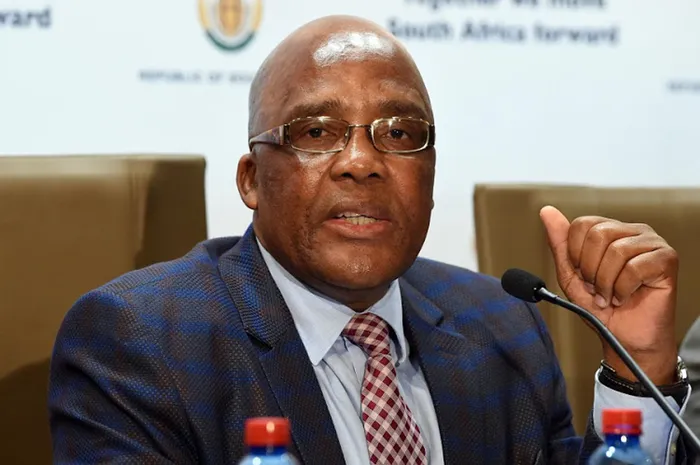
Health Minister Aaron Motsoaledi says South Africa was not yet in a position to establish a State-owned pharmaceutical company.
Image: GCIS
Health Minister Aaron Motsoaledi has shed light on the government’s intentions concerning local manufacturing of ARV drugs.
Although discussions regarding the long-awaited establishment of a State-owned pharmaceutical company have been shelved for now, Motsoaledi emphasised a commitment to support local manufacturers in the absence of this entity.
During a briefing to the Health Portfolio Committee earlier this week, Motsoaledi confirmed that President Cyril Ramaphosa is heading a committee focused on enhancing local production capabilities as the country grapples with supply chain vulnerabilities.
The concerns were heightened following the business rescue of two major ARV suppliers in December 2025, leaving many to question the future stability of access to ARVs in South Africa.
ActionSA MP Kgosi Letlape enquired about the prospects for the future after discussions were held about a State-owned pharmaceutical company.
“When are we likely to see that coming? It can give us security of supply across most products,” said Letlape.
The department has pointed out the allocation of R25 billion for the HIV Conditional Grant, a significant portion of which is directed towards procuring ARVs.
Motsoaledi said he had approached Ramaphosa, who formed a committee, on what should happen for the country to rely on local companies in the absence of a State-owned pharmaceutical company.
“We believe we are not yet in a position to establish a State-owned pharmaceutical company, though there is an intention to do so,” he said.
Motsoaledi also said the failure to manufacture ARVs locally was not a question of a lack of political will or budget due to financial constraints.
The minister noted the complexities surrounding the establishment of this pharmaceutical entity, following a decision in 2007 for the Department of Health to create the company.
Motsoaledi recalled the estimated R15 billion required in 2010 to kickstart local ARV production, emphasising the broader implications of this initiative, which also involved collaboration with the Department of Trade and Industry and National Treasury.
This happened when the department owned childhood manufacturer Biovec, which the Auditor-General queried the ownership of by the department and ordered that it be taken over by the Department of Science and Technology.
Although the State-owned pharmaceutical company, Ketlaphela, was subsequently established with the involvement of the Department of Science and Technology, it has not taken off the ground.
Motsoaledi said it has always been the position of the department that the manufacturing of ARVs was not just a health matter, but department-wide, involving the Department of Trade and Industry, the National Treasury, and the Department of Science and Technology.
“The Department of Health can't establish an industry (State-owned pharmaceutical company). It is not our primary role. We consume what the industry produces, but we work together.”
He stated that he has since approached Ramaphosa regarding the local manufacturing of the ARVs because the National Treasury was insisting on them to buy locally.
Motsoaledi added that the directors-general of the four departments have since formed a technical committee that was reporting to the political committee consisting of Ramaphosa and the respective ministers.
Echoing Motsoaledi’s sentiments, Deputy Director-General Nicholas Crisp highlighted the inter-departmental committee’s progress in mapping out current players in the pharmaceutical landscape, stating that substantial work has been done.
“The next meeting is coming within the next week or two, where we report on the progress to date,” he said.
“We are also working with other African countries across our borders, particularly SADC, to get a larger volume and working across Africa, where local manufacturing for the whole of Africa should take place. We believe we are to make some progress,” said Crisp.
Motsoaledi reiterated that the conversation around local ARV manufacturing is intrinsically linked to the push for a state-owned company, asserting that regulatory clearance will be paramount for any future production.
“All we have to do in health, after establishing that company, is to see if the regulator has passed the product they manufacture. And if they have done so, we can buy from that company,” he added.
mayibongwe.maqhina@inl.co.za