
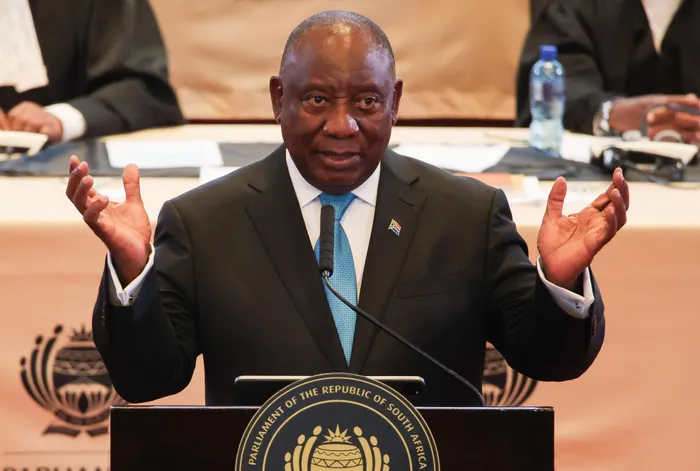
President Cyril Ramaphosa has agreed to delay the proclamation of sections of the NHI Act pending a Constitutional Court ruling on challenges to Parliament’s public participation process.
Image: IOL
President Cyril Ramaphosa has agreed to delay the proclamation of any sections of the National Health Insurance (NHI) Act until the Constitutional Court has delivered judgment in legal challenges to the legislation’s adoption process.
The move follows litigation brought by various parties against the President and Health Minister Aaron Motsoaledi over the public participation process that preceded Parliament’s adoption of the NHI Bill.
The Constitutional Court is set to hear the matters from May 5 to 7, 2026.
In a statement, Presidential Spokesperson Vincent Magwenya said the litigation had “necessitated that President Cyril Ramaphosa, following consultations with Minister Aaron Motsoaledi, agree to delay the proclamation of any sections of the National Health Insurance (NHI) Act until the Constitutional Court has handed down its judgments in challenges due to be heard on 5-7 May 2026.”
Magwenya said the undertaking would not affect the broader rollout of the NHI, noting that “preparatory work has been ongoing, such as the improvement of health services before any sections of the NHI Act are ready for commencement.”
He added that “the Department of Health will continue in its constitutional responsibility to strengthen the health system and improve the quality of care.”
The Presidency said it expects the agreement to be formalised in court.
“It is anticipated that this agreement will be made an order of court on 24 February 2026,” Magwenya said.
Lobby group AfriForum has approached the Gauteng High Court in Pretoria seeking to have the NHI Act declared unconstitutional.
The organisation has cited Ramaphosa, Motsoaledi, and Finance Minister Enoch Godongwana as respondents, along with National Assembly Speaker Thoko Didiza and National Council of Provinces chairperson Refilwe Mtshweni-Tsipane.
In its court papers, AfriForum argues that the Act centralises the funding of healthcare services and the purchasing of medicines and related goods, thereby undermining the constitutional powers of provinces to budget, finance, plan and run healthcare services.
It contends that the centralisation of the provincial equitable share amounts to an intrusion by the national government into the legitimate tax revenues of provinces allocated to their constitutionally mandated healthcare and ambulance functions.
The organisation further argues that the NHI Act’s requirement that users obtain healthcare services exclusively through accredited providers within the NHI network threatens the future of medical aid schemes and private healthcare, creates financial uncertainty and could adversely affect the economy.
AfriForum is seeking an order declaring the Act inconsistent with the Constitution and invalid, with Parliament to be given 24 months to remedy the defects or repeal it, subject to confirmation by the Constitutional Court.
The delay has also drawn criticism from the South African Communist Party (SACP), which described the suspension as “opportunistic, irrational, and a blatant attack on the struggle for universal healthcare.”
SACP national spokesperson Mbulelo Mandlana said the failure to implement the NHI was “a political choice of the president and his government and not a random circumstance forced upon him by court proceedings against the scheme.”
Mandlana warned that halting implementation was “tantamount to a reversal of a key important transformative policy,” and undermined efforts to dismantle what he described as South Africa’s unequal two-tier healthcare system.
Despite mounting legal and political opposition, the Presidency reiterated that the government “remains committed to the National Health Insurance and will work within the requirements of the law and judicial process to ensure that there is no undue delay."
hope.ntanzi@iol.co.za
IOL Politics