
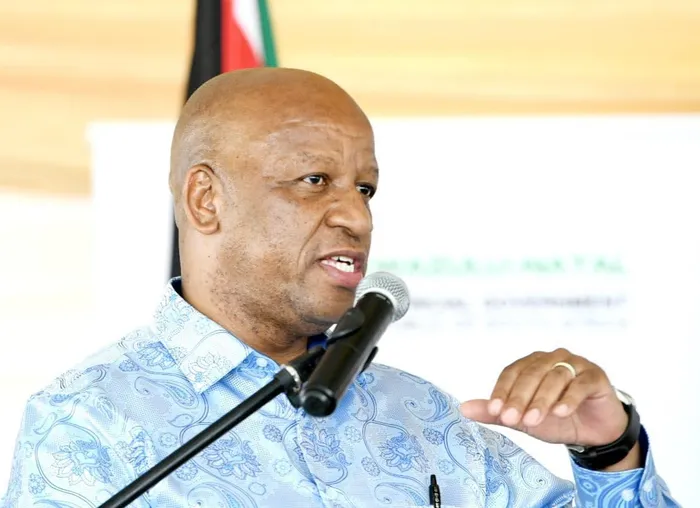
Premier Thami Ntuli announces R100 billion in investment pledges as KwaZulu-Natal’s economy steadily recovers from the 2021 unrest and COVID-19, creating over 100,000 jobs across key sectors.
Image: KZN provincial government
KwaZulu-Natal Premier Thami Ntuli says KwaZulu-Natal is steadily recovering from the devastation caused by the July 2021 unrest and the COVID-19 pandemic, with the provincial government focusing on rebuilding the economy on a stronger, more inclusive foundation.
Ntuli’s emphasised that provincial government has sought not just to restore what was lost, but to transform the province’s economic outlook with deliberate, long-term strategies aimed at creating sustainable growth.
In his SOPA on Friday, the premier emphasised the province’s economic recovery efforts, which have seen promising results despite significant challenges.
“In 2025, our provincial economy grew by 1.8%, slightly above the national average, which is encouraging given the obstacles we've faced,” said Ntuli.
“The forecast for 2026 shows further improvement, with a 2.1% projected increase, driven by improvements in key infrastructure, particularly in rail and port operations.”
Despite these positive signs, Ntuli acknowledged the ongoing issues that the province continues to face.
"Our economy still contends with structural constraints, such as electricity disruptions and inefficiencies in freight and logistics,” he explained.
“However, investor confidence is steadily rebuilding. In late 2025, KwaZulu-Natal surpassed R100 billion in investment pledges, which is a testament to the resilience of our economic strategy."
The investments, according to the Premier, are expected to generate over 100,000 jobs, providing a much-needed boost to employment across various sectors including tourism, manufacturing, logistics, and agriculture.
Tourism, which is one of the province's key economic pillars, saw strong performance, with the festive season alone contributing an estimated R13 billion to KwaZulu-Natal’s Gross Domestic Product (GDP) in 2025.
"Tourism has shown remarkable growth," Ntuli said.
"With high domestic and international visitor numbers, the contribution to the provincial GDP is significant. Additionally, between the mid-2025 quarters, KwaZulu-Natal recorded a net gain of about 54,000 new jobs, a development that supported household income, boosted consumer spending, and reinforced broader economic growth.''
However, the Premier also emphasised the need for ongoing efforts to reduce the province's unemployment rate, which currently stands at 30.8%.
"To meet our target of reducing unemployment to 20%, we need R168 billion in investment and targeted efforts across the province," Ntuli said.
"This will require a concerted push from both public and private sectors, especially in rural and township economies."
Ntuli stressed the importance of infrastructure-led growth as a key element of KwaZulu-Natal's economic strategy.
"The province's growth must be underpinned by strong infrastructure in sectors like agriculture, manufacturing, and tourism," he stated.
"We are also focusing on improving cross-border trade through smart infrastructure solutions, including public Wi-Fi, and revitalizing the King Shaka International Public Link Solution to enhance connectivity across key economic hubs in the province."
He emphasised that KwaZulu-Natal’s development strategy will prioritize interconnected growth between sectors and areas.
"We must ensure that our sectoral developments align with spatial planning and infrastructure needs, such as roads, rail, water, and energy. This is crucial for driving economic growth across the province," he said.
Ntuli reaffirmed his confidence in the province’s recovery path.
"KwaZulu-Natal is reclaiming its position as a strategic gateway to the rest of the African economy," he stated.
"With strong leadership, robust social partnerships, and a focus on inclusive economic renewal, we are well on track for sustainable long-term growth."
hope.ntanzi@iol.co.za
IOL Politics