
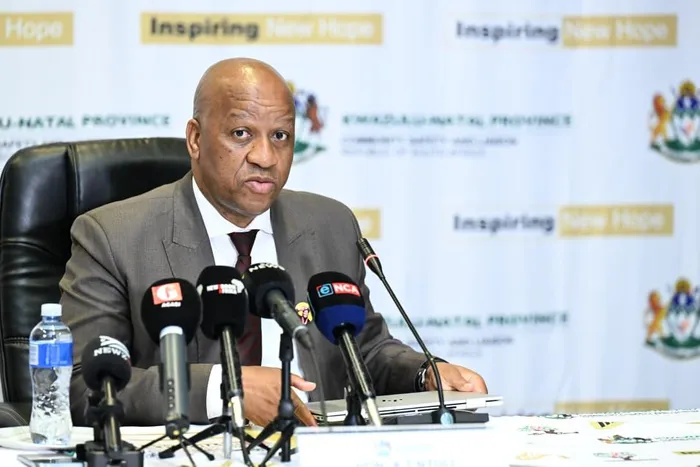
Premier Thami Ntuli celebrates a 13% crime drop in KwaZulu-Natal, stressing the importance of continued community collaboration for lasting safety and crime prevention.
Image: Supplied
KwaZulu-Natal Premier Thami Ntuli has praised a significant 13% drop in crime across the province, attributing the reduction to the ongoing collaboration between the South African Police Service (SAPS), local communities, and the provincial government.
While acknowledging this decrease as a positive step, he emphasised that the work is far from over, with the province still grappling with high levels of crime that demand a sustained, multifaceted approach.
In his State of the Province Address, Ntuli commended the leadership of SAPS Provincial Commissioner, Lieutenant General Nhlanhla Mkhwanazi, for his effective strategy that has contributed to this drop in crime.
However, he highlighted the importance of continuing to strengthen partnerships between the government and communities to achieve lasting safety.
''Crime is decreasing in the province, though it is still high. The recent revelations that crime has decreased by 13% in KwaZulu-Natal is a testimony to the good leadership provided by the Provincial Commissioner, Lt-Gen Nhlanhla Mkhwanazi.
''I do not regret bringing the Department of Community Safety and Liaison under the Executive Authority of the Premier.''
The Premier went on to assert that ensuring safety cannot be the responsibility of law enforcement alone.
He argued that a comprehensive approach, where the community plays a central role, is necessary to address the root causes of crime.
This approach, which places social cohesion, trust, and shared responsibility at its core, aims to build safer communities by fostering long-term solutions, not just temporary fixes.
“Community safety is not merely the absence of crime. It is the presence of social cohesion, trust, and the shared responsibility of all our people,” Ntuli said, stressing the importance of collaboration across various sectors.
Ntuli also addressed the distressing issue of young South Africans being recruited into foreign conflicts.
He thanked President Cyril Ramaphosa for intervening to bring the young men back home after they were sent to Russia to join foreign wars.
“I commend the president for his swift intervention, which helped bring our sons back safely,” he said.
The Premier reflected on the broader importance of youth involvement in crime prevention and safety initiatives.
He highlighted the placement of 186 Gender-Based Violence and Femicide (GBVF) activists in 99 police stations across the province, emphasising the role of these young professionals in supporting victims, conducting legal research, and contributing to the overall crime prevention strategy.
Of these, 103 are qualified social workers, 30 hold degrees in social sciences, and 42 have law degrees.
These activists, Ntuli explained, have become “force multipliers” working alongside police to improve victim support and provide guidance to survivors of violence.
“By investing in the development of young people, we are not just creating jobs; we are strengthening the very communities we seek to protect,” Ntuli said.
In line with this vision, the province plans to create 1,000 new work opportunities for young graduates and matriculants in 2026 through the Expanded Public Works Programme (EPWP). These roles will be geared towards direct community safety involvement, from crime prevention support to data collection and patrolling.
The Premier also discussed the ongoing social crime prevention programs being implemented across all 10 districts of KwaZulu-Natal, which have been tailored to address the province’s unique crime dynamics.
These initiatives include efforts to curb Gender-Based Violence, tackle cross-border crime, and ensure safety in both urban and rural communities.
One of the notable programs that has gained attention is the School Safety Programme, launched in 2025 to tackle crime in schools located in hotspot areas.
The initiative, a partnership between the Department of Community Safety and Liaison, the Department of Education, and SAPS, has already equipped several schools with solar-powered CCTV cameras and is working to instill a sense of discipline and social responsibility among learners through programs like the revitalised Scouts initiative.
“We are not just focusing on infrastructure; we are building character. Safe schools are about fostering belonging, creating platforms for mentorship, and teaching young people how to contribute to a peaceful and prosperous society,” Ntuli said.
hope.ntanzi@iol.co.za
IOL Politics